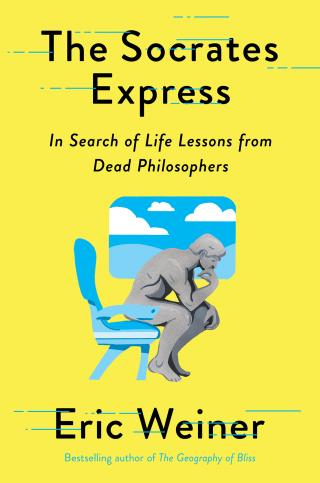
The Socrates Express
- Автор: Вейнер Эрик
- Год: 2020
- Язык: английский
- Год: Avid Reader Press / Simon & Schuster
- Жанр: География, путевые заметки

Электронная книга - «The Socrates Express». Краткое содержание книги:
We contemplate for the same reasons we travel: to see the world from a different perspective, to unearth hidden beauty and find new ways of being. We want to learn how to embrace wonder. Face regrets. Sustain hope.
Eric Weiner, *New York Times* bestselling author of *The Geography of Bliss* , combines his twin passions for philosophy and global travel in a pilgrimage that uncovers surprising life lessons from philosophers around the world, from Marcus Aurelius to Arthur Schopenhauer, Confucius to Montaigne. Traveling by train (the most thoughtful mode of transport) he traversed thousands of miles, making stops in Athens, Delhi,...
The last criterion, I think, is the most important. We live in the age of the algorithm and artificial intelligence, with their tacit promise to manage the uncertainty, the messiness, of life. They have not. If anything, life feels less predictable, and messier, than ever.
This is where Stoicism shines. The philosophy’s core teaching—change what you can; accept what you can’t—is appealing in our tumultuous times. Stoicism offers a handrail, a way forward. I knew this, having read Marcus. What I didn’t know was how demanding the philosophy is, and how much fun.
Stoicism, the philosophy of tough times, was born of catastrophe. In about 300 BC, a Phoenician merchant named Zeno was sailing to the Athenian port of Piraeus when his ship capsized, his precious cargo of purple dye lost. Zeno survived the shipwreck and wound up in Athens, broke. One day, he stumbled upon a biography of Socrates, who was by then long dead.
“Where can I find a man like that?” Zeno asked the bookseller.
“Follow yonder man,” he replied, pointing to a shabbily dressed Athenian who happened to be walking by.
It was Crates, a Cynic. The Cynics were the hippies of the ancient world. They lived on little, owned nothing, and questioned authority. Zeno found the Cynics’ contrariness admirable, up to a point. Lacking, he thought, was a comprehensive philosophy, so he founded his own school.
Zeno set up shop under the stoa poikile (literally, “painted porch”), a long colonnade where people came to shop, conduct business, and talk. There, amid murals depicting battles real and mythological, Zeno delivered his lectures while pacing vigorously. Since they gathered at the stoa, these philosophers became known as Stoics.
Unlike the Epicureans, ensconced behind their garden wall, the Stoics practiced their philosophy publicly, in view of merchants and priests and prostitutes and anyone else passing by. For the Stoics, philosophy was a public act. They never shied from politics.
Toward the end of his life, Zeno liked to joke, “I had a good voyage when I was shipwrecked.” This would become a major theme of Stoicism: in adversity lies strength, and growth. As the Roman senator and Stoic philosopher Seneca said: “No tree becomes rooted and sturdy unless many a wind assails it. For by its very tossing it tightens its grip and plants its roots more securely… disaster is virtue’s opportunity.”
On day one of Stoic Camp, I discover that everything I thought about Stoicism is wrong. The stereotype of the stony, heartless Stoic is as erroneous as is the one about the gourmand Epicurean. The Stoic is no cold fish. He does not suppress strong feelings, putting on a brave face as he trembles inside. Stoics do not jettison all emotions, only the negative ones: anxiety, fear, jealousy, anger, or any of the other “passions” (or pathe, the closest ancient Greek word to “emotion”).
Stoics are not joyless automatons. They are not Mr. Spock. They do not endure life’s bad bits with a stiff upper lip, or any other body part. “It’s not bad and there’s nothing to endure,” says Rob.
Stoics are not pessimists. They believe everything happens for a reason, the result of a thoroughly rational order. Unlike grumpy Schopenhauer, they believe we are living in the best of all possible worlds, the only possible world. Not only does the Stoic consider the glass half full; he finds it a miracle he has a glass at all—and isn’t it beautiful? He contemplates the demise of the glass, shattered into a hundred pieces, and appreciates it even more. He imagines life had he never owned the glass. He imagines a friend’s glass breaking and the consolation he’d offer. He shares his beautiful glass with others, for they, too, are part of the logos, or rational order.
“Joyful Stoic” is not an oxymoron, says William Irvine, a professor of philosophy at Wright State University and a practicing Stoic. He explains: “Our practice of Stoicism has made us susceptible to little outbursts of joy. We will, out of the blue, feel delighted to be the person we are, living the life we are living, in the universe we happen to inhabit.” I confess: that sounds appealing.
Stoics are not selfish. They help others—not out of sentimentality or pity but because it is rational to do so, the way fingers help the hand; and they are happy to endure discomfort and even pain while helping others.
Stoic altruism sometimes appears clinical, but it is exceptionally effective. I have a friend, Karen, who is a Stoic, though she doesn’t know it. I first met her in Jerusalem, where we were both working as journalists. There are a lot of stray cats in Jerusalem, more than in most places. It broke my heart to see these scruffy felines, with matted fur and open sores. I felt bad for them. That was the extent of my “helping.” I responded to their suffering by suffering myself, as if that somehow constituted a form of aid.
Not Karen. She sprang into action, scooping up a stray tabby here, a gimpy Oriental shorthair there. She fed them, and took them to a veterinary clinic. She found them homes. She did more than just emote.
Rob hands each of us a Stoic Camp workbook and a slim ancient text. More of a pamphlet, actually. Only eighteen pages. The Enchiridion, or Handbook. The teachings of the former Roman slave turned philosopher Epictetus. Stoicism distilled to its essence.
We turn to the first line on the first page, which Rob reads aloud: “Some things are up to us and some are not up to us.” This strikes me as both extremely true and extremely obvious. Of course some things are up to us and some aren’t. I traveled two thousand miles for this?
But that single sentence expresses the essence of Stoicism. We live in an age where we’re told everything is up to us. If you’re not smarter or richer or thinner it’s because you’re not trying hard enough. If you get sick, it’s because of something you ate, or didn’t eat, or a medical test you failed to get, or did get, or an exercise you didn’t do, or overdid, or a vitamin you did or did not take. The message is clear: you are in control of your destiny. Are you, though? Where exactly does your sovereignty reside?
Not where you think, the Stoics reply. Most of what we consider under our control is not. Not wealth or fame or health. Not your success or the success of your children. Yes, you can exercise regularly, but you can also get hit by a bus on the way to the gym. You can eat only the healthiest foods, but that is no guarantee of longevity, either. You can put in fourteen-hour days at the office, but maybe your boss doesn’t like you and sabotages your career.
The Stoics have a word for these circumstances and achievements that lie beyond our controclass="underline" “indifferents.” Their presence doesn’t add one iota to our character or our happiness. They are neither good nor bad. The Stoic, therefore, is “indifferent” to them. As Epictetus says: “Show me a man who though sick is happy, who though in danger is happy, who though dying is happy, and who though in disrepute is happy. Show him to me! By the gods, I would then see a Stoic!”
An enemy can harm your body but not you. As Gandhi, who had read the Stoics, said, “Nobody can hurt me without my permission.” Even the threat of torture at the hands of a tyrant needn’t rob you of tranquility and nobility, adds Epictetus. His teachings helped James Stockdale, an American pilot shot down over North Vietnam, endure seven long years of imprisonment and torture.
They helped Rob Colter, too. He was in New Zealand, looking forward to delivering a lecture, when he began to experience stomach pains. At first he dismissed the pain as a touch of tummy upset from the long journey. Soon, though, it grew worse, much worse. “The kind of pain that morphine doesn’t put a dent in,” Rob recalls. At the hospital, doctors diagnosed an obstructed bowel, a potentially life-threatening condition.