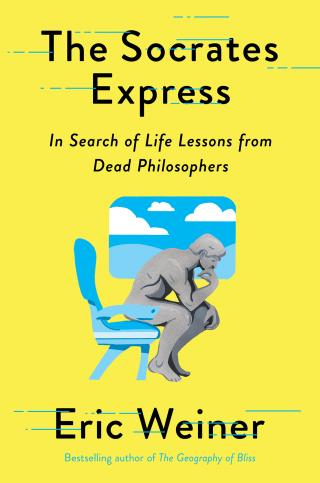
The Socrates Express
- Автор: Вейнер Эрик
- Год: 2020
- Язык: английский
- Год: Avid Reader Press / Simon & Schuster
- Жанр: География, путевые заметки

Электронная книга - «The Socrates Express». Краткое содержание книги:
We contemplate for the same reasons we travel: to see the world from a different perspective, to unearth hidden beauty and find new ways of being. We want to learn how to embrace wonder. Face regrets. Sustain hope.
Eric Weiner, *New York Times* bestselling author of *The Geography of Bliss* , combines his twin passions for philosophy and global travel in a pilgrimage that uncovers surprising life lessons from philosophers around the world, from Marcus Aurelius to Arthur Schopenhauer, Confucius to Montaigne. Traveling by train (the most thoughtful mode of transport) he traversed thousands of miles, making stops in Athens, Delhi,...
Too often we confuse what is ours and what is not. There’s no need for this confusion, say the Stoics. It’s simple. Nothing is ours, not even our bodies. We always rent, never own. This is liberating. If there is nothing to lose there is nothing to fear losing.
I lost a hat recently. I had just purchased it a few days earlier, and took the loss hard. When I mentioned this to my daughter, I decided to fully articulate my reaction: “That hat made me happy, so when I lost it I lost my happiness.” Spoken aloud it sounded childish and absurd. I didn’t lose the hat, I returned it, and, besides, it was a mere indifferent.
Like the Japanese, the Stoics know “all things everywhere are perishable.” They see this fact as cause for neither sadness, like many of us, nor celebration, like the Japanese, but merely a fact of life. Rationally there is nothing we can do about it, so best not to worry. Marcus reminds us that all we cherish will one day disappear like leaves on a tree so we must “beware lest delight in them leads you to cherish them so dearly that their loss would destroy your peace of mind.”
What about bigger losses? Surely there is none greater than the death of a loved one. Grief is natural and the Stoics encourage it, right? Wrong. The Stoics acknowledge the need for some grieving, but not much. “Let your tears flow, but let them also cease,” wrote Seneca to a friend who had lost a loved one. Another time, he admonished a woman for letting grief for her dead son rob her of time better spent with grandchildren. When greeted with the news of the death of a child, the proper response, Stoics say, is: “I was already aware that I had begotten a mortal.”
Here the Stoics lose me. By suppressing our grief, aren’t we suppressing our joy, too? Shouldn’t we open ourselves to the full spectrum of our humanity, including grief?
I suspect Rob struggles with this aspect of Stoicism, too, a suspicion confirmed when, toward the end of Stoic Camp, he tells us a story. The fireplace is going full tilt. Outside, it has turned cold and cloudy. Snow is coming.
Rob’s daughter had her ears pierced at a young age, and added several piercings later. One time, though, when she was thirteen years old, the bleeding wouldn’t stop. They took her to the family doctor and discovered “the blood counts were all wrong.” More tests. Then the bad news. Rob’s daughter had a rare disease called aplastic anemia. Her bone marrow had stopped producing platelets, cells that clump together to help blood clot.
It is an extremely difficult disease to treat. “Cancer is easy compared to this,” one doctor told Rob. They watched a friend who had the disease die. Rob googled life expectancy for those with the disease: sixteen years.
“So,” Rob continues, his voice calm and steady, “for me this is the value of Stoicism, where the rubber hits the road. I’ll be honest. It’s hard. It’s hard to say of my daughter, ‘You are only an appearance,’ but I have to do this.” Rob asked himself the Stoic question: What part of this situation is up to me? His answer: Be the best father you can. “All of the analyses and proofs don’t matter for shit if I can’t be a better father. What does that mean? It means I get to be the one who drives her to the hospital and I get to be the one who gets her meds. It means I get to be the one who does not freak out.” Being a Stoic makes Rob a more useful father, a better father, and, though the Stoics seldom use this word, a more loving father.
On the last day of Stoic Camp, I wake to driving snow. Several inches have fallen, and more is on the way. Snow. In late May. Nature doesn’t seem to be in accord with Herself, but what do I know?
I do know the road to Denver is closed, and I have a flight to Paris to catch. People are worried, and by people I mean me. Rob suggests calm.
“I wish there was an app for that,” I say.
“There is,” he replies. “It’s in your hand.”
“My iPhone?”
“No, your other hand. The Handbook. Epictetus.”
Of course. Haven’t I learned anything at Stoic Camp? All these grand ideas about withholding assent and reserve clauses and premeditated adversity evaporate when I confront actual adversity. Not much adversity, either. My disrupted travel is nothing compared to Rob’s health scare in New Zealand, or his daughter’s illness.
I take a deep breath, close my eyes, and imagine the View from Above. This vantage helps a bit, but not much: in my mind’s eye I see the airliner flying to Paris without me.
I turn to Seneca, who promptly pisses all over my immediate predicament—as well as my life’s work: therapeutic travel. “Do you suppose that wisdom, the greatest of all skills, can be assembled on a journey? Believe me, there is no journey that could deposit you beyond outbursts of temper, beyond your fears.” Roman bastard.
I turn to Epictetus, who is more encouraging. He sees the traveler as an “intelligent cosmic spectator.” Much better. He offers no direct advice about snowstorms in May, so I improvise. What in this situation is under my control? Not the snow or the closed roads or, for that matter, my philosophical journey. I am too attached to all of it. I am, Epictetus says, like those travelers who find a nice hotel and never want to leave. “Have you forgotten your intention, man? You were not traveling to this place, but only through it.”
My anxiety, I realize, is a reaction to perceived loss. I will lose my flight and therefore lose time and therefore lose… what?
I’m not sure. I had not thought through the ramifications. Now that I have, I realize how little is actually at stake. My flight is an indifferent. My happiness does not depend on it. Not one iota. I have no claim to it. It is not mine to lose. I am a temporary tenant here, just passing through. Besides, whether I make it to Paris or not is beyond my control. If the road is closed, it is closed.
Some relabeling is in order, I decide. I relabel my predicament a mini-vacation, a chance to spend more time with my fellow Stoics. Paris has been there for many centuries. It can wait a while longer. The snow won’t last forever; nothing does. Soon it will stop and I’ll be driving south, past the Snowy Range, under the big Wyoming sky, on my way to Denver International and eventually the bright lights of Paris. Yes, I will be there soon enough. Fate permitting.
13. How to Grow Old like Beauvoir
1:42 p.m. On board the high-speed TGV, Train No. 8534, en route from Bordeaux to Paris.
A blur of green—farmland, presumably—streaks past my window. On the horizon giant white windmills circle lazily in the hot, still air. Sitting across from me is a teenage girl wearing a sweatshirt that reads “Reality Sucks.” Ah, but what is reality? I’m tempted to say, if I could muster the French.
I look around and discover I am the oldest person within sight. This has been happening a lot lately. I find this sudden abundance of adjacent youth disconcerting. I can’t explain it. I’m certain it has nothing to do with me, though. I am not old.
A few weeks ago, I decided to write at a coffee shop near a university. Big mistake. I was awash in a shiny sea of youth: perfect specimens with perfect teeth, perfect hair and perfect, wide-open futures. They wore studied sweatpants and expensive headphones and greeted one another with explosive fist bumps.
Fuck them, I almost thought, but caught myself, for that is exactly the sort of thought a bitter old man would have, and I am not old. When the chirpy young barista announced my Earl Grey was ready and I didn’t reply because I was thinking about existentialism or Plato maybe and she had to repeat herself, I worried she concluded I was old, and I am not old. Not like that geezer who requested a copy of the New York Times—the paper version!—which the barista retrieved from underneath the counter, like pornography; or like that sad shrub of a man with a calculator—a calculator!—propped on his table like some ancient artifact. No, that is not me. I am not old.