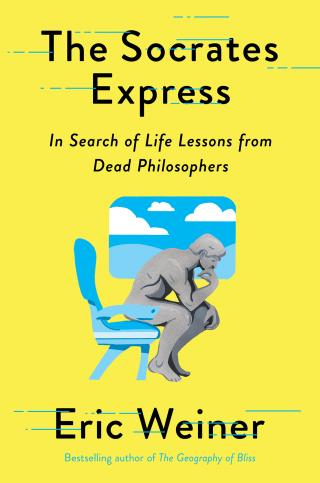
The Socrates Express
- Автор: Вейнер Эрик
- Год: 2020
- Язык: английский
- Год: Avid Reader Press / Simon & Schuster
- Жанр: География, путевые заметки

Электронная книга - «The Socrates Express». Краткое содержание книги:
We contemplate for the same reasons we travel: to see the world from a different perspective, to unearth hidden beauty and find new ways of being. We want to learn how to embrace wonder. Face regrets. Sustain hope.
Eric Weiner, *New York Times* bestselling author of *The Geography of Bliss* , combines his twin passions for philosophy and global travel in a pilgrimage that uncovers surprising life lessons from philosophers around the world, from Marcus Aurelius to Arthur Schopenhauer, Confucius to Montaigne. Traveling by train (the most thoughtful mode of transport) he traversed thousands of miles, making stops in Athens, Delhi,...
I’m immersed in his taut words, possibly on the verge of “flow,” when I sense a presence. I look up and see a butterfly. It has alighted on Nietzsche, its golden-brown wings fluttering atop page 207. I’m not sure what to do. I’m tempted to snap a photo but fear that might spook the butterfly. Besides, recording the moment seems a poor substitute for experiencing it.
The butterfly has landed on a passage called “At the Sight of a Learned Book.” A fine selection. Classic Nietzsche. “Our first question concerning the value of a book, a man, or a piece of music is: Can it walk? Or still better: Can it dance?”
Some philosophers shock. Many argue. A few inspire. Only Nietzsche danced. For him, there was no finer expression of exuberance and amor fati: love of fate. “I would only believe in a God who knows how to dance,” he wrote. Nietzsche’s Zarathustra dances wildly, fervently, with not even a trace of self-consciousness.
The spirit of every good philosopher, Nietzsche said, is that of a dancer. Not necessarily a good dancer. “Better to dance ponderously than to walk lamely,” he said, and did. He couldn’t muster even a few decent steps on the dance floor. So be it. The good philosopher, like the good dancer, is willing to make a fool of himself.
Nietzsche’s philosophy dances superbly. It has rhythm. It skips and sashays across the page, and occasionally moonwalks. Just as dancing has no purpose—the dance is the purpose—so, too, with Nietzsche’s philosophy. For Nietzsche, dancing and thinking move toward similar ends: a celebration of life. He’s not trying to prove anything. He simply wants you to see the world, and yourself, differently.
Like an artist, a philosopher like Nietzsche hands us a pair of glasses and says, “Look at the world through these. Do you see what I see? Isn’t it miraculous?” What we see may or may not be true in a scientific sense, but that is not the point. The philosopher conveys the truth not of the scientist but of the artist or novelist. It is an “as if” approach. View the world as if another level of reality, the noumenon, lies beneath the surface. Live your life as if it repeats endlessly. See what happens. Does looking at the world this way illuminate yours? Good. Then it has value. Viewing the world in a different way—even an “incorrect,” different way, like Thoreau peering between his legs—enriches our lives.
The butterfly departs, its golden-brown wings lifting it skyward, and I resume my walk along the lakeshore. The air is thin and crisp. I see why Nietzsche craved it. Warm air dulls the mind. Cold air sharpens. I’ve covered several miles but, still, no sign of Nietzsche’s mighty stone. I look everywhere. I look where it should be and where it shouldn’t. Nothing. I backtrack, twice, and I hate backtracking. Still nothing. I’m exhausted and consider quitting but, no, I must persevere. Nietzsche’s will to power demands it. He didn’t quit when rejected by lovers and ignored by readers. Neither will I.
Nietzsche wasn’t the first to suggest the universe repeats itself. The Greek philosopher Pythagoras posited a similar idea some 2,500 years ago, and the Indian Vedas even earlier. Nietzsche surely knew of these theories. Like Marcus Aurelius, he was a wisdom scavenger, casting his mind far and wide.
Nietzsche wanted to take the idea further. He wanted to convert Eternal Recurrence from myth to science. For days, weeks, he scribbled possible “proofs” on notepads. In one, he likens the universe to a pair of dice. There are only so many combinations possible. Eventually you’ll roll them all. In tic-tac-toe, there are many more combinations: 26,830 possible games. That’s a big number, but finite. Eventually, every possible game repeats, move for move. In chess, considerably more games are possible: 10 to the 120th power (one followed by 120 zeros). That’s a mind-boggling number but, still, finite. It may take a very long time, but eventually two chess players will exhaust every possible combination of moves, play every possible game. The universe is, in a way, a large and complex game. Eventually everything repeats.
Nietzsche’s belief, though, was just that: supposition propped up by ancient myths and fascinating but dubious statistical probabilities. Nietzsche never felt confident enough to publish his notes. Today most physicists dismiss Eternal Recurrence as more fiction than science.
There’s another possibility, says Nietzsche. Maybe the question of proof doesn’t matter. The lack of scientific evidence renders Eternal Recurrence—the “impossible hypothesis”—no less arresting. “Even the thought of a possibility can shatter and transform us,” he says, pointing to the Christian concept of eternal damnation. Hell may not be real but the idea of it motivates. We need not prove Eternal Recurrence in order to act as if it were true, then see what happens.
Consider the case of Robert Solomon. In the 1960s, he was an “unhappy first-year medical student” at the University of Michigan. On a whim, he decided to take a course called Philosophy in Literature. When the professor introduced Nietzsche’s Eternal Recurrence, Solomon was floored. It stirred a “whirlwind” of emotions and thoughts. Doubts, too. Did he really want to live this unhappy life over and over again, forever? That struck him as an especially fiery hell.
After the class, Solomon dropped out of medical school and pursued a life of philosophy, eventually becoming one of the world’s top Nietzsche scholars. It’s a decision he has not once regretted.
Eternal Recurrence is a thought experiment. An existential stress test. When it comes to life’s pleasurable moments, we pass the test easily. We’d gladly relive eating that ice cream sundae, or sinking that game-winning three-pointer at the buzzer. Despairing over his Punxsutawney plight, Phil Connors, Bill Murray’s character in Groundhog Day, muses: “I was in the Virgin Islands once. I met a girl. We ate lobster, drank Piña Coladas. At sunset, we made love like sea otters. That was a pretty good day. Why couldn’t I get that day over and over and over?”
Eternal Recurrence doesn’t work that way. It is all or nothing. A package deal. Your life repeats exactly the same way, “nothing to be different, not forward, not backward, not in all eternity,” says Nietzsche. No editing allowed. You must relive this life, with all its flaws and lengthy dialogue. The director’s cut. Nietzsche knows this scenario makes you squirm. He knows you’d love to revise your life, delete some scenes, add others, airbrush a few more, hire a body double.
I’d love to go back to that day of my first solo flight, only this time close the door before taking off. And I’d give anything to return to one warm Chicago evening. I was traveling with my daughter, six years old at the time. It was late. She was sleepy, and sometimes when children are sleepy, buried fears surface. As we walked, she looked at me and asked: “Are you my real daddy?”
I had a chance, as an adoptive parent, to supply a loving and reassuring answer. Instead, for reasons I still don’t understand, I replied briskly, coldly. “Of course I am,” I snapped. “Why would you even ask such a thing?” Her eyes swelled with tears and hurt. I had blown it. If only I could relive that moment but, this time, answer her question with love.
No, says Nietzsche. No editing. Were you not paying attention? Affirm the entirety of your life, in every detail, or not at all. No exceptions.
No wonder Nietzsche calls Eternal Recurrence “the heaviest burden.” Nothing is weightier than eternity. If everything recurs infinitely, then there are no light moments, no trivial ones. Every moment, no matter how inconsequential, possesses the same weight and mass as others. “All actions are equally great and small.”
Think of Eternal Recurrence as a daily check-in with yourself: Are you living the life you want to live? Are you sure you want to drink that bottle of tequila and endure an infinite hangover? Eternal Recurrence demands we ruthlessly audit our lives and ask: What is worthy of eternity?