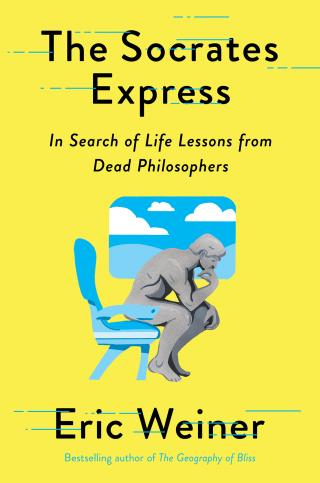
The Socrates Express
- Автор: Вейнер Эрик
- Год: 2020
- Язык: английский
- Год: Avid Reader Press / Simon & Schuster
- Жанр: География, путевые заметки

Электронная книга - «The Socrates Express». Краткое содержание книги:
We contemplate for the same reasons we travel: to see the world from a different perspective, to unearth hidden beauty and find new ways of being. We want to learn how to embrace wonder. Face regrets. Sustain hope.
Eric Weiner, *New York Times* bestselling author of *The Geography of Bliss* , combines his twin passions for philosophy and global travel in a pilgrimage that uncovers surprising life lessons from philosophers around the world, from Marcus Aurelius to Arthur Schopenhauer, Confucius to Montaigne. Traveling by train (the most thoughtful mode of transport) he traversed thousands of miles, making stops in Athens, Delhi,...
One way of wrapping your mind around Eternal Recurrence is by taking what one scholar calls the “Marriage Test.” Imagine you’re recently divorced after a long marriage. Knowing what you know now, would you say “yes” again?
That’s not a bad test, but I’ve devised another: The Teenager Test. Back home, I was having dinner with my daughter. Between talk of science projects and soccer schedules, I explained Nietzsche’s Eternal Recurrence. What did she think? Would she sign up?
Sonya knows what she likes and what she doesn’t and she does not like Nietzsche’s Eternal Recurrence. She promptly declared it “the idea of a sociopath.” No way would she want her life to recur forever. “Think of how miserable that would be. You’re stuck in an infinite loop. Everyone has made one huge mistake in their life—I haven’t yet, but I know it’s going to happen—so imagine reliving that over and over again. Like imagine, you’re murdered by an ax murderer. Do you want to relive that over and over? What if you had cancer? Would you want to relive that?”
“Fair point,” I said, before rallying to Nietzsche’s defense. “But what about the good things in life: concerts and friends and chicken nuggets? Don’t they compensate for the bad?”
“No,” she said without hesitation. “No one’s life is that good. Nothing in my life could make me want to relive any bad things I potentially do.”
I found myself in an unaccustomed state: silence. I had no rejoinder. Life’s bad moments do seem to outweigh the good. The pleasure of Rocky Road dims when compared to the agony of chemo. Or does Nietzsche know something that Sonya—and the rest of us—do not?
If anyone had reason to go full Schopenhauer and conclude we are living in “the worst of all possible worlds,” it was Friedrich Nietzsche. Instead, toward the end of his troubled, too-short life, he declares himself grateful for it all and adds a hearty Da capo! Again.
Suffering is inevitable—you don’t need a philosopher to tell you that—but how we suffer, and about what, matters more than we think. Do we experience “essential suffering,” as Nietzsche called it, or something else, something less? Do we merely tolerate suffering or do we value it for its own sake?
Nietzsche was no masochist. He saw suffering as an ingredient in the good life, a means of learning. “Only suffering leads to knowledge,” he said. Suffering is the call we didn’t solicit but must answer anyway. Do we reply by numbing ourselves or, as Schopenhauer suggests, retreating to art and asceticism? Or do we answer suffering by engaging with the world more deeply? Recklessly, even? Nietzsche called this option the Dionysian way, after the Greek god who loved wine and theater and life. “I want to learn more and more to see as beautiful what is necessary in things; then I shall be one of those who make things beautiful,” he said. Don’t love life despite the suffering, he says, but because of it.
Writing to his sister in 1883, Nietzsche offers what I think is his most honest account of the role suffering played in his life. “The whole meaning of the terrible physical suffering to which I was exposed lies in the fact that, thanks to it alone, I was torn away from an estimate of my life-task which was not only false but a hundred times too low. Some violent means were necessary in order to recall me to myself… an act of self-overcoming of the highest order.”
I love that one phrase in particular: “recall me to myself.” You need not look outside yourself for meaning, says Nietzsche. You needn’t look inside yourself, either. Look up. “Your true being does not lie deeply concealed within you, but immeasurably high above you, or at any rate above what you usually regard as your ‘I.’ ”
Eternal Recurrence strips our illusions bare and gives the lie to our accomplishments. You’ve closed the big deal, finished the book, earned the promotion? Congratulations—except now it’s evaporated and you must start over. Again and again. Forever. We’re all Sisyphus, the poor slob from Greek mythology condemned by the gods to push a boulder up a hill, only to watch it roll down again, for all eternity. I think back to that deck in Montclair, New Jersey, and my friend Jennifer’s question. “What does success look like?” I know how Nietzsche would answer: It looks like radical acceptance of your fate. It looks like Sisyphus happy.
Like many philosophers, Nietzsche was better at dispensing wisdom than acting on it. “Die at the right time,” he said, but didn’t. He died too early—and too late.
He was in Turin, Italy, in 1889, when he saw a man whipping a horse. Nietzsche rushed toward the animal, hugged it—and collapsed. Nietzsche’s last cognizant action was an attempt to ease the suffering of another being. When he gained consciousness, he was insane. He began signing his letters “Dionysus,” and suggested he was God.
Concerned friends intervened and brought Nietzsche home to Germany. Incapacitated, most likely due to syphilis, and only forty-four years old, he would never write another word. For the next decade, family members cared for him—first his mother, then, after she died, his sister. Though now mute, his fame grew with each passing year.
It is this Nietzsche, broken and gone, that, sadly, is the one immortalized in photographs and exploited by his ambitious and anti-Semitic sister. Her misuse of his legacy led to Hitler’s mercenary embrace of Nietzsche.
At the time of his collapse, Nietzsche was working on a book he called The Revaluation of All Values. A clunky title but a profound idea, one that, had he finished, might have offered important insights into Eternal Recurrence. If our life—indeed the entire universe—does repeat, what do we control? Not our actions, Nietzsche thought, but our attitude. His philosophy was, at its heart, “an experiment in reorienting oneself within a world of total uncertainty.” Typically, we run from uncertainty and toward certainty. But that, says Nietzsche, is not an immutable fact. It is a value, and anything we value we can revalue.
We can choose to find joy not in certainty but in its opposite. Once we do that, life—the same life from an outsider’s perspective—feels quite different to us. Find joy in uncertainty and the tumult at the office becomes cause for celebration, not teeth gnashing and an extra glass of wine at the end of the day. Find joy in uncertainty, and even illness, while still physically painful, no longer terrifies. This shift in perspective is subtle but profound. The world looks different. A reorientation like this is not easy, Nietzsche acknowledges, but it is possible—and what is philosophy but an exploration of heretofore undreamt-of possibilities?
My walk ends in failure. Despite much searching, and even more backtracking, I do not find the pyramid-shaped boulder. Oh well, there’s always tomorrow. Then I recall the words of Groundhog Day’s Phil Connors: “What if there is no tomorrow? There wasn’t one today.”
In Eternal Recurrence, every tomorrow is today and every today tomorrow. I will walk this same path an infinite number of times. In the Hollywood version, I’m able to make course corrections, adjustments large and small, until I find the boulder and get the girl and all is well. Roll credits.
Nietzsche’s version of Eternal Recurrence supplies no such happy ending. Yes, I will walk the same path, again and again, but without deviation. I will choose the same bench, encounter the same butterfly, and I will seek but not find Nietzsche’s boulder. Every time. Forever.
Can you accept that endless failure? asks Nietzsche. More than that, can you embrace it? Can you love it?
About a missed rock—sure, Friedrich. About life’s larger disappointments—botched job interviews, bungled parenting, fickle friends—I’m less certain. I can resign myself to their existence, accept them even. But love them? That is asking an awful lot. I’m not there yet. Maybe I never will be, no matter how many times the universe and I repeat.