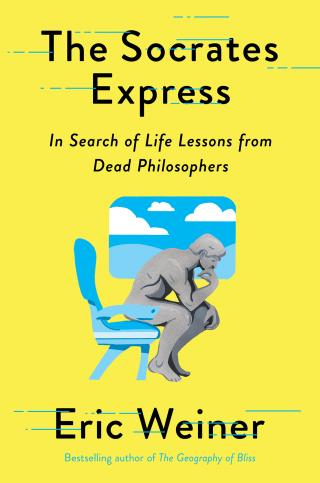
The Socrates Express
- Автор: Вейнер Эрик
- Год: 2020
- Язык: английский
- Год: Avid Reader Press / Simon & Schuster
- Жанр: География, путевые заметки

Электронная книга - «The Socrates Express». Краткое содержание книги:
We contemplate for the same reasons we travel: to see the world from a different perspective, to unearth hidden beauty and find new ways of being. We want to learn how to embrace wonder. Face regrets. Sustain hope.
Eric Weiner, *New York Times* bestselling author of *The Geography of Bliss* , combines his twin passions for philosophy and global travel in a pilgrimage that uncovers surprising life lessons from philosophers around the world, from Marcus Aurelius to Arthur Schopenhauer, Confucius to Montaigne. Traveling by train (the most thoughtful mode of transport) he traversed thousands of miles, making stops in Athens, Delhi,...
Our train is late arriving in Paris. The conductor announces a twenty-minute delay, then an hour, then two. The young people on board grow restless, compulsively checking their watches, as if that will hasten our arrival. The older passengers do not check their watches. When the conductor announces, regrettably, a further delay, I twist my wrist and stare purposively at my watch, for, you see, I am not old.
Old age is a large, immovable object, and closer than it appears. Encounters with it are never gentle. You do not brush up against old age. You do not sideswipe old age. You collide with it head-on.
One morning Simone de Beauvoir looked in the mirror, as she did every morning, and saw a stranger staring back. Who was this person? This woman with “the eyebrows slipping down toward the eyes, the bags underneath, excessive fullness of the cheeks, and that air of sadness around the mouth that wrinkles always bring.” It couldn’t be her. Yet it was. “Can I have become a different being while I still remain myself?” she wondered.
Beauvoir was fifty-one years old at the time and beautiful, but age, as she’d argue in her book on the subject, is in the eyes of those who behold us. She worried those eyes didn’t approve of what they saw or, worse, saw nothing at all. For the twenty-year-olds, she surmised, she was “already dead and mummified.” The final, piercing blow came when, not long after her mirror episode, a young woman stopped her on the street and said, “You remind me of my mother.”
Beauvoir felt confused, and betrayed. Time, once her friend, now schemed against her. She had always lived prospectively, “stretched toward the future,” planning her next great project or expedition, but now she was doubling back, looking over her shoulder at the past. Beauvoir had collided with her age.
You’d think she’d have seen the collision coming. She had obsessed about growing old since she was a young girl. She feared old age even more than death. Death is “absolute nothingness” and therefore oddly comforting, she reasoned. But old age? Old age is “life’s parody.”
Old age is what her longtime partner, the philosopher Jean-Paul Sartre, called an “unrealizable.” An unrealizable is a state of being we inhabit but never fully internalize; only others do. We may look old, act old, and, by any objective measure, be old, but we never feel old. We never realize our elderliness. Thus, a dozen years after she collided with her age, Beauvoir notes: “I am sixty-three: and this truth remains foreign to me.”
There are few road maps for old age, and even fewer role models. Sure, there are plenty of old people impersonating young people, but they are role models for old people impersonating young people. They are not role models for growing old.
Simone de Beauvoir, novelist, philosopher, and feminist hero, is an unlikely candidate, I concede. Her writings on old age make for grim reading. She did not age gracefully. She aged reluctantly, combatively. She raged, raged against the dying of the light, and against those who denied her this rage, too. Yet in the end she made her peace with old age, came to accept it, and, though she’d probably deny this, came to love it.
I could use a role model, for I sense my collision coming. The warning signs are there. Just this morning a small brown spot materialized on my left cheek, joining its twin on the other cheek, its siblings on my head, and its distant cousins on my neck. It wasn’t there yesterday. I don’t think it was there. To be honest, I don’t look at myself in the mirror very often. When I do, it is more of a squinty glance than an actual look. Just enough visual data is imported from mirror to brain to confirm my continued existence in the physical universe but not enough data to register inconvenient truths, like this newborn spot. Now that I think about it, I haven’t actually seen myself in years.
Can you blame me? I am not a man of a certain age but an uncertain one. Older yet not old. What to call this awkward interval? “Late middle age” is not ideal, owing to the word “late,” but is far preferable to “early old age,” owing to the word “old.” And I am not old.
When I see an actual old person, I see what Beauvoir calls the Other: someone so alien we view him as an “object; the inessential.” He is old, I tell myself. I am not. Implicit in that statement is and I never will be. It is a lie, I know, but a useful one, for it allows me to get out of bed each morning, like Marcus, and continue the fight.
It is a losing battle, I know. Already my retreat has begun. When my beard first turned gray, I dyed it brown every week, lest I become a graybeard. Now one week slides into two, then three. I can envision the day when I surrender to the gray. I can see my collision coming. But not now. Not yet. I am not old.
My capacity for self-deception didn’t begin with the first wisps of gray. As the Roman philosopher Cicero noted, many of the deficiencies we blame on old age are really failings of character. Old age does not produce new personality traits so much as it amplifies existing ones. As we age, we become more intensely ourselves. Usually, not in a good way. The fiscally cautious young man grows into a miserly old grouch. The admirably determined young woman grows into an infuriatingly stubborn old lady. Must this character amplification always trend negative? Can we reverse the trajectory as we age? Can we become older, better versions of ourselves?
Most philosophers are curiously silent about old age. I say curiously not only because aging is such an important part of life but also because so many philosophers lived long, productive lives. Plato was still hard at work when he died at eighty. Isocrates lived until ninety-nine and wrote his most famous work at ninety-four. Gorgias made them all look like young bucks; he lived until 107, and worked up until the end.
Good for them, you say, but do we really need a philosophy of aging? After all, there’s no shortage of scientific research about “successful aging.” (Such a ridiculous term. Oh, now I have to age successfully, too? Great. Something else to feel inadequate about.) There is no shortage of books on diet, exercise, preventative medicine, and no shortage of glossy brochures touting the good life at “senior living communities.” What can philosophy contribute to the conversation?
Quite a lot. Philosophy doesn’t teach us what to think but how to think, and we need a new way of thinking about old age. The truth is we don’t really think about growing old. We think about staying young. We don’t have a culture of aging. We have a youth culture to which an aging cohort desperately clings.
Old age is not a disease. It is not a pathology. It is not abnormal. It is not a problem. Old age is a continuum, and everyone is on it. We’re all aging all the time. You are aging right now as you read these words—and not any faster or slower than an infant or a grandfather.
Philosophy helps us define our terms, à la Socrates. What do we mean by “old”? Chronological age misses the mark. It is meaningless. It tells us nothing about a person, says the philosopher of aging, Jan Baars. “Chronological age is not the cause of anything.”
The ancient Greeks had two words for time: chronos and kairos. Chronos is chronological time: the minutes on your watch, the months on your calendar. Kairos signifies opportune or appropriate time. Ripe time. When you say “it’s now or never” or “now’s not the time,” you’re speaking of kairos.