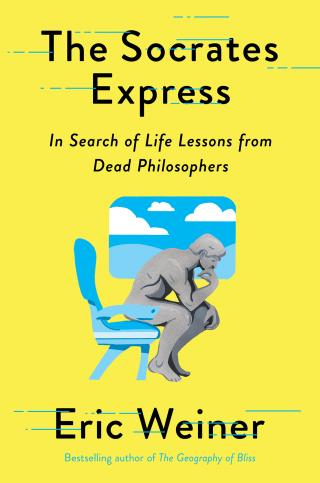
The Socrates Express
- Автор: Вейнер Эрик
- Год: 2020
- Язык: английский
- Год: Avid Reader Press / Simon & Schuster
- Жанр: География, путевые заметки

Электронная книга - «The Socrates Express». Краткое содержание книги:
We contemplate for the same reasons we travel: to see the world from a different perspective, to unearth hidden beauty and find new ways of being. We want to learn how to embrace wonder. Face regrets. Sustain hope.
Eric Weiner, *New York Times* bestselling author of *The Geography of Bliss* , combines his twin passions for philosophy and global travel in a pilgrimage that uncovers surprising life lessons from philosophers around the world, from Marcus Aurelius to Arthur Schopenhauer, Confucius to Montaigne. Traveling by train (the most thoughtful mode of transport) he traversed thousands of miles, making stops in Athens, Delhi,...
I walk past the front desk, again, and say hello to Laura, who today like yesterday and the day before is wearing lederhosen. I step outside to a perfect Swiss day, a day like yesterday and the day before, and I set out on one of the nearby hiking trails. It is a different hiking trail from yesterday and, as Bill Murray’s exasperated character in Groundhog Day says, different is good. I am on a mission. Not from God (we killed Him, Nietzsche reminds me) but from Zarathustra, Nietzsche’s dancing prophet. I am determined to find the mighty stone, the place where the philosopher first imagined Eternal Recurrence. By seeing it, touching it, I hope to think what he thought that day—better yet, to feel what he felt.
I walk like Rousseau, as if I had all the time in the world. It feels good, not only the melodic cadence of my steps but the way sun and shade alternate as I step in and out of the pine trees that line Lake Silvaplana. The ground feels soft and spongy underfoot, as if it were conversing with me.
I walk and walk some more. My legs ache. Still I walk. I walk despite the pain, because of the pain. Nietzsche would approve, noting that I’m exercising my “will-to-power,” overcoming an obstacle, on my way to becoming an Übermensch (literally “overman”), one step at a time.
I’m tempted to stop and read Nietzsche, but the philosopher dissuades me: “How can anyone become a thinker if he does not spend at least a third of the day without passions, people and books?”
His poor eyesight was a secret blessing. It liberated him from the tyranny of the book. When he couldn’t read, he walked. He walked hours at a stretch, covering great distances. “Do not believe any idea that was not born in the open air and of free movement,” he said. We write with our hands. We write well with our feet.
“All truth is crooked,” Nietzsche said. All lives, too. Only in retrospect do we straighten the narrative, assign patterns and meaning. At the time, it’s all zigs and zags. And white space: breaks in the text that cleave our former selves from some incipient future self. These white spaces look like omissions. They are not. They are wordless transitions, points where the currents of our life shift course.
One such bifurcation occurred early in Nietzsche’s life. He was studying theology at Leipzig University when one day he popped into a secondhand bookshop. He felt drawn, he recalled, to one book in particular: Schopenhauer’s masterpiece, The World as Will and Representation. He usually dithered before purchasing a book. Not this time.
Once home, Nietzsche threw himself on the sofa and “let that energetic and gloomy genius operate upon me.” Nietzsche was delighted—and horrified. “Here I saw sickness and health, exile and refuge, Hell and Heaven.” Shortly afterward, he switched his study from theology to philology, the study of language and literature. That may not seem momentous, but for the son and grandson of Lutheran pastors, it represented an act of rebellion.
Nietzsche excelled. At the age of twenty-four, he was appointed professor of classical philology at Switzerland’s Basel University. The honeymoon proved brief.
His first book, The Birth of Tragedy, flouted academic norms. No footnotes, no dry, measured prose. An old mentor called it “a piece of pseudo-aesthetic, unscholarly religious mystification produced by a man suffering from paranoia.” The wunderkind’s shine had dulled. The academy likes nothing less than a smart rebel.
The second bifurcation came in 1879. His health had deteriorated. At times he could barely see and asked students to read to him. His attempt to gain a professorship in philosophy, his new passion, had failed. Most people, I imagine, would muddle along, seek better doctors, mend fences with department heads, make peace with the cushioned cage that is academia. No one walks away from a tenured position at one of Europe’s most prestigious universities.
But Nietzsche walked. He set his affairs in order and fired off a brief letter to his publisher. “I am on the verge of desperation and have scarcely any hope left,” he said, signing the letter, in all caps: “A HALF-BLIND MAN.”
And so with that dramatic gesture he traded the settled life of a professor for that of a feral philosopher, answerable to no one but himself, unaffiliated and unbound. It was an incredibly courageous, or knuckleheaded, move. “Perhaps no one,” says the writer Stefan Zweig, “has hurled a former life so far from himself as Nietzsche.”
Like Rousseau, Nietzsche wandered. Unlike Rousseau, his wandering had a pattern, a cadence: Switzerland in the summer, Italy or southern France in the winter. His only property was the clothes he wore, the paper he wrote on, and the large trunk where he kept them.
He traveled by train. He hated trains. He hated the unheated carriages. He hated the rocking motion. He vomited a lot and paid for a single day’s journey with three days of recovery.
Changing trains befuddled him. Sometimes he’d end up heading in the wrong direction. Once, while visiting the composer Richard Wagner, Nietzsche left a bag at a railway station. Inside were a precious volume of Ralph Waldo Emerson’s essays and an autographed copy of Wagner’s Ring des Nibelungen operas. Nietzsche, like Hemingway and T. E. Lawrence, could point to nothing redeeming about the incident. Sometimes a loss is just a loss.
I’ve yet to find Nietzsche’s “mighty pyramidal block of stone” and decide to stop walking and read, an act of rebellion I’m sure he’d understand. I spot a bench. I sit down and crack open Nietzsche’s book The Gay Science or, as it’s sometimes translated, The Joyful Wisdom. After only a few sentences I realize Nietzsche doesn’t speak to me. He shouts at me! If Socrates was the philosopher of the question mark, Nietzsche is the philosopher of the exclamation mark. He loves them! Sometimes he’ll string two or three together!!!
Nietzsche is both a delight and a burden to read. It’s a delight because his prose rivals that of Schopenhauer for its clarity and refreshing simplicity. He writes with the unabashed exuberance of a teenager with something important to say. He writes as if his life depended on it.
Nietzsche thought philosophy should be fun. He is playful, and funny in a biting way. Every truth, he said, should be accompanied by at least one laugh. He toys with ideas, and with literary devices. He writes in aphorisms, nursery rhymes, songs—and in the faux-biblical voice of his most famous invention, Zarathustra. His short, snappy sentences feel right at home on Twitter.
Nietzsche is a burden because, like Socrates, he demands we question entrenched beliefs, and that’s never pleasant. I’ve always assumed philosophy was powered by hard reason and cold logic. If Rousseau put a dent in that belief, Nietzsche demolishes it. Infusing the pages is a quiet (and often not so quiet) celebration of the impulsive and the irrational. For Nietzsche, emotions are not a distraction, or a detour on the road to logic. They are the destination. The virtuous are irrational, and the most noble of all “succumbs to his impulses, and in his best moments his reason lapses altogether.”
Rousseau embraced the heart. Nietzsche aims lower. He is the philosopher of the viscera—that place, says scholar Robert Solomon, “where doubts and rebellion grow, the parts of the body not easily tamed by merely valid arguments or the authority of professors.”
Nietzsche was no fan of purely abstract thought. Such fuzzy ruminations never inspired anyone to do anything, he argued. “We have to learn to think differently… to feel differently,” he said. He suffered from a kind of affective synesthesia. He thought the way most of us feeclass="underline" instinctively, and with a ferocity not entirely under his control. Nietzsche didn’t formulate ideas. He birthed them.