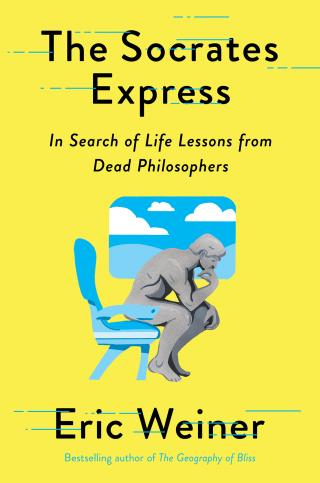
The Socrates Express
- Автор: Вейнер Эрик
- Год: 2020
- Язык: английский
- Год: Avid Reader Press / Simon & Schuster
- Жанр: География, путевые заметки

Электронная книга - «The Socrates Express». Краткое содержание книги:
We contemplate for the same reasons we travel: to see the world from a different perspective, to unearth hidden beauty and find new ways of being. We want to learn how to embrace wonder. Face regrets. Sustain hope.
Eric Weiner, *New York Times* bestselling author of *The Geography of Bliss* , combines his twin passions for philosophy and global travel in a pilgrimage that uncovers surprising life lessons from philosophers around the world, from Marcus Aurelius to Arthur Schopenhauer, Confucius to Montaigne. Traveling by train (the most thoughtful mode of transport) he traversed thousands of miles, making stops in Athens, Delhi,...
1. The way the conductor glides down the aisle then pivots and, facing the passengers, bows. 2. The way a passenger, a young woman in high heels, teeters ever so slightly while walking down the aisle but steadies herself with the grace of a ballerina. 3. The feel of the Styrofoam coffee cup, one of those solid, thick ones that radiate a pleasant, not painful, warmth. 4. The way the cup says, in English, “Aroma Express Café” and the way the “o” in “Aroma” is shaped like a coffee bean. 5. The way, as you approach Tokyo, the view grows increasingly urban but gradually, so that the city doesn’t appear so much as materialize. 6. The spotless toilets. 7. The unexpected glimpse of the sea. 8. The whooshing sound made by a train passing in the opposite direction, moving so fast there is no time to worry about a head-on collision. 9. The way the rain droplets bead across my window, forming rivulets and tributaries, moving with alacrity and seeming agency.
Dispiriting Things about Riding a Japanese Bullet Train. 1. That momentary thrill of spotting Mount Fuji only to be followed by the sharp stab of disappointment when you realize that, no, it is not Mount Fuji but just another mountain, nothing special. 2. Reveling in the sight of an empty seat next to you only to have it occupied at the last minute by a man who looks like an off-duty sumo wrestler. 3. The dated aqua-blue seats. 4. The fact that everyone on board is quiet, not a peep, even though you are not in the Quiet Car.
I’ve written my lists on quality paper—not Michinoku but, still, good stuff. Acid-free, it will last a long time. A few centuries, maybe longer. Not forever, though. Eventually, my lists will disintegrate, and join the other casualties of impermanence. This fact saddens but does not devastate me. It is the sadness of the moving van, of high school graduation, of the retirement party. It is the sadness of a late autumn day, when a wind gust stirs a pile of fallen leaves, and they dance.
We arrive in Tokyo on time. Good. I am meeting my friend Junko at a bar and don’t want to be late. It is not just any bar. It is an otaku bar. An otaku is a geek, only in Japan, a nation of geeks, the word carries less opprobrium than it does elsewhere. Otaku is, in certain circles, a badge of honor.
The bar is a train otaku bar. A bar for train geeks. In the middle of the room, a model train runs with shinkansen punctuality. Such an arrangement could easily slide into gimmickry, but not here. The train—and the miniature town it passes through—seem natural, and thoroughly okashii, delightful. No detail was too small, too insignificant, for the person who designed this little railroad town. Not the tiny signboards fronting the tiny store or the tiny cars in the tiny parking lot or the tiny shrubbery lining the tiny road. The bar itself is small, too: six or seven chairs arranged in a circle with the train in the middle. A nook.
Junko orders a beer, and I order a Suntory. My whiskey arrives in a sturdy, serious glass that oozes quiet elegance. The bartender, a smiley man, had chiseled a single ice cube, as if it were David and he Michelangelo.
As he works, I ask him about—what else?—trains. He explains how as a child he could see trains rolling past his bedroom window, a reassuring presence during the bumpy years of his youth. Most children outgrow trains. Not him. As an unhappy salaryman, he spent his free time taking train rides to nowhere. “Riding a train makes me feel calm and happy,” he explains. “On a train, I can think more clearly about life.”
I nod and sip my whiskey, delighting in the solidity of the serious glass and the oaky taste and the slightly sweet aroma, all the while gazing at the tiny, beautiful world that lay before me.
PART THREE
DUSK
11. How to Have No Regrets like Nietzsche
2:48 p.m. Somewhere in the Swiss Alps. On board Swiss Federal Railways, Train No. 921, en route from Zurich to St. Moritz.
My tray table locks into place with a solid and satisfying click. Nice. My window reveals a Heidi vista of soaring peaks and emerald fields. Nice. A few minutes later, a strange thought gate-crashes my reverie: all of this is nice but too nice.
Too nice? Is that possible? Everyone likes nice. Americans in particular. We sprinkle “nice” in our conversations like paprika. Sometimes we elongate it: niiiiiice. We can’t get enough nice. When we say, reflexively, “Have a nice day,” we don’t add, “but not too nice.” Too much niceness is like too much Rocky Road or too much love: theoretically possible but no one has experienced it.
Until now. After several hours of unrelenting nice, I crave grit, roughness. Grime.
Maybe I’ve been traveling too long and have gone a bit “coco-nuts,” as a friend calls this road-induced loopiness. Maybe, I wonder, as the train noses into a nice tunnel (I didn’t know tunnels could be nice), I’ve roused my latent masochism and will soon go full Rousseau, exposing my backside and inviting a good spanking.
There’s another possibility, though, one that occurs to me as the cabin attendant, perfectly coiffed, pushing a perfect cart brimming with perfect pastries and perfectly brewed coffee, asks me if there’s anything she can do to make my journey nicer. Maybe, I think, as I consider her question, suffering is essential to the good life. Maybe suffering is, in its own twisted way, nice.
“Sir? Can I offer you something?”
Yes, you can, I think. You can rough me up a bit, smear me with dirt and muck. Hurt me. Make me suffer, please.
More than a century ago, another traveler riding a Swiss train had similar thoughts. A failed composer and poet, an academic wunderkind who walked away from early success to live in the mountains, an “aeronaut of the spirit” who celebrated laughter and dance and whose motto was “Live dangerously!,” he, too, craved suffering.
Groundhog Day is my favorite movie. By a mile. I must have watched it dozens of times. Groundhog Day is my favorite movie. By a mile. I must have watched it dozens of times. Groundhog Day is my favorite movie. By a…
I haven’t merely watched the movie, I’ve communed with it, imbibed its ethos. I loved it when it first came out in 1993. I loved it before it became a cultural meme, before people used the word “meme” in conversation. I still love it. More than ever.
The protagonist is a curmudgeonly TV weatherman named Phil Connors. He is in Punxsutawney, Pennsylvania, to cover the annual Groundhog Day festival. Again. Phil isn’t happy with this assignment and takes every opportunity to share his unhappiness with his earnest crew. Phil files his report, then goes to sleep. The next morning he wakes to find it is Groundhog Day again. And again and again. Phil is stuck in plebeian Punxsutawney, fated to relive the same day and cover the same insipid story, over and over. He responds to his plight with incredulity, indulgence, anger, deceit, despair, and, ultimately, acceptance.
The movie is classified as a romantic comedy, but Groundhog Day is, I believe, the most philosophical movie ever made. As Phil Connors wrestles with the blessing and the curse that are his eternally recurring day, he also wrestles with philosophy’s major themes: What constitutes moral action? Do we possess free will or are our lives fated? How many blueberry pancakes can a grown man eat without exploding?