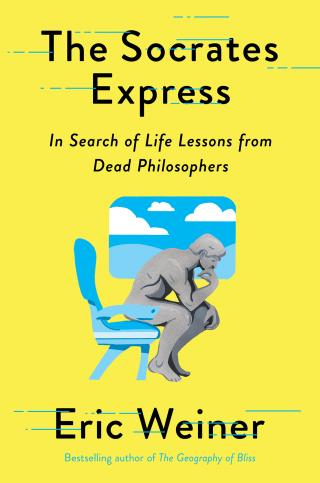
The Socrates Express
- Автор: Вейнер Эрик
- Год: 2020
- Язык: английский
- Год: Avid Reader Press / Simon & Schuster
- Жанр: География, путевые заметки

Электронная книга - «The Socrates Express». Краткое содержание книги:
We contemplate for the same reasons we travel: to see the world from a different perspective, to unearth hidden beauty and find new ways of being. We want to learn how to embrace wonder. Face regrets. Sustain hope.
Eric Weiner, *New York Times* bestselling author of *The Geography of Bliss* , combines his twin passions for philosophy and global travel in a pilgrimage that uncovers surprising life lessons from philosophers around the world, from Marcus Aurelius to Arthur Schopenhauer, Confucius to Montaigne. Traveling by train (the most thoughtful mode of transport) he traversed thousands of miles, making stops in Athens, Delhi,...
Sei Shōnagon was clearly a witty, insightful writer, but was she a philosopher? Consult any compendium of history’s great philosophers and you will not find her name. That’s understandable. She developed no philosophical system, no theories about the universe and our place in it. She expressed little interest in ideas per se. It was people and things, beautiful things, that enthralled her.
Yet if the task of the philosopher is, as one scholar says, “to demonstrate that things can be otherwise,” Shōnagon is clearly a philosopher. She shows us the world, her world, and says, in so many words: Look at this. Isn’t it marvelous? So tiny yet so beautiful. If the task of philosophy is, as Nietzsche said, “to enhance our taste for life,” then Shōnagon is a philosopher. After reading her for a few hours, colors appear more vivid, food tastes better.
Implicit in Shōnagon’s philosophy is this: Who we are is largely shaped by what we choose to surround ourselves with. And it is a choice. Philosophy reveals the hidden choices we make. Realizing something is a choice is the first step toward making better choices. As the German writer Hermann Hesse said: “The man who for the first time picks a small flower so that he can have it near him while he works has taken a step toward joy in life.”
I am sitting at a desk in Vermont, writing. I come here every summer. Always the same house, surrounded by the same objects. There’s my laptop, with the soft, almost ethereal glow of its backlit keys, and the satisfying click they make as I type. There’s my cup of coffee. I savor the pleasant weightiness of the mug, and the way it warms my hands on this, an unseasonably chilly summer day. I sense the gentle swoosh of liquid as I raise cup to mouth, touching its lip to mine and tasting the coffee, warm and pleasantly bitter.
Then there is the desk itself, solid and serious. Embedded in the wood is the intention of the designer, his or her guiding hand suggesting the desk be used for a certain purpose and in a certain way. There is the history of the desk, its biography, for objects have stories to tell, too. There is the lingering presence of the craftsman who made it, the people who owned it before, the movers who lugged it here, the nice woman who cleans it on Sundays. It’s only a desk, yes, but it contains multitudes.
I read The Pillow Book and, across the centuries, Shōnagon and I lock eyes. Hers is a steely stare. She is sizing me up. She sees the bald head, the endemic keratoses, the mismatched clothes. I can imagine the lists I’d appear in. Things That You Wish Weren’t. Things that are oh-my-God-I-can’t-even. Sure, she also sees a mind that enjoys wrestling with big ideas but, still, she’s not impressed, for here is a man who lacks the aesthetic impulse.
She’s right. I am not a detail person. Grooming is for lesser mortals. I, a Man of Ideas, have no time for such trifles. I take perverse pride in my slovenliness, believing that intellectual depth is inversely proportional to neatness. My mind favors the big, like a camera stuck in wide angle. It overlooks details and seeks out the grand and the universal.
My size-ism extends to nearly every corner of my life. I excel at opening food containers (big) but forget to close them (small). I remember to feed the dog (big) but not the cat (small). I write books (big) but have awful handwriting (small). I never gave my size-ism much thought—who has time for such trivialities?—until now. My inattention to details, I realize, comes at a cost. It’s hobbled me, constrained me. Once, it nearly killed me.
While still a teenager, I took flying lessons. I was doing well. Up to a point.
“You get the big things right but not the small ones,” my flight instructor told me after one lesson. I wasn’t sure whether this was a compliment or an insult. It all depends, I suppose, on how much you value the small. He did. I didn’t.
One day, after our scheduled lesson ended, I taxied the plane back to the ramp and shut down the engine. I was unbuckling my shoulder harness when he said, nonchalantly, “I’m getting out here. Why don’t you take it up yourself?”
“Say what?”
“You’re ready.”
“I am?”
“Yes, you are.”
My first solo flight. I was sixteen years old and had not yet driven a car by myself. I gulped audibly.
“You can do this, Eric,” said a voice that sounded remarkably familiar, for it was my own.
“Yes, I can do this,” I replied to myself.
“I have no doubt,” said my instructor, “but let me get out first.”
“Oh yeah, of course.”
He exited the plane, leaving the right seat eerily empty. I radioed ground control and requested permission to taxi for takeoff.
“Roger. Taxi to Runway 14,” came the crisp reply.
I steered the plane until just short of the runway, then ran through my preflight checklist.
Flaps? Set.
Gas? Full.
Altimeter? Set.
Everything looked good. I radioed the control tower. Cleared for takeoff, I eased the throttle forward. Airspeed climbing nicely. Engine power on track. Wait—what’s that rattling noise?
Something was wrong. I had seconds to decide whether to continue down the runway or abort the takeoff. As I gained speed, the rattling grew louder. I glanced up and saw the door handle was in the open position.
Damn. I had forgotten to—what’s the technical term?—close the door. With one hand on the control yoke, I reached up with the other and latched the door shut. Seconds later, I was airborne. The rest of the flight went the way all flights should go: uneventfully. I nailed the landing.
As I taxied back to the ramp, the air traffic controller broke the usual clinical remove and transmitted a quick “Congratulations, Eric.”
“Thank you,” I said, all the while thinking, If you only knew. If you only knew.
Back home that evening, I replayed the incident in my mind. It was a small oversight, a mere door handle, but one that was potentially disastrous. My instructor was right. I was not good at the small things. Small things can kill you. They can also save you.
No one knew this better than Sei Shōnagon. One day, Empress Teishi, watching the joy Shōnagon derived from a finely woven tatami mat, remarked, “The simplest trifles console you, don’t they?” Shōnagon doesn’t record her reply, but I can imagine what she was thinking. Yes, they do, Your Majesty, only they are not so trifling as you think.
Sadness feels like a great weight, but maybe that is an illusion. Maybe it is lighter than we think. Maybe no heroic maneuvers are necessary. Maybe life’s so-called trifles—the great beauty of small things—can save us. Maybe salvation is closer than it appears. All we need to do is reach out—and close the door.
Does any of Japan’s “cult of beauty” remain today? Take one look at the bleak high-rises and concrete-lined rivers and you’d conclude no, it doesn’t. And, from that vantage point, you’d be right. Big Japan is ugly.
Go small, though, and everything looks different. I feel like a ten-year-old peering through a microscope for the first time, marveling at this hidden world that was there all along. I see micro-beauty everywhere: the soft glow of the vending machines; the onigiri, small triangles of rice and fish, wrapped so the seaweed remains crisp and crunchy until it’s time to bite into it; a glass of sake served in a perfect wooden box.
Back on the shinkansen, bulleting toward Tokyo, I retrieve my bento box from the shopping bag the clerk at the station had packed it in. The bag is made of paper, and it is beautiful. Solid handles. An attractive design on front. I remove the box carefully, grateful for the clerk’s kindness.
After lunch, I reach for my notebook and write, in all caps: “JAPANESE BULLET TRAIN: LISTS.” A good start. Too broad, though. I need to get specific. I need to go small. Delightful things about a Japanese bullet train. Better.