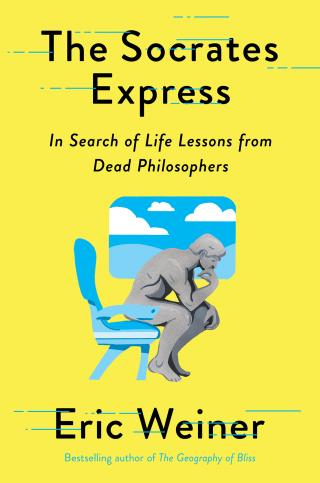
The Socrates Express
- Автор: Вейнер Эрик
- Год: 2020
- Язык: английский
- Год: Avid Reader Press / Simon & Schuster
- Жанр: География, путевые заметки

Электронная книга - «The Socrates Express». Краткое содержание книги:
We contemplate for the same reasons we travel: to see the world from a different perspective, to unearth hidden beauty and find new ways of being. We want to learn how to embrace wonder. Face regrets. Sustain hope.
Eric Weiner, *New York Times* bestselling author of *The Geography of Bliss* , combines his twin passions for philosophy and global travel in a pilgrimage that uncovers surprising life lessons from philosophers around the world, from Marcus Aurelius to Arthur Schopenhauer, Confucius to Montaigne. Traveling by train (the most thoughtful mode of transport) he traversed thousands of miles, making stops in Athens, Delhi,...
Kindness is hard. It includes empathy, but that is not enough. Confucian ritual is needed. There’s a reason we turn to rituals during life’s weightiest moments—a wedding, a graduation, a death. These events evoke such strong feelings we risk coming unglued. Ritual holds us together. Ritual provides the container for our emotional content. We F train riders needed such a container when this sad woman swayed into our car. There was none, alas, so we did nothing.
“The burden is heavy and the road is long,” Confucius said. Kindness is hard. Everything worthwhile is.
10. How to Appreciate the Small Things like Sei Shōnagon
11:47 a.m. On board Japan Rail East Train No. 318. En route from Tokyo to Kyoto. Speed: 185 miles per hour.
Speed, I’ve learned, is the enemy of attention. Swiftness fragments our awareness, splinters it into a million tiny pieces, none large enough to grasp.
What about beauty? Does it, too, decrease as we accelerate? Or does speed possess its own blurred beauty? A hummingbird’s wings, flapping eighty times per second. A flash of lightning, arcing across the sky. The quiet whoosh of a Japanese shinkansen, or bullet train, rocketing from city to city.
When I boarded the one I’m on now, at Tokyo’s shiny Shinagawa station, I didn’t know whether to gasp or laugh. With a flat platypus nose attached to a toned swimmer’s body, the train looks ridiculous. And beautiful. The shinkansen is the Robin Williams of trains: an absurdity blatantly flouting the laws of physics but doing so at such mind-boggling speed that all is forgiven.
Just as Robin Williams didn’t compete with other comedians, the shinkansen doesn’t compete with other trains. It competes with the airlines. Japan Rail has done its best to mimic the feel of an airline cabin. I could be on board an Airbus, with the notable absence of seat belts and canned announcements about what to do in the unlikely event of a water landing.
As we departed Shinagawa station, precisely on time, the echoes of air travel grew louder: the high-pitched whoosh, the G forces gently pressing me against my seat—smoothly, without even a hint of Amtrak shake-and-rattle.
If all goes according to plan, and in Japan it almost always does, we will cover the 227 miles from Tokyo to Kyoto in a brisk two hours and eight minutes. We are flying. We are not flying. Only when I glance out the window—not at the horizon but at a nearby house or railroad crossing—do I experience an inkling of our exceptional velocity. Speed is relative. Without reference points, it is meaningless.
A conductor walks by and scoops up a chopstick shard that somebody (okay, me) had dropped. In my mind, it was too small to qualify as litter. Clearly he felt otherwise. My stray speck of wood had upset the aesthetic harmony of the train. In Japan, something is either just right or it is not right at all.
I retrieve my little black notebook, not the gem I lost in England (it is irreplaceable), but a more pedestrian model. I unfurl the elastic band that contains my thoughts. I turn to a fresh page, blank with possibility, and start a list. I like lists. List making is, I believe, a profoundly philosophical activity. Don’t take my word for it. Ask Plato. He made lists. He listed the attributes of a philosopher-king, and of the good life. His student Aristotle outdid him. Aristotle was philosophy’s great list maker. Keen to superimpose order upon messy reality, he created layers of categories and subcategories.
Some two thousand years later, Susan Sontag offered this eloquent and characteristically cerebral defense of her chronic list making: “I perceive value, I confer value, I create value, I even create—or guarantee—existence. Hence, my compulsion to make ‘lists.’ ” Umberto Eco put it more succinctly: “The list is the origin of culture.”
My list making is considerably less grand. My lists do not guarantee existence or establish cultures. My lists do not, as far as I know, perceive value, but they do help me corral my thoughts. They help me make sense of the world, of myself, and what is more philosophical than that?
The key to good list making is getting the category right. It must be large enough to encompass a variety of entries yet small enough to wrap your mind around. “The Greatest Music Ever” is too broad while “The Greatest Polkas Composed by Polish-Americans of 1930s Chicago” is too narrow.
I glance at the list I’ve just created in my notebook. “Foreign Countries Where I Have Lived.” It is not a long list, only three entries, but it has, more than any other list, shaped how I think, and who I am.
Each country on the list taught me something important, even if inadvertently. India taught me how to find stillness in chaos. Israel taught me the importance of savlanut, patience. Valuable lessons all, but nothing compared to Japan. Japan taught me, a person of the book, a head-heavy aficionado of words and the people who use words, how to shut the fuck up for five minutes and experience a different way of being. Japan opened my eyes to a philosophy of things. Beautiful small things.
The Pillow Book. What a strange title, I thought, when I first learned of its existence, nearly two decades ago. I was living in Tokyo, working as a correspondent for NPR. It tickled my interest. What is this peculiar book named after a nocturnal accessory and penned a millennium ago by a little-known courtier from Kyoto? And how does it attract readers ten centuries later?
My investigations started and ended there. I was busy filing reports about the Japanese economy or the country’s aging population or jetting off to cover some simmering conflict in Indonesia or Pakistan. I didn’t have the time—or, to be honest, the inclination—to read a thousand-year-old book about nothing in particular. The book, though, the idea of the book, stayed with me, relegated to the exurbia of my brain, waiting patiently for space to open up downtown.
I snuggle with The Pillow Book while, appropriately, resting my head on a pillow. I am in a hotel room in Tokyo’s Shibuya neighborhood, though in Japan, “room” is a matter of opinion.
Both in style and scale, the alleged room reminds me of a ship’s cabin. A masterpiece of spatial efficiency, it supposedly sleeps three, but there’s a catch. These three bodies must remain at rest. Any motion requires the sort of advance coordination typically demanded of presidential visits and premarital sex. It is less room than nook.
Nooks don’t get their fair due. Not with adults at least. Children appreciate a good nook. They instinctively seek them out, and if none is available create one. I recall, as a melancholic five-year-old, transforming our Baltimore living room into a labyrinth of nooks by stringing together dozens of blankets and sheets, then anchoring them to anything within reach: chairs, couches, the dog. I was too young to articulate my motives, but I now realize what it was I craved: the sublime combination of coziness and wonder, confinement and expansiveness, security and adventure, that only a nook provides.
I still like nooks. I suffer (if that is the right word) from claustrophobia’s opposite. I am drawn to confined spaces, thrive in them. Maybe this is why I am so fond of Japan. No one confines like the Japanese. People of the Nook. They shoehorn themselves into subway cars and bars and alleged hotel rooms. Remarkably, they do all this without killing one another.
I turn to the first page. The Pillow Book reads like a private diary, and for good reason: it’s a private diary. “I merely wrote for my personal amusement things that I myself have thought and felt,” writes the author, Sei Shōnagon. She never expected her words to be read by others, which explains why others find them such a joy to read. The Pillow Book is written with the naked honesty typically reserved for the anonymous and the dying.