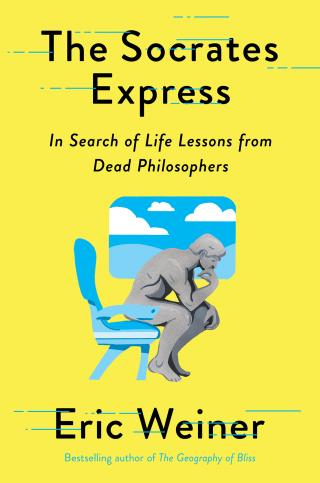
The Socrates Express
- Автор: Вейнер Эрик
- Год: 2020
- Язык: английский
- Год: Avid Reader Press / Simon & Schuster
- Жанр: География, путевые заметки

Электронная книга - «The Socrates Express». Краткое содержание книги:
We contemplate for the same reasons we travel: to see the world from a different perspective, to unearth hidden beauty and find new ways of being. We want to learn how to embrace wonder. Face regrets. Sustain hope.
Eric Weiner, *New York Times* bestselling author of *The Geography of Bliss* , combines his twin passions for philosophy and global travel in a pilgrimage that uncovers surprising life lessons from philosophers around the world, from Marcus Aurelius to Arthur Schopenhauer, Confucius to Montaigne. Traveling by train (the most thoughtful mode of transport) he traversed thousands of miles, making stops in Athens, Delhi,...
The F train isn’t only a train. It is a culture and, as with all cultures, certain rules apply. Some are written, others understood. I look around and see the written variety everywhere. Thou shalt not lean on doors or hold doors. Thou shalt not pass between cars. Thou shalt not eat or drink. Thou shalt stand clear of the closing doors.
Confucius could have written these rules. He saw great value in li, or “proper ritual conduct,” as expressed in classic Chinese texts such as The Book of Rites. Here’s a small sample, on the subject of proper dining habits.
Do not roll the rice into a ball; do not bolt down the various dishes; do not swill down the soup. Do not make noise in eating; do not crunch the bones with the teeth; do not put back fish you’ve been eating; do not throw the bones to the dogs; do not snatch at what you want. Do not spread the rice to cool; do not use chopsticks in eating millet.
I read that and sigh. This is my image of Confucianism: a rules-based philosophy where one honors one’s parents, does not question authority, and always, always, stands clear of the closing doors. No wonder it is Lao-Tzu, with his warm and fuzzy wu wei, or “non-doing,” who is the darling of the New Age crowd, not Confucius. If Lao-Tzu is the surfer dude of Chinese philosophy, Confucius is its substitute teacher.
I confess: the words “proper ritual conduct” do not appeal to me. Not a single one. For me, ritual is something you rebel against, not embrace. Blindly following tradition flies in the face of philosophy’s rallying cry, as articulated by Kant: “Dare to think for yourself!” But there is more to Confucianism. Much more. It doesn’t advocate mindless allegiance to ritual. Motivation matters. “Ritual performed without reverence—these are things I cannot bear to see!” Confucius said.
And there is a reason for his punctiliousness, one that relates directly to ren, to kindness. Kindness is not free floating. It needs a container. For Confucius that container is li, proper ritual conduct. You may not see value in these rituals. That’s okay, Confucius says. Straighten your mat as if you cared, eat your food in the prescribed manner as if it mattered. These might seem like mundane matters. But it is on this quotidian foundation that kindness rests.
Confucius’s goal was character development: the acquisition of moral skills. And no skill was more important than filial devotion. Each page of The Analects is watermarked with a wagging, parental finger. A son is obliged to honor his father, even if it means covering for his misdeeds. And these obligations don’t end with a parent’s death. The obedient son or daughter must continue to behave as his or her parents had wished.
Confucius demands unswerving but not unthinking devotion. If an elderly parent veers off course, by all means redirect him, but do so judiciously, respectfully. Filial piety is a means, not an end. Just as we go to the gym not to sweat but to get in shape, we practice filial piety not for its own sake (only) but to develop our kindness muscles. Caring for an elderly parent is heavy lifting. Confucius adds a few pounds by insisting we do so cheerfully, with a genuine smile.
The family is our ren gym. It is where we learn to love and be loved. Proximity matters. Start by treating those closest to you kindly, and go from there. Like a stone tossed into a pond, kindness ripples outward in ever-widening circles, as we expand our sphere of concern from ourselves to our family to our neighborhood to our nation to all sentient beings. If we can feel compassion for one creature, we can feel it for all of them.
Too often, though, we fail to make the leap from familial kindness to a broader benevolence. Too often parenting remains “an island of kindness in a sea of cruelty,” as two contemporary authors put it. We need to escape the island or, better yet, enlarge it and invite others to join us.
“Stand clear of the closing doors.” I stand clear, following proper ritual conduct. Nearby, a woman cradles an enormous Dunkin’ Donuts cup, in clear violation of the no-eating-or-drinking rule. A man not more than five feet away outdoes her by retrieving an entire pizza from his backpack and chowing down.
A recorded announcement startles me with its directness: “Attention passengers: Do not carry your wallet or phone in your back pocket.” It’s a reminder that others can’t be trusted, that kindness has no home here, in the big city. If you want kindness, go to a small town, or so we think.
As we pull into the Fifty-Third Street station, the doors slide open and the car fills with the sound of a busker singing John Lennon’s “Imagine.” He’s a bit off key but it is touching despite that fact, or perhaps because of it.
The song, I realize, is Confucius’s utopian “Great Harmony” set to music. Callousness is the result not of cruel intentions but of a failure of imagination. The unkind person can’t imagine the suffering of another, cannot put himself in her shoes. And yet it’s easy if you try, says John Lennon, and Confucius, too. “Since you desire status, then help others achieve it, since you desire success then help others attain it.”
Did the brief burst of John Lennon affect the mood on the train? Did it make us more prone to human-heartedness? It’s impossible to quantify, of course, but I’d like to think so. I’d like to think kindness begets kindness.
I exit at Canal Street and decide to stop at a Chinese restaurant for lunch. It is crowded, like the F train, though less rickety and with a more pleasant aroma.
“How many?” barks the host, accusingly, as if I’ve interrupted an important meeting.
“One,” I say, sheepishly holding up an index finger.
“You sit with other customers, okay?”
It is not okay, but I don’t say so. I don’t want to disappoint the barking man. He sits me with a group of German tourists.
A New York City Chinese restaurant is not an obviously kind place any more than the F train is. The service is brusque at best. The waitstaff not only barks at you but expects you to order, and eat, quickly.
Yet a current of subterranean benevolence runs through the place, infuses the dim sum and the bok choy, steeps in the metal teapots. It is a kindness that honors the common good. If you’re willing to share a table, everyone benefits. If you eat quickly, others waiting can enjoy the shrimp shumai also. These rules are not written but understood. They constitute the li, the proper ritual conduct, of a Chinese restaurant. They are the container that holds the kindness.
My Chinese restaurant ticks off many of Confucius’s five boxes of ren: respect, magnanimity, sincerity, earnestness, and kindness. The staff treats me with respect, up to a point, and they are certainly sincere, something that can’t be said of haughtier establishments. They are earnest and, in their own way, kind. Magnanimous? Not so much, but four out of five isn’t bad.
Back on the F train, snaking through Queens, I scan my fellow passengers and wonder: Are they good people? Kind? Do we all possess ren, human-heartedness, or do only a few exceptional beings, what Confucius calls a junzi, a “superior person”?
The question of human nature is one of the thorniest in philosophy. Some philosophers, such as Thomas Hobbes, believed humans are naturally selfish; society tempers this brutish disposition. Thinkers like Rousseau believed man is born good; society corrupts. Still others, such as the French existentialist Simone de Beauvoir, doubted human nature exists at all; it is our nature not to have a nature.