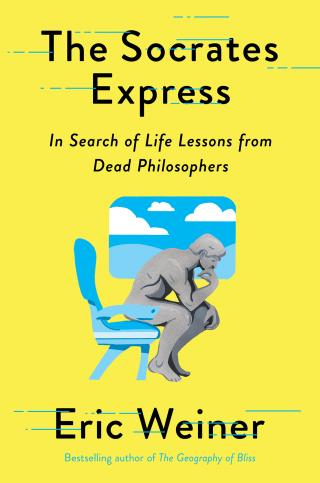
The Socrates Express
- Автор: Вейнер Эрик
- Год: 2020
- Язык: английский
- Год: Avid Reader Press / Simon & Schuster
- Жанр: География, путевые заметки

Электронная книга - «The Socrates Express». Краткое содержание книги:
We contemplate for the same reasons we travel: to see the world from a different perspective, to unearth hidden beauty and find new ways of being. We want to learn how to embrace wonder. Face regrets. Sustain hope.
Eric Weiner, *New York Times* bestselling author of *The Geography of Bliss* , combines his twin passions for philosophy and global travel in a pilgrimage that uncovers surprising life lessons from philosophers around the world, from Marcus Aurelius to Arthur Schopenhauer, Confucius to Montaigne. Traveling by train (the most thoughtful mode of transport) he traversed thousands of miles, making stops in Athens, Delhi,...
Confucius fell on the people-are-good side, a notion expanded a century later by a philosopher named Mencius. “All people have a heart that cannot bear the suffering of others,” he said, and suggested a thought experiment to make his point. Imagine you’re passing through a village, minding your own business, when you spot a child teetering on the edge of a well, about to fall in. How do you react?
Most likely, says Mencius, you feel “alarm and compassion.” Instinctively, you want to help—not to win favor from the child’s parents, or praise from neighbors and friends, but because you are human and “the feeling of commiseration is essential to man.” Merely hearing this tale, we experience a “stirring of our hearts.” If you don’t, he says, you are not fully human. (Nowhere does Mencius predict people would actually help the child. A sizable gap separates compassion and action, and many a good intention has fallen into it, never to be heard from again.)
We each possess the same latent goodness, Mencius says. Just as a denuded mountain still sprouts tiny shoots, even the cruelest person retains a dormant kindness. “Given the right nourishment, there is nothing that will not grow, and deprived of it, there is nothing that will not wither away.”
Our capacity for kindness is like our capacity for language. We’re all born with an innate ability to speak a language. But it must be activated, either by our parents or Rosetta Stone. Likewise, our inherent kindness must be mobilized, and the way to do that, Confucians believe, is through study. The opening line of The Analects sings the praises of studying. “Isn’t it a pleasure to study and practice what you have learned?”
By “study” Confucius doesn’t mean rote memorization or even learning, per se. He has something deeper in mind: moral self-cultivation. What we are taught, we learn. What we cultivate, we absorb. There are no small acts of kindness. Each compassionate deed is like watering a redwood seed. You never know what heights it might reach.
I have a question for Confucius: If human nature is inherently good, why does the world seem so cruel? From Genghis Khan to Hitler, the story of humanity is written in blood. Flip on your TV or fire up your laptop, Master, and you’ll see this is still the case. The news is all bad: terrorist attacks and natural disasters and political brawls. Kindness is truant. Or so it seems.
Kindness is always there, whether we notice it or not. “The Great Asymmetry,” the late Harvard paleontologist Stephen Jay Gould called this phenomenon. “Every spectacular incident of evil will be balanced by 10,000 acts of kindness,” he said. We witness these acts every day on our streets and in our homes and, yes, on the New York subway. An elderly woman braves a cold November day to feed the neighborhood squirrels; a businessman, late for a meeting, stops to help a single mom carry the groceries to her car; a teenager, skateboard in hand, notices an expired parking meter and drops a quarter in. That these ordinary acts of kindness rarely make the news renders them no less real, or heroic.
It is our duty, almost a holy responsibility, says Gould, “to record and honor the victorious weight of these innumerable little kindnesses.” Gould, a hard-nosed scientist, saw a practical reason for registering goodness. Kindness honored is kindness multiplied. Kindness is contagious. Witnessing acts of moral beauty triggers a flood of physical and emotional responses. Observing acts of kindness encourages us to act more kindly ourselves, a phenomenon confirmed in several recent studies.
I experience the kindness contagion firsthand. After my week riding the F train, hyperalert to acts of kindness, I become kinder myself. I hold doors for people. I pick up litter. I thank my barista—and leave a tip when she isn’t looking. These small acts won’t snare me the Nobel Peace Prize or sainthood, I realize. But it’s a start. A few more drops on the redwood seed.
Ride the F train long enough and you start to notice patterns. I do. Acts of kindness are not constant. They ebb and flow. During off-peak hours, I observe relatively few. Yet during rush hour, I notice many: a muscular young man offering his seat to an older woman; an “excuse me” here, a “sorry” there. People have no less kindness in their heart at noon than at 5:00 p.m. of course. There are simply fewer kindness opportunities. Kindness expands to fit the need demanded.
During rush hour, that need swells to galactic proportions. As we inch toward Brooklyn, more and more people board at each stop. By Union Square, the train is full. We can’t possibly hold one more passenger, I think. Yet we do.
Everything happens more quickly: people rush for a seat more quickly, scan more quickly. Even the conductor’s announcements accelerate. ConeyIslandboundFtrainstandclearoftheclosingdoors.
“New Yorkers aren’t rude,” my friend Abby, a native New Yorker, said when I told her of my plan to seek kindness on the F train. “They’re fast.”
She might be onto something. Is it possible, I wonder, to act kindly quickly, or does kindness demand slowness? Slow cooking tastes better than fast food and, as we’ve seen, good philosophy takes time, too. As the F train trundles under the East River, I contemplate the relationship between velocity and kindness. Does kindness decrease as you accelerate? Confucius seems to think so. He describes the benevolent person as “simple in manner and slow of speech.”
I’m not so sure. Yes, people moving quickly are less likely to notice a person in distress, but sometimes speediness is kinder. If your house were on fire, would you prefer a slowpoke firefighter or a fleet-footed one? If you were sick, would you want an ER doctor who dawdles or one who moves quickly? If I were to collapse right here on the F train, suffering from a medical crisis triggered by excessive thinking, I’d want my fellow passengers to help swiftly, not slowly.
A friend recently told me about the time he witnessed just such an emergency on the New York subway. A woman collapsed on the floor of a train as it pulled into a station. Reflexively, her fellow passengers sprang into action. One held the door so the train remained in the station, another alerted the conductor, a third administered first aid. Mencius would recognize this display of reflexive compassion. Kindness comes naturally. Cruelty is learned.
Am I kind? I wonder. Yes, I did display Confucian ren, human-heartedness, when I helped Kailash in India. But I didn’t seek out Kailash. He found me. He was the child in the well. I deserve no more credit for my reflexive reaction than I would for sneezing in a dusty room. The world, now more than ever, demands not only reflexive kindness but a more assertive variety, too.
I hear her before I see her. A plaintive, wounded voice that cuts through me like a rusty knife. “I had a young face,” she says, addressing none of us and all of us. “What happened? I had a young face? Why?”
She is dressed in clothes that are little more than rags. She is unsteady, her large frame swaying, as if buffeted by a gale.
I look down and see the source of her unsteadiness (one source anyway). At first, I assume she’s wearing old shoes but she is not. She is barefoot. Her feet, swollen and deformed, are grotesque. They do not look like human feet.
For a long time, she stands there, swaying, not soliciting money or help of any kind. This is the worst part: the ambiguity of the situation. I feel alarm and compassion, but don’t know what to do.
Kindness is hard. Even if we want to help, we don’t know how. Better to do nothing, we tell ourselves. My fellow passengers are uneasy, too, in that subtle New York way. Some move aside to let her pass. Others double down on their straight-ahead stare. I bury my head in Confucius.
The woman moves to the far end of the car. I can’t see her anymore, but I can still hear her. “I used to have a young face.”
Then she’s gone. Everyone exhales, or so I imagine. I lift my head and reflect on what transpired. What to do when faced with such suffering? Yes, I could have helped the woman but, as I said, I didn’t know where to begin. Nobody did. How, then, can the kindness contagion take hold? Someone has to go first.