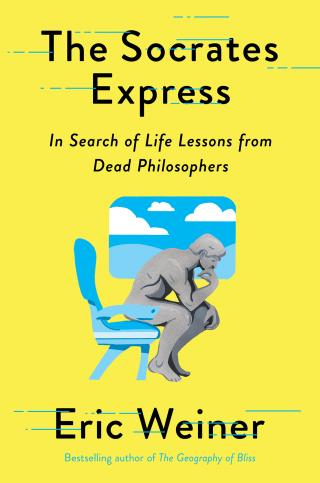
The Socrates Express
- Автор: Вейнер Эрик
- Год: 2020
- Язык: английский
- Год: Avid Reader Press / Simon & Schuster
- Жанр: География, путевые заметки

Электронная книга - «The Socrates Express». Краткое содержание книги:
We contemplate for the same reasons we travel: to see the world from a different perspective, to unearth hidden beauty and find new ways of being. We want to learn how to embrace wonder. Face regrets. Sustain hope.
Eric Weiner, *New York Times* bestselling author of *The Geography of Bliss* , combines his twin passions for philosophy and global travel in a pilgrimage that uncovers surprising life lessons from philosophers around the world, from Marcus Aurelius to Arthur Schopenhauer, Confucius to Montaigne. Traveling by train (the most thoughtful mode of transport) he traversed thousands of miles, making stops in Athens, Delhi,...
“I said, ‘Please turn off the light,’ again and again.” She grew angry, but Kailash remained calm. For a while. One day he saw her leaving yet again without switching off the light. When he asked her to, she pointed out she, not Kailash, paid the electricity bill. He yelled at her. She yelled back. It was not a Gandhian fight.
“Did she have a point?” I ask Kailash. “Was she right?”
“She was right, but at the same time she was wrong,” he says.
That is, I think, a Gandhian response. Each side in a conflict possesses a slice of the truth, not the whole pie. Rather than trading slices, aim to enlarge the pie.
In the last hour of the last day of his life, Mahatma Gandhi met with a minister in the new Indian government. Afterward, Manu brought him dinner: fourteen ounces goat’s milk, four ounces vegetable juice, and three oranges. While he ate, he weaved khadi cloth with his charkha, or spinning wheel. He noticed the time—a few minutes past 5:00 p.m.—and sprang to his feet. He was late for his evening prayers. Gandhi hated being late.
With his grandnieces—my “walking sticks,” he affectionately called them—on either side, he walked toward the prayer grounds, where several hundred supporters awaited him. Gandhi lifted his hands from his grandnieces’ shoulders and folded them into a Namaste, greeting the crowd.
At that moment, a stout man wearing a khaki tunic approached Gandhi. Manu thought the man was going to touch Gandhi’s feet in a show of reverence. It happened often. Gandhi hated it. “I am an ordinary human being,” he’d say. “Why do you want to pick up the dust of my feet?”
Manu intervened, chiding the man for further delaying Gandhi. “Do you want to embarrass him?” she asked.
The man replied by pushing her—so forcefully she stumbled backward, dropping Gandhi’s rosary and eyeglass case. As she reached down to pick them up, three shots rang out in rapid succession. Smoke filled the air and, recalls Manu, “darkness prevailed.” Gandhi, still standing, hands still folded in greeting, was heard uttering the words Hey Ram, “Oh God,” before collapsing.
Gandhi’s last steps are memorialized here. A pathway of white stone footprints leads along a grass walkway, ending where the assassin’s bullets struck. Kailash and I stand on the last two markers now. Two bare feet: one brown, one white. The stone feels cool against my skin, and not for the first or last time do I wonder what it is about places of death that I find so peaceful.
“Would you do it?” asks Kailash.
“Do what?”
“Live with Gandhi. Would you have joined his ashram if you could?”
Gandhi had millions of admirers, but his closest followers numbered only in the hundreds. Life with Gandhi was demanding. Acolytes adhered to eleven vows, ranging from the easy (not stealing) to the tricky (physical labor) to the onerous (chastity). Gandhi was, as we’ve seen, not always a nice man. He was demanding and, at times, harsh. “To live with Gandhi is to walk on the blade of a sword,” said one follower. Am I capable of such a balancing act? I wonder.
“Yes,” I tell Kailash. “I would join Gandhi.”
As I hear my own words, as if spoken by someone else, I realize they are true. Sometimes we don’t recognize truth until we speak it.
I would join Gandhi—not despite the demands of such a life but because of them. I spend considerable time and money endeavoring to increase my comfort when, I know, that is not what I need. What did Epicurus say? Nothing is enough for the man to whom enough is too little. At his death, Gandhi’s worldly possessions consisted of a pair of spectacles, a wooden bowl (for taking his meals), his pocket watch, and, from a Japanese friend, three tiny porcelain monkeys, signifying “see no evil, hear no evil, speak no evil.”
Inhaling chunks of Delhi air, I glance out the taxi’s window at the traffic, heavier than usual today. We’re on our way to the train station. Kailash insisted on seeing me off, even though it’s late. I didn’t resist.
As we wait for the train, I get a good look at Kailash. He is no longer the scrawny kid I first met all those years ago. He has filled out, and grown up. He is a man. A good man. I see traces of Gandhi in Kailash. The persistence. The openness to new ways of thinking. The unwavering honesty. The innate goodness.
I don’t mention this observation to Kailash. He’d find it absurd, I’m sure, and more than a little blasphemous. Gandhiji? Me? There was only one Gandhiji.
Maybe, maybe not. Gandhi never saw himself as sui generis. He was not a god or a saint. He was simply a man who experimented with new ways of fighting and a powerful force called love. An Einstein of the heart.
A train pulls into the station and the already frenetic activity on the platform accelerates: porters hauling suitcases the size of small boats; chai wallahs calling out in singsong tones, hoping to sell a cup or two; families holding hands lest they be swept away by the torrent of humanity. The train slows to a stop. A placard on the side reads: “Rajdhani Express.”
I had decided to accept Mr. Roy’s offer for the last remaining ticket on the “good train.” The not-the-Yoga-Express train. It was a surrender, of sorts, a bow to reality. I lost the battle. I failed. Like Gandhi. His dream of a peaceful transition to a unified India never materialized. In his last days, he felt adrift in “an aching, storm-tossed and hungry world.” Despair threatened to drown him.
Yet he never stopped fighting. When Indians celebrated independence at the stroke of midnight on August 15, 1947, Gandhi spent the day fasting, and praying. Soon after, he crisscrossed the young nation, by train and by foot, trying to stanch the bleeding. He achieved his means, if not his ends.
How you fight matters more than what you’re fighting about. I fought well. I recognized an injustice and confronted it. I battled creatively and cleanly against a recalcitrant adversary: Indian Railways. I did not resort to violence, however much tempted to do so. True, the results were not what I wanted, but it is the wanting not the results that lies at the root of my suffering. Besides, there will be other fights. There always are.
Kailash helps haul my luggage on board, reminding me to lock my bags during the overnight journey. I promise him I will. We hug good-bye before he jumps from train to platform. I watch him for a few seconds, then he is gone, swallowed up by the warm Delhi night, thick with pollution, and people: countless souls in motion, negotiating tight spaces and complex relationships, loving and fighting, fighting and loving, usually sequentially but, every now and then, at the same time.
Mahatma Gandhi took one last train journey. Thirteen days after his assassination, his ashes were placed on board a train bound for Allahabad, at the confluence of three sacred rivers. Gandhi’s final resting place.
All along the route, people scrambled for a glimpse of the train, eyes tearing, hands joined in a final Namaste. At night, villagers lit bonfires and torches and cried, Mahatma Gandhi, ki-jai! Victory to Gandhi. The train, outfitted for the journey, consisted entirely of third-class carriages.
9. How to Be Kind like Confucius
5:34 p.m. Somewhere in lower Manhattan. On board the New York City subway F train, en route to nowhere.
I’ve been riding the F train for a long time—longer than most commuters, and mental health professionals, would advise. I have taken the train to Jamaica, Queens, and to Coney Island, Brooklyn, and many places in between. For a solid week, the F train has been my home.