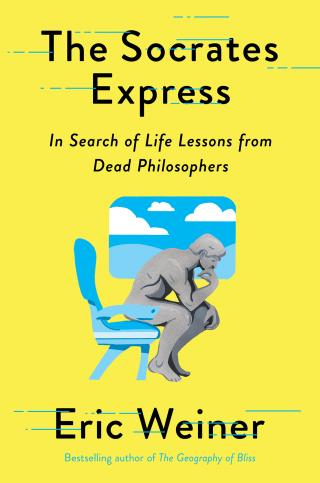
The Socrates Express
- Автор: Вейнер Эрик
- Год: 2020
- Язык: английский
- Год: Avid Reader Press / Simon & Schuster
- Жанр: География, путевые заметки

Электронная книга - «The Socrates Express». Краткое содержание книги:
We contemplate for the same reasons we travel: to see the world from a different perspective, to unearth hidden beauty and find new ways of being. We want to learn how to embrace wonder. Face regrets. Sustain hope.
Eric Weiner, *New York Times* bestselling author of *The Geography of Bliss* , combines his twin passions for philosophy and global travel in a pilgrimage that uncovers surprising life lessons from philosophers around the world, from Marcus Aurelius to Arthur Schopenhauer, Confucius to Montaigne. Traveling by train (the most thoughtful mode of transport) he traversed thousands of miles, making stops in Athens, Delhi,...
I am not insane, I assure you. I am a man on a mission. I am looking for kindness. I concede the New York City subway is an unlikely place to find it. Many consider it a heartless underworld. That’s why I’m here. I figure if you can find kindness on the New York subway, you can find it anywhere.
I scan my surroundings with Thoreau eyes and Schopenhauer ears, alert to the slightest inkling of benevolence. Three young people board. Colleagues, clearly. I catch snippets of their conversation. She needs to quit.… No, she needs to get fired. No kindness there.
I spot a Hispanic man wearing a New York Yankees cap who accidentally jostles another passenger. “Excuse me,” he says. Scan. A woman holding a small white dog tight against her chest stumbles, then pinballs into no fewer than three passengers. “Sorry,” she says. Both were certainly polite, but were they kind? Politeness is social lubricant, kindness social superglue. Polite cultures are not necessarily kind ones.
The young man sitting next to me is wearing a hoodie and torn jeans. Earphones securely inserted, he is slumped over, asleep. Or so I think. When a teenager approaches, selling candy bars to raise money for his school, the man perks up, fishes a dollar bill from his pocket, and hands it to the teenager. Then, without missing a beat, he returns to his music and his slumping. I remind myself, once again, to always question assumptions.
My companion on the F train is a strange hodgepodge of a book called The Analects. It’s how we know Confucius. He didn’t write it. His disciples did, distilling his wisdom to its essence, and perhaps adding a dash of their own views, as Plato spiced Socrates. The Analects is the perfect subway read. Consisting of a series of short dialogues and snappy sayings, it’s easily digested piecemeal, between station stops. The book’s herky-jerky rhythm mirrors that of the F train. One moment Confucius is expounding on the virtues of filial piety, the next he’s advising which color robe to wear.
It’s tempting to conclude the book contains no unifying themes or cogent ideas. Yet it does. The F train may move in fits and starts, but it’s still heading somewhere, and so is Confucius.
When we pull into the East Broadway station in Manhattan, I disembark and climb the stairs and am greeted by one of those cruel early-spring days that feel like winter. Zipping my jacket and wrapping my scarf tight, I head west, in search of the man.
After a few blocks, I turn a corner and am dwarfed by a housing and commercial complex with an impersonal, Soviet aesthetic. Confucius Plaza has all the charm of a Greyhound bus station.
I walk past the Confucius Social Day Care Center and the Confucius Pharmacy, turn right at the Confucius Florist, and there, sandwiched between Confucius Optical and Confucius Surgical Supplies is… Confucius.
He must be ten feet tall, but somehow he doesn’t make me feel small. He is sporting his trademark beard, long and thin, simultaneously neat and unruly. His hands are clasped, his eyes wise. Aimed at Bowery street, Confucius’s wise eyes see all. They see the Lin Sister Herb Shop and the Abacus Federal Savings Bank. They see the Ball Room Dance Studio (“Learn to Dance Ballroom/Latin!”) and they see the Golden Manna Bakery. They see kindness, too: a gaggle of schoolchildren, five-year-olds, steered by their adult minders, as a cold wind whips through Confucius Plaza.
I pause at the bottom of the statue, where an inscription, in Chinese and English, reads: “The Chapter of Great Harmony.” In this passage, Confucius imagines a utopia where rulers are wise, criminals scared, and everyone like family. It was a bold vision, given that, at the time—the fifth century BC—kindness was a newfangled idea.
I stand there for a long while, oblivious to the spring cold, picturing this perfect world and the imperfect man who conceived it a long, long time ago.
Confucius had a difficult life, even for a philosopher. He was born into a fairly affluent family, but when he was only three years old, his father, a military officer, died. Confucius was raised by his mother, who struggled to make ends meet. Confucius helped by holding a number of menial jobs. All the while, he studied Chinese classics such as I Ching, or “Book of Changes.”
When he looked around he saw a people splintered into warring factions and governed by rulers more interested in personal gain than public good. This wasn’t only immoral, he thought, but impractical. Confucius sensed there was a better way, says journalist Michael Schuman in his excellent biography. “Swords and shields would not win an empire; burdensome taxes and military servitude would not woo loyal subjects. Benevolence was the correct and only route to power and prestige.” We’ve strayed from the Way, Confucius proclaimed. We need to get back on course.
His message landed with a deafening silence. If anything, the corruption and misrule grew worse. The final straw for Confucius came in the form of dancing girls. Hundreds of them were dispatched from a neighboring state. The local ruler, clearly distracted, failed to show up at the royal court for three days.
“I have yet to meet a man who loves Virtue as much as he loves sex,” Confucius said, before departing on what would be a thirteen-year exile. He traveled from state to state, offering his services as wise counsel to any ruler who would listen. None did.
Confucius returned home, weary but not defeated. He decided to teach, and thank goodness. Had he succeeded in obtaining a position as royal advisor, we might not know him today. He refused no student, regardless of background or ability to pay. Tuition was a small bundle of silk or a bit of cured meat, the beef jerky of its day.
Confucius was an intimidating presence in the classroom. The Master, as he was known, came across as “an uptight fuddy-duddy, a tireless stickler on points of propriety,” writes Schuman. He would not sit on a mat that was not straight, and maintained perfect posture, even when alone. When he saw a young man sitting “with his legs spread wide,” in an early display of manspreading, Confucius scolded him, calling him a “pest” and rapping him on the shin with his cane.
Yet the Master could also be gentle, lighthearted even. He sang and played the lute. He laughed and joked with friends, and found pleasure in the everyday: using his elbow as a pillow, for instance, while eating coarse rice.
Thousands of miles separated Confucius and Socrates, yet the two philosophers had a lot in common. They were nearly contemporaries. Socrates was born less than a decade after Confucius died, in 479 BC. Both men occupied precarious positions, admired by their disciples, mistrusted by the elites. Both had an informal, conversational teaching style. Both questioned assumptions. Both valued knowledge a lot and ignorance more. Neither cared for metaphysical speculation. (When a student asked Confucius about the afterlife, the Master replied, “If you cannot understand life, how can you understand death?”) Both were sticklers for definitions. “If words are not right, judgments are not clear,” Confucius said.
Words mattered to Confucius, but no word mattered more than ren. It appears 105 times in The Analects, far more than any other word. There’s no direct translation (Confucius himself never explicitly defines it), but ren has been variously rendered as compassion, altruism, love, benevolence, true goodness, consummate action. My favorite is “human-heartedness.”
A person of ren regularly practices five cardinal virtues: respect, magnanimity, sincerity, earnestness, and kindness. Confucius didn’t invent kindness, of course, but he did elevate it: from an indulgence to a philosophical linchpin, and the basis for good governance. He was the first philosopher to place kindness, and love, at the top of the pyramid. “Do not impose on others what you yourself do not desire,” said Confucius, articulating the Golden Rule some five hundred years before Jesus. For Confucius, kindness is not squishy. It is not weak. Kindness is practical. Extend kindness to all, says one Confucian, “and you can turn the whole world in the palm of your hand.”