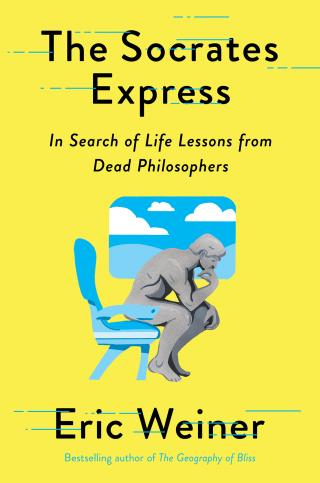
The Socrates Express
- Автор: Вейнер Эрик
- Год: 2020
- Язык: английский
- Год: Avid Reader Press / Simon & Schuster
- Жанр: География, путевые заметки

Электронная книга - «The Socrates Express». Краткое содержание книги:
We contemplate for the same reasons we travel: to see the world from a different perspective, to unearth hidden beauty and find new ways of being. We want to learn how to embrace wonder. Face regrets. Sustain hope.
Eric Weiner, *New York Times* bestselling author of *The Geography of Bliss* , combines his twin passions for philosophy and global travel in a pilgrimage that uncovers surprising life lessons from philosophers around the world, from Marcus Aurelius to Arthur Schopenhauer, Confucius to Montaigne. Traveling by train (the most thoughtful mode of transport) he traversed thousands of miles, making stops in Athens, Delhi,...
At the young age of thirteen, Gandhi was married. He was not a good husband. He’d lash out in jealous rages against his wife, Kasturba. Once, he threatened to expel her from the house unless she did certain household chores. “Have you no shame?” she sobbed. “Where am I to go?”
The father of the nation was a lousy father to his children. In the political arena, too, he made mistakes. “My Himalayan blunder,” he called one such bungled campaign. As for his experiments, some went too far. At age seventy-five, he decided to test his vow of celibacy by sleeping naked with young women, including his grandniece Manu.
Yet here was a man who owned his shortcomings. Here was a man not afraid to change his mind. Here was a man who attracted “cranks, faddists, and madmen” and embraced them all. Here was a man who overcame terrible shyness and self-doubt to lead a nation. Here was a man willing to die, but not kill, for a cause. Here was a man who stared down an empire, and won. Here was a man—not a god or a saint but a flesh-and-blood man—who showed the world what a good fight looks like.
Gandhi was spiritually omnivorous. He sampled many religious delicacies, from Christianity to Islam, but it was the Hindu Bhagavad Gita that reliably satisfied his hunger.
Gandhi first encountered the spiritual poem while studying law in London. Two English Theosophists asked Gandhi about the scripture. Embarrassed, he admitted he hadn’t read it. So, together, the three of them read Edwin Arnold’s English translation. Gandhi traveled west to find the East.
Gandhi grew to love his “Mother Gita,” as he called the spiritual poem. It was his inspiration, and his consolation. “When doubts haunt me, when disappointments stare me in the face, and I see not one ray of hope on the horizon, I turn to the Bhagavad Gita, and find a verse to comfort me; and I immediately begin to smile in the midst of overwhelming sorrow.”
The storyline of the Gita is simple. Prince Arjuna, a great warrior, is poised for battle. But he’s lost his nerve. Not only is he weary of bloodshed but he’s discovered the opposing army includes soldiers from his own clan, as well as beloved friends and revered teachers. How can he fight them? Lord Krishna, disguised as Arjuna’s charioteer, counsels him. The story unfolds as a dialogue between them.
The conventional interpretation of the Gita is that it’s an exhortation to duty, even violence, if necessary. After all (spoiler alert!), Krishna ultimately convinces Arjuna to wage war against his own kin.
Gandhi read it differently. The Gita, he said, is an allegory, one that depicts “what takes place in the heart of every human being today.” The true battlefield lies within. Arjuna’s struggle is not with the enemy but with himself. Does he succumb to his baser instincts or rise to a higher plane? The Gita, Gandhi concluded, is a disguised ode to nonviolence.
Another tenet of the Gita is nonattachment to results. As Lord Krishna, an incarnation of God, tells Arjuna: “You have the right to work, but never to the fruit of work. You should never engage in action for the sake of reward, nor should you long for inaction.” Sever work from outcome, the Gita teaches. Invest 100 percent effort into every endeavor and precisely zero percent into the results.
Gandhi summed up this outlook in a single word: “desirelessness.” It is not an invitation to indolence. The karma yogi is a person of action. She is doing a lot, except worrying about results.
This is not our way. We are results-oriented. Fitness trainers, business consultants, doctors, colleges, dry cleaners, recovery programs, dieticians, financial advisors. They, and many others, promise results. We might question their ability to deliver results, but rarely do we question the underlying assumption that being results-oriented is good.
Gandhi was not results-oriented. He was process-oriented. He aimed not for Indian independence but for an India worthy of independence. Once this occurred, her freedom would arrive naturally, like a ripe mango falling from a tree. Gandhi didn’t fight to win. He fought to fight the best fight he was capable of fighting. The irony is that this process-oriented approach produces better results than a results-oriented one.
My heroic efforts to secure a seat on the Yoga Express continue to prove futile. I am still number one on the wait list. Still drowning. I refresh the app on my phone. Nothing. I push it again and again, like one of those rats pulling a lever, hoping for a morsel. Nothing.
What would Gandhi do? He would fight. He did fight. Appalled by conditions in third class, he made a “perfect nuisance” of himself. He complained to Indian Railways about the “evil-looking” restrooms and the “dirty looking” refreshments and the so-called tea, “tannin-water with filthy sugar and a whitish looking liquid miscalled milk which gave this water a muddy appearance.” He wrote to managers and directors and managing directors. He wrote to newspapers.
So I persist, as Gandhi surely would. I hop in a taxi and crawl across town. Delhi traffic is heavy today, a statement as self-evident as “the air is polluted today” or “the subway is crowded today.” A certain unhappy consistency undergirds the apparent randomness of India.
I arrive at the station to the usual controlled anarchy, as reliable as the heavy traffic and the dirty air. Passing through a perfunctory security checkpoint, I set off the metal detector. The guard waves me through. He waves with his eyes, lest he overexert himself.
I swim upstream against a river of humanity, then climb a flight of stairs. A sign outside an office reads: “International Tourist Bureau. Rail Reservation for Foreign Tourists.” I take a seat, joining the bedraggled backpackers.
When I’m called to the counter, I flash my wait-list form as if it were a good report card or winning lottery ticket.
“I’m number one,” I say.
“I can see that,” says the man behind the counter, unimpressed.
Mr. Roy is a compact, no-nonsense man. He tells me it’s festival season, failing to add that, in India, home to a handful of major religions and countless minor ones, it is always festival season.
There is, he informs me, one second-class ticket available on another train, the Rajdhani Express. “A very good train,” Mr. Roy assures me.
I’m sure it is. It is not, however, the Yoga Express, and it is the Yoga Express I have my heart set on.
“What do you want to do, Mr. Eric?” asks Mr. Roy, gesturing toward the waiting backpackers, as if to say, “You’re not the only person in this land of a billion souls.”
I am stuck.
“Well?” says Mr. Roy, irritation seeping into his voice. “Do you want the ticket?”
“Please give me a second. I’m thinking.”
“Thinking is very good, Mr. Eric, but please be thinking quickly.”
When Gandhi said, “I represent no new truths,” he wasn’t merely being humble. He didn’t invent the concept of ahimsa, or nonviolence. It is thousands of years old. In the sixth century BC, Mahavira, a spiritual leader of the Jain religion, implored his followers not to “injure, abuse, oppress, enslave, insult, torment, torture, or kill any creature or living being.”
Gandhi knew about the Jains. They were regular visitors at his childhood home. One of his spiritual mentors was Jain. Gandhi also read Tolstoy on love and Thoreau on civil disobedience. Nonviolence wasn’t new, but Gandhi’s application of it was. What had been reduced to a dietary rule in India, vegetarianism, “emerged from Gandhi’s hands as a weapon—a universal weapon—to fight oppression,” explains his grandson Rajmohan Gandhi.
At first Gandhi called his new technique “passive resistance” but soon he realized he needed another name. There was nothing passive about it, or about him. Gandhi was always doing something: walking, praying, planning, holding meetings, answering correspondence, spinning khadi cloth. Even Gandhi’s thinking had a kinetic quality, reflected in his alert eyes and expressive face—a “twinkling mirror,” said those who met him. When a journalist pressed Gandhi for a précis of his philosophy, he struggled to answer before saying: “I am not built for academic writings. Action is my domain.”