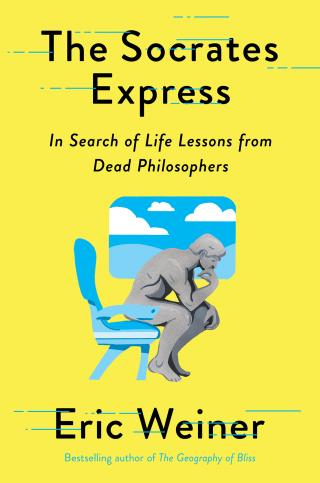
The Socrates Express
- Автор: Вейнер Эрик
- Год: 2020
- Язык: английский
- Год: Avid Reader Press / Simon & Schuster
- Жанр: География, путевые заметки

Электронная книга - «The Socrates Express». Краткое содержание книги:
We contemplate for the same reasons we travel: to see the world from a different perspective, to unearth hidden beauty and find new ways of being. We want to learn how to embrace wonder. Face regrets. Sustain hope.
Eric Weiner, *New York Times* bestselling author of *The Geography of Bliss* , combines his twin passions for philosophy and global travel in a pilgrimage that uncovers surprising life lessons from philosophers around the world, from Marcus Aurelius to Arthur Schopenhauer, Confucius to Montaigne. Traveling by train (the most thoughtful mode of transport) he traversed thousands of miles, making stops in Athens, Delhi,...
I always imagined my relationship with Kailash would follow a linear, screenplay trajectory. Orphaned Indian boy has fateful meeting with bighearted American; boy struggles to overcome disadvantaged youth; boy perseveres and is eternally grateful for bighearted American’s help. But more than a decade after I left India, Kailash and I were stuck in the second act.
Thanks to my quarterly wire transfers, Kailash lived in a tiny apartment in Delhi that was too cold in the winter and too hot in the summer. His main companion was a Pomeranian named Envy. When he told me he had turned down a job serving tea, an opportunity he would have jumped at before meeting me, I was angry but not surprised. I had raised his expectations, dangerous in a country of more than a billion restive souls.
My Indian friends watched from the sidelines, skeptical of my efforts. “You’re thinking like an American,” they said, as if it were a mental illness. “Kailash is from a lower class, a lower caste. He can only go so far. Face the facts.”
They’re right, I told myself, trying to come to terms with the possibility that this Indian orphan and I would be tethered for life. Yet I couldn’t shake the naïve idea that one day Kailash would float free into a life of his own making.
And he has. The trajectory proved more jagged than the Hollywood version, but the ending just as happy. Kailash now lives in a ramshackle neighborhood with middle-class aspirations. He is a husband, and a father. A landlord, too. He owns a two-story building. He and his family live on the top floor. On the ground floor he’s opened a small stationery store called Emma’s, named after his daughter. He sells notebooks and pens and Gandhi wallets. Kailash and I are no longer tethered financially. Our bond is made of sturdier stuff.
On this, an unseasonably warm December day, we walk under a white marble colonnade that leads to the spot where Gandhi died.
Kailash knows of my Gandhi obsession. He finds it touching and, I suspect, a bit odd. Most Indians know Gandhi the way most Americans know George Washington: a hazy father figure whose name is uttered with reverence and whose image graces the money in their wallet.
As we pause for a moment, cooling off and absorbing the quiet beauty of Birla House, Kailash turns and asks, “Why do you like Gandhiji so much?”
I’m not sure how to answer. I concede my interest in Gandhi makes little sense. I am not Indian. I am not an ascetic. I do practice nonviolence, but inconsistently, and with passive-aggressive undertones. Gandhi was a leader of his people. I lead no one, not even my dog, Parker, who answers to a higher power: food. Gandhi’s worldly possessions, at the time of his death, could fit in a small shoulder bag. Mine require considerably more space, and I’m still shopping. Yet Gandhi spoke to me, and I listened.
During my three years living in India, Gandhi seeped into my brain. How could he not? His image, if not his ideas, was everywhere: on the money, in office buildings. Even the phone company’s offices featured a photo of Gandhi using a telephone, the enormous receiver dwarfing his small head.
Mohandas K. Gandhi was many things: barrister, vegetarian, sadhu, experimenter, writer, father of a nation, friend of all, enemy of none, manual laborer, failed dancer, stretcher-bearer, meditator, mediator, gadfly, teacher, student, ex-convict, humorist, walker, tailor, timekeeper, rabble-rouser. Most of all, he was a fighter. Gandhi fought the British and he fought bigotry, among foreigners and among his own people. He fought to be heard. His biggest fight, though, was the fight to change the way we fight.
Eventually, yes, Gandhi imagined a world without violence, but he was realistic enough to know that was unlikely to happen soon. In the meantime, we must learn how to fight better.
Think of the married couple that boasts how they “never fight.” When you hear of their divorce, you’re not surprised. Fighting, done properly, is productive. Both sides can arrive not only at a win-win solution but something more: a solution that neither would have found had they not fought in the first place. Imagine a soccer match that ends in a tie but with the field greener and healthier than before the game. Gandhi saw fighting not as a necessary evil but as a necessary good. Provided we fight well.
When the American journalist and biographer Louis Fischer met Gandhi at his ashram, he was surprised to find a fit, barrel-chested man, with “long, thin muscular legs” and who appeared much taller than his five feet, five inches. He “looked very male and had a man’s steel strength of body and will,” wrote Fisher.
Gandhi was obsessed with masculinity. Words like “manliness” and “strength” and “courage” appear frequently in his writing. Even his complaints about Indian Railways were couched in terms of emasculation. “That we tamely put up with the hardships of railway traveling is a sign of our unmanliness.”
The British, Gandhi believed, had emasculated India. He was determined to “remasculate” it, though he had a different kind of masculinity in mind: one deriving its strength not from violence but its opposite.
Gandhi considered it “unmanly” to obey unjust laws. Those laws must be resisted and with great force. Nonviolent force. This, he said, demands genuine courage. “What do you think? Wherein is courage required—in blowing others to pieces from behind a cannon, or with a smiling face to approach a cannon and be blown to pieces? Believe me, that a man devoid of courage and manhood can never be a passive resister.”
Gandhi abhorred violence, but there was something he hated even more: cowardice. Given a choice between the two, he preferred violence. “A coward is less than a man.” Thus Gandhi’s true objective: reclaiming his nation’s lost virility, and on its own terms. Do that, he believed, and freedom would follow.
I am no fighter. I avoid physical confrontations. My one fistfight took place at age seventeen at 2:00 a.m. at a Howard Johnson’s parking lot in suburban Baltimore and ended with a broken nose. Mine. I shy away from more quotidian confrontations, too: calling an airline to change a flight, or a restaurant to inform them I’m running a few minutes late for my 8:00 p.m. reservation and could they please if it’s not too much trouble hold the table for me?
I realize most people, most normal people, don’t consider these sorts of everyday interactions confrontational. I do, and avoid them whenever possible. Ditto the confrontations (anticipated confrontations) I avoid with editors, family, neighbors, and fellow subway passengers. I’m not sure where and why I acquired this avoidance strategy, but it has not served me well. By avoiding small confrontations today, I set myself up for much larger ones tomorrow. I hoped a world-class confronter like Gandhi could show me another way.
Shortly after I moved to India, I began to read Gandhi, and about Gandhi. A handful of books soon grew into a bookcase’s worth. I visited Gandhi museums and Gandhi ashrams. I took college courses on Gandhi. I bought a Gandhi wallet and a Gandhi T-shirt and Gandhi underwear, the least violent pair of boxer briefs I’ve ever owned. One day, while in Delhi, I had lunch with Gandhi’s grandson Rajmohan, an erudite and kind man, now elderly himself. As we nibbled on naan and chutney, I detected traces of the Mahatma: the way Rajmohan’s jawline angled a certain way, the way his eyes flashed, slightly askance and mischievous.
We don’t admire the gods. We might revere them or fear them, but we don’t admire them. We admire mortals, better versions of ourselves. Gandhi was no god. No saint, either. At age twelve, he stole money from his parents and brother to buy cigarettes. He’d sneak off to eat meat (forbidden among his caste), chewing on goat flesh along the river with a friend who, like Gandhi, was convinced it was the Englishman’s carnivorous diet that made him strong.