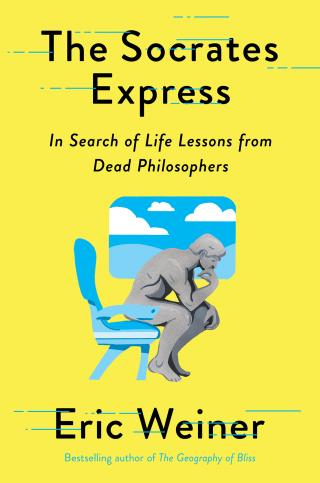
The Socrates Express
- Автор: Вейнер Эрик
- Год: 2020
- Язык: английский
- Год: Avid Reader Press / Simon & Schuster
- Жанр: География, путевые заметки

Электронная книга - «The Socrates Express». Краткое содержание книги:
We contemplate for the same reasons we travel: to see the world from a different perspective, to unearth hidden beauty and find new ways of being. We want to learn how to embrace wonder. Face regrets. Sustain hope.
Eric Weiner, *New York Times* bestselling author of *The Geography of Bliss* , combines his twin passions for philosophy and global travel in a pilgrimage that uncovers surprising life lessons from philosophers around the world, from Marcus Aurelius to Arthur Schopenhauer, Confucius to Montaigne. Traveling by train (the most thoughtful mode of transport) he traversed thousands of miles, making stops in Athens, Delhi,...
A trim man carrying more flowers arrives. Her father, I presume. They all sit on the ground in front of a grave marker and enjoy an impromptu picnic.
There’s a story here, and I know it is not a happy one. How unhappy I don’t learn until later when, after they’d left, I approach the grave site. Only then do I notice how small it is and how the tombstone is fashioned in the shape of a teddy bear. Many physical objects trigger strong emotions, but nothing, absolutely nothing, tears a heart asunder more quickly and thoroughly than a tombstone shaped like a teddy bear.
I find Simone Weil without looking for her. Strolling through the cemetery grounds, I look up and there she is.
The plot is well maintained, though I notice a few flowers are dying and the wind has toppled a small plastic flowerpot. Hers is a simple tombstone, indistinguishable from the others except the dates are in French. 3 Février 1909, 24 Août 1943.
Resting on the ground is a framed photograph of Weil. It’s the same one I had seen before. The same unruly hair and chunky glasses and knowing eyes. And something else, something I had missed before: a slight arcing of the lips into the suggestion of a smile. What explains this proto-smile? I wonder. Perhaps the photographer had cracked a joke, or perhaps Weil had just received word of her acceptance to the prestigious École Normale.
There’s another possible explanation. Perhaps the photographer had captured Simone Weil in a moment of extreme attention, of flow, and her reaction, the natural and indeed only reaction to such a state, was to forget for a moment the torturous headaches and the genius brother and the coming war, and smile.
We lose objects suddenly but experience the loss gradually. It takes time to accept that your car keys or wallet or heart is not merely misplaced but has crossed that invisible yet no less precipitous line that separates objects we possess from objects we once possessed. Nonexistence terrifies us. It takes time to register.
“Loss” is a short but menacing word. The Napoleon of nouns. Unless preceded by “weight,” it is almost always negative. That’s why we don’t just experience a loss. We suffer a loss. Someone struggling, in work or love, is said to be “lost.” When retracing the arc of a nation, or a life, historians demarcate a specific point in time beyond which “all was lost.”
Losses come in different sizes, though not in small. They start at medium and ascend from there. They come in different flavors, too. Some losses are painful, some devastating, some merely inconvenient. A few are ironic. Losing a notebook while writing a chapter about paying attention, for instance.
I loved that notebook. I still recall when I first laid eyes on it. It was at a chic little stationery store in Baltimore on a warm spring day. I was drawn to its clean aesthetics and muted colors, its robust cover, so solid and reassuring, the soft-to-the-touch pages complemented with not one but three—three!—of those little ribbons that mark your place.
My reaction to losing the notebook is disproportionate. I know this intellectually, but to know something intellectually only is not to know it at all. I take a deep breath and examine my reaction. Where is it coming from? I’ve lost things before and have not reacted this way. In college, I once lost an entire week and hardly missed a beat. Why has this one missing notebook tipped me into a tailspin?
Because it was not just a notebook. Thoughts committed to paper represent a record of our mind at its most attentive. These rapt moments are fragile things, sand dogs on High Street, and, once lost, nearly impossible to recover. It’s easier to retrieve a lost diamond than a lost thought. Which is why I must—must!—find my notebook and restore the past.
A surefire way to increase your fondness for something, anything, is to lose it. As my search turns up dry, the missing notebook grows not only in aesthetic excellence but editorial brilliance as well. By day two of my search, I’m convinced the thoughts contained within its covers, recorded during my trip to England, are unequaled in astuteness and originality. By day four, I declare the notebook the Most Precious Notebook in the World. Ever. More precious than Da Vinci’s Codex Leicester or Hemingway’s cahiers.
I look in the obvious places (cabinets, bookshelves) and the less obvious ones, too (refrigerator, litter box). Nothing. I double and triple my efforts. I retrace my steps. I look in the same desk drawer, three, four, five times.
My behavior alarms the dog and freaks out the cat, who has, wisely, gone to ground. My daughter declares the entire episode “literally the most annoying thing in the world.”
It is not only the notebook’s absence that smarts but the act of losing it, and what that lapse of attention says about me. Nothing good, I’ve decided. (There’s a word for people who chronically lose things: losers. The most damning of labels.) The memoirist Mary Karr lost a notebook recently but had the good editorial sense to do so on a boat captained by a sultry Greek named Dionisos and his “freewheeling, tequila-soaked heart.” I lost mine in the kitchen while putting away boxes of Ellio’s frozen pizza and Honey Nut Cheerios. No tequila. No Dionisos. Only regret and self-loathing.
At a loss (that word again), I turn to Simone. Desperate times, I tell myself, opening one of her books. She looks at my predicament and offers a simple diagnosis: I don’t really want to find my notebook. I want to possess it. I am consumed with desire, and desire is incompatible with attention. To desire something is to want something from it, and that clouds our vision.
We think the problem rests with the object of our desire when in reality it is the subject—the “I”—that is the problem. It might appear that by craving something you are paying attention to it, but this is an illusion. You are engrossed in your desire for the object, not the object itself. A heroin addict doesn’t crave heroin. He craves the experience of having heroin, and the concomitant relief of not not having heroin. Freedom from mental disturbance, ataraxia, is what he wants.
I return to Simone. “What could be more stupid than to tighten up our muscles and set our jaws about virtue, or poetry, or the solution of a problem? Attention is something quite different.”
I loosen my muscles and turn the page.
“The cause is always that we have wanted to be too active; we have wanted to carry out a search.”
This confounds me. Annoys me, too. Of course I want to carry out a search, Simone! How else am I going to find my notebook but by searching for it?
I take a deep breath and read on. It’s important, Weil continues, “to draw back before the object we are pursuing. Only an indirect method is effective. We do nothing if we have not first drawn back.”
I draw back, retreating to the basement and the large-screen TV that beckons like a truckload of opium. Not good. I’ve drawn back too far. I have succumbed to resignation. Despair in disguise.
My problem, says Weil, is that I have yoked action to results. Life doesn’t work that way, nor does attention. An attentive life is a risky one. Results are not guaranteed. We don’t know where our attention will lead, if anywhere. Pure attention, the kind Weil advocated, is untainted by external motives such as impressing your friends or advancing your career. The person who applies his full attention to something—anything—makes progress “even if his effort produces no visible fruit,” says Weil.
She’s right, I know, but we live in a world that celebrates visible fruit. The more visible and the fruitier the better. Is it possible to live like Simone Weil, invested in the moment yet indifferent about future rewards? Can I raise my daughter, lovingly and attentively, and not care whether she pursues a career as a neurosurgeon or as a barista? Can I enter a writing contest and not care if I win? Can I let my notebook go?