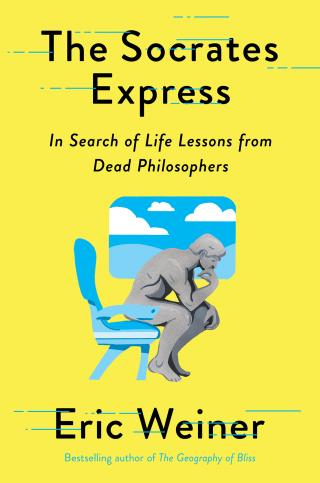
The Socrates Express
- Автор: Вейнер Эрик
- Год: 2020
- Язык: английский
- Год: Avid Reader Press / Simon & Schuster
- Жанр: География, путевые заметки

Электронная книга - «The Socrates Express». Краткое содержание книги:
We contemplate for the same reasons we travel: to see the world from a different perspective, to unearth hidden beauty and find new ways of being. We want to learn how to embrace wonder. Face regrets. Sustain hope.
Eric Weiner, *New York Times* bestselling author of *The Geography of Bliss* , combines his twin passions for philosophy and global travel in a pilgrimage that uncovers surprising life lessons from philosophers around the world, from Marcus Aurelius to Arthur Schopenhauer, Confucius to Montaigne. Traveling by train (the most thoughtful mode of transport) he traversed thousands of miles, making stops in Athens, Delhi,...
I see Chip now, but for a long time I didn’t. Not until my daughter, ten years old at the time, pointed him out. Now whenever we pass that intersection, she chirps, “There’s Chip!” and insists I give him a dollar or two.
True attention entails not merely noticing the Other but acknowledging him, honoring him. Nowhere is this more essential than in medicine. An overworked ER doctor can notice when a patient is in pain, treat the pain and its underlying cause, yet never give the patient his or her attention. The patient, consciously or not, feels cheated.
My mother is not happy with her cardiologist. Technically, he is proficient. He went to all the right schools. Yet he lacks the capacity for attention. “I get the feeling I could drop dead in front of him and he wouldn’t care,” she told me one day. She is looking for a new cardiologist. A more attentive one.
I am at London’s St. Pancras Station. It is glorious. All glass and light and promise. The station, like many, was built with two distinct purposes in mind: functional and aesthetic. “Mi-usine, mi-palais.” Half factory, half palace. After the success of London’s Crystal Palace Exhibition in 1851, cities began building the main hall of railway stations out of glass and steel, while constructing the fronts of cut stone.
The result was a Janusian edifice, an architectural paradox bound to make you think. No wonder Wittgenstein said the only place where one can tackle philosophical problems is the railway station. The train station is philosophy made manifest in stone and steel. The station’s dual allegiances, to art and commerce, remind us that it’s sometimes necessary to hold two paradoxical thoughts simultaneously. The station is a factory; the station is a palace. Both statements are true. Neither negates the other.
My favorite station is Antwerp Central. If train stations are cathedrals, Antwerp is St. Peter’s. With its soaring ceilings and polished marble, the station elicits the same sublimity I’ve experienced in other great buildings, that sensation of being diminished and enlarged at the same time. A train station is where I am at my most attentive.
I love all train stations, even the ugly ones. They don’t get much uglier than New York’s Penn Station, a rat-infested cavern of dingy, low-ceilinged halls. But as a student of human quirks I can’t help but marvel at the strange boarding custom. Station officials don’t announce a departing train’s platform number until just a few minutes ahead of time. Until then, passengers, clutching boarding passes and lattes, wait anxiously. Some try to guess the gate and, like a roulette player betting it all on 32 Red, stake their claim. Others, in a display of learned helplessness, stare at the floor, forlorn.
Rail stations, even bad ones, pulse with life in a way that airports, even good ones, do not. They are training grounds for attention. This has been true from the beginning. One painting, from 1862, captures the vivacity of the rail station. Called simply The Railway Station, by William Frith, it depicts a frenzied scene, or scenes, unfolding on the platform. Porters, young ruddy-skinned men, haul huge suitcases onto trains. A passenger adjusts the collar on one of his two dogs. A wedding party, complete with bridesmaids, prepares to board. Two Scotland Yard detectives arrest a criminal. A bearded man in a fur coat, a Venetian nobleman, haggles over his cab fare.
Viewing the painting, my attention fragments. Splinters. That is the nature of attention, right? It is like a feral cat, a wild savanna lioness that must be “captured,” not by us but by outside agents, like Scotland Yard detectives cuffing a fugitive. Maybe, maybe not.
Today’s St. Pancras Station features no Venetian noblemen or Victorian bridesmaids. Yet currents of energy still pulse through its departures hall and through the ticket counters and cafés. There is nothing stationary about a train station. Everyone is in motion.
Everyone but me. I have planted myself at a little coffee shop. I order an overpriced espresso and find a seat that overlooks the action.
I reach into my bag, a waxed canvas and leather beauty, and retrieve a collection of Weil’s writing. I turn to her essay “Reflections on the Right Use of School Studies with a View to the Love of God.” It’s a curious title. Weil was profoundly, if unconventionally, spiritual, and she frames many of her ideas in religious terms. Her work resonated with Pope Paul VI. But you needn’t be a pope or religious at all to appreciate Weil’s wisdom. No less an unbeliever than Albert Camus called her “the only great spirit of our time.” He spent an hour meditating in her Paris apartment before boarding the plane for Stockholm to accept the Nobel Prize for literature.
The essay is short, only eight pages, but it takes me a long time to read it. I start and stop, then start again. Each reading produces a different shade of meaning, like a crystal that appears as different colors, depending on how the light strikes it. The essay is arresting, demanding. Weil begins by telling me I know nothing. Attention is not what I think it is.
Attention is not concentration. Concentration can be coerced—listen up, class!—while attention cannot. Observe what happens to your body when you concentrate. Your jaw tightens, your eyes narrow, your brow furrows. Weil found this sort of muscular effort ridiculous.
Concentration constricts. Attention expands. Concentration tires. Attention rejuvenates. Concentration is focused thinking. Attention is thinking suspended. “Above all our thought should be empty, waiting, not seeking anything but ready to receive in its naked truth the object that is to penetrate it,” Weil writes. If that statement isn’t perplexing enough, Weil goes further, declaring that “all errors arise from a lack of passivity.”
Really? Isn’t it an excess of passivity that bedevils? That is certainly what our culture teaches. We assume the active person is paying attention and the passive one is somehow clueless.
No, says Simone Weil. Attention is not something we do so much as consent to. Less weight lifting, more yoga. “Negative effort,” she called it. Genuine attention, she believed, is a kind of waiting. For Weil, the two are virtually the same. “We do not obtain the most precious gifts by going in search of them but by waiting for them.” The opposite of attention is not distraction but impatience.
Don’t seek solutions. Wait for them. The more you scan your brain for the “right” word, the more it eludes you. Wait for it, though, and it will come. Eventually.
Speed is the enemy of attention. Of all the indecencies she witnessed on the factory floor, the greatest, Weil thought, was the violation of the workers’ attention. The conveyor belt moved at a velocity “incompatible with any other kind of attention since it drains the soul of all save a preoccupation with speed.”
We pay attention only to what we consider worthy of our attention. On one level, this mental triage is necessary, lest our lives become, in the words of William James, “a bloomin’ buzzin’ confusion.” But it comes at a cost. By triaging too quickly, too impulsively, we risk overlooking precious gems.
Just as we often rush to judgment, so, too, do we rush to attention. We latch on to an object or idea too quickly, and pay a price: a flash of beauty, or an act of kindness, not seen. That’s why, says Weil, it’s important to maintain a state of unknowing, of unthinking, for as long as possible. This requires patience, something scarce during Weil’s time and even more so today.
Weil paid great attention to matters most of us consider trivial. Handwriting, for instance. In high school, relays her friend and biographer Simone Pétrement, Weil decided to reform her “sloppy, almost careless, scrawled handwriting.” She worked at it tirelessly, attentively, despite headaches and frequently swollen and painful hands. Her scrawl grew “progressively less rigid and more supple and, finally, attained the pure, beautiful script of her last years.”