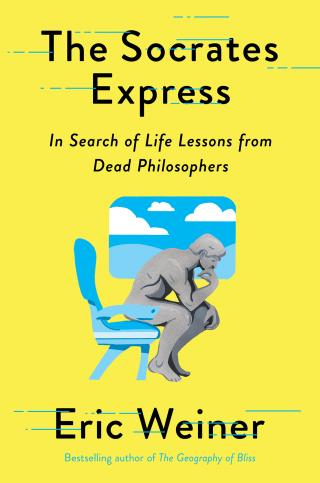
The Socrates Express
- Автор: Вейнер Эрик
- Год: 2020
- Язык: английский
- Год: Avid Reader Press / Simon & Schuster
- Жанр: География, путевые заметки

Электронная книга - «The Socrates Express». Краткое содержание книги:
We contemplate for the same reasons we travel: to see the world from a different perspective, to unearth hidden beauty and find new ways of being. We want to learn how to embrace wonder. Face regrets. Sustain hope.
Eric Weiner, *New York Times* bestselling author of *The Geography of Bliss* , combines his twin passions for philosophy and global travel in a pilgrimage that uncovers surprising life lessons from philosophers around the world, from Marcus Aurelius to Arthur Schopenhauer, Confucius to Montaigne. Traveling by train (the most thoughtful mode of transport) he traversed thousands of miles, making stops in Athens, Delhi,...
Patience is a virtue. It is also good for you, as the latest research shows. Patient people are happier and healthier than impatient ones, studies find. Patient people are more likely to act rationally. They have better coping skills.
Patience, though, doesn’t strike us as a lot of fun. The English “patience” comes from the Latin patiens, for suffering, endurance, forbearance. The Hebrew savlanut is a bit cheerier. It means both patience and tolerance. Tolerance for what? For suffering, yes, but also tolerance for the rejected parts of our selves. People impatient with others are rarely patient with themselves.
I am not a naturally patient person. Mine is a mercenary mind. It always wants something, ideally something big: the Big Idea, the Big Break, the Big Breakfast. Like a stealthy alcoholic whom no one suspects, I am able to conceal my impatience from others. Usually. Sometimes people see through me. Like the Dutch messiah I met in Jerusalem.
I was working on a story for NPR about “Jerusalem Syndrome.” That’s a malady that afflicts some visitors to the Holy Land. They arrive sane enough but soon are convinced they are Elijah or Lazarus or some other biblical figure. It’s more common than you’d think.
I had heard of a hostel in Jerusalem’s Old City that for some reason attracted people suffering from Jerusalem Syndrome, so that’s where I headed and, sure enough, where I met the Dutch messiah. A balding, middle-aged man, unremarkable in appearance, he explained, as if relaying that day’s weather forecast, that the messiah will be coming soon. “And he is a Dutch man, like me,” he said.
That was it. I had it. That was the tape cut I knew I was going to use. I kept listening and recording but my mind had checked out; it had bagged its prey. The Dutch messiah, sensing my inattention, suddenly stopped talking and stared at me. “You,” he said, slowly, accusingly, “are an impatient man.”
His words stopped me cold. He was right. I had seen him not as a fellow human being, or potential messiah, but as a tape cut. Ego food. A piece in a story that would, I hope, win me accolades. I had what I needed from him and, as far as I was concerned, our transaction was over. Not for him, though. I’m fairly certain he didn’t view it as a transaction at all. From his perspective, we were engaged in a conversation, a mutual exchange of attention, and I was being stingy.
All disputes stem not from a misunderstanding per se, but a “category error.” It’s not that the two sides see the same problem differently. They see two different problems. Where one person sees an inefficient loading technique that fails to maximize the cleansing power of the high-performance dishwasher, another person sees a swipe at his core competency and, by extension, his masculinity. This is how wars and hissy fits begin.
The Dutch messiah’s words stung because until then I had prided myself on my attentiveness. Eyes trained, ears cocked, I was on the lookout for the compelling character, the emotive tape cut, or the resonant bit of ambient sound that would add auditory texture to my story. I was concentrating but not paying attention. I knew what I was looking for before I found it. I was caught up in my own desire. That’s always dangerous.
Weil warned against the sort of mercenary impatience I displayed in Jerusalem, and of another kind, too. An intellectual impatience, born from insecurity, that grasps at ideas, even bad ones, the way a drowning man will grasp even a sword. All our mistakes, says Weil, “are due to the fact that thought has seized upon some idea too hastily, and being prematurely blocked, is not open to the truth.”
We see this dynamic at work in people eager to hook the Big Idea, one they hope will transform them from mere thinker to Thought Leader. More interested in packaging ideas than pondering them, they release their Big Idea into the world before it has ripened.
These aspiring Thought Leaders don’t want to do the hard work attention demands. Attention is hard not the way judo or archery is hard. It’s hard the way meditation, or parenting, is hard. It’s hard the way waiting for a train is hard. Attention is not a skill we acquire, like knitting or fencing. It is a state of mind, an orientation. We don’t so much learn attention as turn toward it. This pivot only happens when we pause, like Socrates, and get out of our own head. “Decreation,” Weil calls it.
I prefer Iris Murdoch’s term: “unselfing.” The British novelist and philosopher describes one such moment of unselfing. She was looking out her window, feeling anxious and resentful due to a perceived slight earlier in the day, when she spotted a hovering kestrel. “In a moment everything is altered,” she says. “The brooding self with its hurt vanity has disappeared. There is nothing now but kestrel. And when I return to thinking of the other matter it seems less important.”
All inattention is a form of selfishness. We’ve decided that whatever is happening in our heads is more interesting, more important, than what is happening in the rest of the universe. That’s why narcissists are so inattentive. Their attention is bottled up, stagnant. Attention is our lifeblood. It needs to circulate. To hoard attention is to kill it.
Sometimes endings reveal more than beginnings. I suspect this was the case with Simone Weil. The final months of her life were like a movie fast-forwarded. There was the prodigious, heroic output, the kindness shown and received, the collapse, and the inevitable, ambiguous end.
All of this played out in England, during the height of World War II. I grow obsessed with Weil’s London days, with the city she loved, the people she met, and with the giant question mark that hangs over her death.
Simone Weil’s life was measured not in coffee spoons but train tickets. In June 1940, she and her parents boarded the last train out of Paris, one step ahead of Hitler’s troops. For a while she taught philosophy to railroad workers. She spent her most productive years in London, where she’d read and think while riding the Tube.
That is where I am now, too, the Central Line, to be precise, the last leg of my journey that began at St. Pancras. In my pocket is the ingenious Tube map. A triumph of simplicity, it dates to 1931. That’s when Harry Beck, a technical draftsman working for the Underground’s signals office, paid attention. Beck knew the old map was flawed. It superimposed the subway lines over a city road map, which confused people, and showed the station distances to scale, which further confused people. No one cared how far apart the stations were or which streets lay above their heads. They wanted to know how to get from one station to another, and where to change lines. Yet they found themselves ensnared in the sort of cognitive trap that Sherlock Holmes warned about: “What was vital was overlaid and hidden by what was irrelevant.”
Beck, working in his spare time, created a new map, one modeled on an electrical schematic. Beck’s map made reality look a bit neater and simpler than it is, with stations equidistant, and lines meeting at neat 45- or 90-degree angles. The Beck map enthralled the public, and remains essentially unchanged today. Beck succeeded because he paid attention. He thought like a passenger and not just like an engineer.
At each stop, the subway car exhales some passengers, inhales others. In. Out. In. Out. “Please Mind the Gap,” chimes the recorded announcement in a chipper English accent. Riding the Tube is a wonderful way to practice paying attention. There’s an endless carousel of people to watch: wide-eyed tourists, narrow-eyed bankers, eyeless panhandlers. The air is ripe with linguistic fragments: a French gerund, an Italian participle, an American exclamation. Much competes for your attention, we’d say, but that’s not right. It is not a competition so much as a wild collaboration.