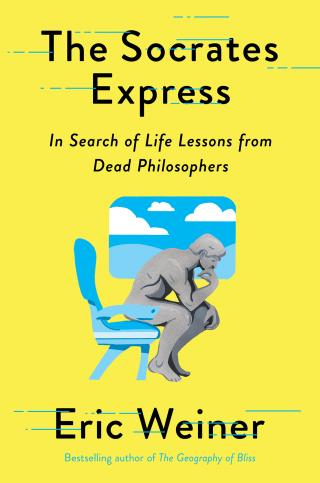
The Socrates Express
- Автор: Вейнер Эрик
- Год: 2020
- Язык: английский
- Год: Avid Reader Press / Simon & Schuster
- Жанр: География, путевые заметки

Электронная книга - «The Socrates Express». Краткое содержание книги:
We contemplate for the same reasons we travel: to see the world from a different perspective, to unearth hidden beauty and find new ways of being. We want to learn how to embrace wonder. Face regrets. Sustain hope.
Eric Weiner, *New York Times* bestselling author of *The Geography of Bliss* , combines his twin passions for philosophy and global travel in a pilgrimage that uncovers surprising life lessons from philosophers around the world, from Marcus Aurelius to Arthur Schopenhauer, Confucius to Montaigne. Traveling by train (the most thoughtful mode of transport) he traversed thousands of miles, making stops in Athens, Delhi,...
During these rare moments, we enter a state of mind—a state of being—that Weil calls “extreme attention” and psychologist Mihaly Csikszentmihalyi calls “flow.” When in a state of flow, you shed any semblance of self-consciousness, and experience an altered perception of time and a heightened sense of reality. Everything seems more real than real. Unlike so much in life, flow is “a condition so rewarding as to be sought out for its own sake,” says Csikszentmihalyi.
People immersed in flow are not self-absorbed, for there is no self to be absorbed. No musician, only music. No dancer, only dancing. Here is how an avid sailor describes being in flow. “One forgets oneself, one forgets everything, seeing only the play of the boat with the sea, the play of the sea around the boat, leaving aside everything not essential to that game.” You don’t need to sail the Atlantic or climb Everest to experience flow. You just need to pay attention.
Given the importance of attention, you’d think philosophers would be all over it. But they’ve paid scant attention to attention. Maybe they find the subject too obvious, or too opaque. Maybe they’re simply too distracted.
Over the centuries, a few philosophers have sat still long enough to weigh in. René Descartes, the father of modern philosophy, saw attention as a kind of intellectual divining rod, a tool that enabled us to distinguish between dubious ideas and “clear and distinct” ones that lie beyond doubt. The philosopher who famously said “I think, therefore I am” also said, in so many words, I pay attention; therefore I am able to transcend doubt. Not as catchy, I admit, but probably more accurate.
As the turn of the twentieth century approached, the subject of attention was, ironically, in a fractured state of chaos. Some thinkers even concluded (as some still do) that attention does not exist. As the British philosopher Francis Bradley wrote, “There is no primary act of attention, there is no specific act of attention, there is no one kind of act of attention at all.”
Nonsense, said William James, wading into the chaos. “Everyone knows what attention is. It is taking possession of the mind, in clear and vivid form, of one out of what seems several simultaneously possible objects or trains of thought.” James, predicting the hazards of multitasking, warned that attention demands not only focusing on some aspects of reality but ignoring others.
Our current conception of attention dates to 1958. That’s when a British psychologist named Donald Broadbent posited the “filter model” of attention (also known as the “bottleneck model”). The world floods our senses with data, like a fire hose. Our brain’s ability to process this data is limited, so it deploys attention as a means to prioritize all that information, to control the fire hose.
It’s a compelling theory, one that intuitively seems to make sense. Attention, we assume, is like a bank account we draw down, or a hard drive with limited capacity. We’ve all experienced that sensation of being overwhelmed by too much information. So much bombards us that nothing sticks. Several studies have found we routinely overestimate our ability to multitask.
Yet history is replete with those whose capacity for attention far exceeded the norm. Napoleon and Churchill, for instance, could juggle multiple tasks and conversations fluently. Our capacity for attention is not finite, concludes Alan Allport, an experimental psychologist at Oxford University. “No such upper bound has been identified, either generally or within specific processing domains.” As Rousseau reminds us, often what we consider natural, “the way things are,” is really the way things are here and now. A local truth masquerading as a universal one.
A sickly toddler, Simone Weil grew into a sickly young adult. At age thirteen, she began to suffer acute, debilitating headaches that would torment her throughout her life. At times the pain was so bad she’d wedge her head in a pile of pillows. Her birdlike appetite didn’t help. She would go days without eating, and may have suffered from anorexia.
The Weils were a family of germophobes. (A bacteriologist was a close family friend, which didn’t help.) Weil’s mother insisted her children wash their hands several times a day, open doors with their elbows, and never kiss anyone. Not surprisingly, Simone Weil grew into an adult who flinched at the thought of physical contact. She once signed a letter to a friend, “Affectionate and bacilli-free kisses.”
Brilliant as she was, Weil felt overshadowed by her wunderkind brother, André, who would go on to become one of Europe’s greatest mathematicians. Clearly, her parents had wished for a second genius son. They sometimes referred to Simone as “Simon” and “our son number two.”
From a young age, Weil experienced the pain of others as if it were her own. At age six, as World War I raged, she announced she was forsaking sugar because “the poor soldiers at the front didn’t have any.” Later, as a young adult, she refused to heat her apartment, out of sympathy for the workers who couldn’t afford heating fuel. She insisted on sleeping on hard floors. For a while, she worked in a vineyard harvesting grapes and in a factory, doing the most tedious assembly line work. “The affliction of others entered into my flesh and my soul,” she wrote.
Weil broke into tears upon hearing news of a famine in China. This deeply impressed fellow philosopher Simone de Beauvoir. “I envied her for having a heart that could beat right across the world,” she recalled. The two Simones, giants of twentieth-century French philosophy, and women in what was, and to an extent still is, very much a boys’ club, met in 1928 in the courtyard of the Sorbonne. They did not get along.
Weil’s radical empathy helps explain her radical views on attention. She didn’t see it as a mechanism, or a technique. For her, attention was a moral virtue, no different from, say, courage or justice, and demanding the same selfless motivation. Don’t pay attention to be more productive, a better worker or parent. Pay attention because it is the morally correct course of action, the right thing to do.
There’s a name for attention at its most intense and generous: love. Attention is love. Love is attention. They are one and the same. “Those who are unhappy have no need for anything in this world but people capable of giving them their attention,” writes Weil. Only when we give someone our attention, fully and with no expectation of reward, are we engaged in this “rarest and purest form of generosity.” This is why the attention denied by a parent or lover stings the most. We recognize the withdrawal of attention for what it is: a withdrawal of love.
In the end, our attention is all we have to give. The rest—money, praise, advice—are poor substitutes. So, too, is time. Giving someone your time but not your attention is the cruelest fraud of all. Children know this instinctively. They can smell bogus attention a mile away.
Pure attention is not easy, Weil concedes: “The capacity to give one’s attention to a sufferer is a very rare and difficult thing; it is almost a miracle; it is a miracle.” Our first impulse when confronted with suffering is to turn away. We make excuses. We’re busy. I’ve been known to cross the street to avoid earnest solicitors raising money for a no-doubt worthy cause. When I spot one, clipboard in hand, smile lighting her face, I shrink, ashamed not by my cheapness but, rather, my attentional impotence, my inability to look suffering in the eye.
It doesn’t take much, says Weil. A simple five-word question can soften a heart, and change a life: “What are you going through?” These words are so powerful, says Weil, because they recognize the sufferer, “not only as a unit in a collection, or a specimen from the social category labeled ‘unfortunate,’ but as a man, exactly like us, who was one day stamped with a special mark by affliction.”
There’s a busy intersection near my home in Silver Spring, Maryland, where on most days, but especially on Sundays, an elderly African American man named Chip stands on the traffic island. He rests his thin frame on a walking stick, Styrofoam cup in one hand, cardboard sign in the other. It says simply, “Chip.” No story. No pitch. Just his name.