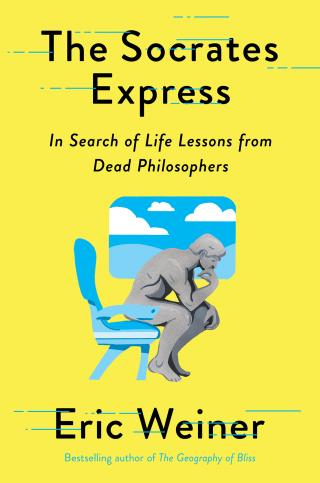
The Socrates Express
- Автор: Вейнер Эрик
- Год: 2020
- Язык: английский
- Год: Avid Reader Press / Simon & Schuster
- Жанр: География, путевые заметки

Электронная книга - «The Socrates Express». Краткое содержание книги:
We contemplate for the same reasons we travel: to see the world from a different perspective, to unearth hidden beauty and find new ways of being. We want to learn how to embrace wonder. Face regrets. Sustain hope.
Eric Weiner, *New York Times* bestselling author of *The Geography of Bliss* , combines his twin passions for philosophy and global travel in a pilgrimage that uncovers surprising life lessons from philosophers around the world, from Marcus Aurelius to Arthur Schopenhauer, Confucius to Montaigne. Traveling by train (the most thoughtful mode of transport) he traversed thousands of miles, making stops in Athens, Delhi,...
We step into a Delhi Metro station. It’s like entering another world. Everything is shiny and new and clean. “Delhi’s lifeline,” Kailash says proudly. We’re about to step onto a departing train but I hesitate. It’s awfully crowded. Should we wait for the next car?
“No,” says Kailash. “It will be just as crowded. Office hours.”
I point out that today is Sunday.
“India,” says Kailash, as if that explains all, which it does.
We squeeze on board, and I hear the chipper words I haven’t heard since London. “Please Mind the Gap.” In India, the gaps are wider and more treacherous. Extra mindfulness is required.
Mohandas K. Gandhi wasn’t ambivalent about much. Except trains. When two American women asked him if it’s true he opposed railways, he replied, “It is and it is not.”
On the one hand, Gandhi saw the railroad as just another way for Britain to keep India under her thumb. And, like other philosophers I’ve encountered, he was wary of excessive speed. “Is the world any the better for quick instruments of locomotion?” he asked. “How do these instruments advance man’s spiritual progress? Do they not in the last resort hamper it?” Yet it was his travels by rail, almost always in third class, that enabled him to crisscross India, touching lives and rallying masses.
One train journey changed Gandhi’s life, and the course of history. It was 1893. Gandhi had arrived in South Africa only a week earlier. His law firm dispatched him from Durban to Pretoria to handle an important case. They booked him a first-class ticket for the overnight journey. When the train reached Maritzburg station, a white passenger entered the compartment, took one look at Gandhi, and summoned the conductor, who insisted Gandhi move to third class.
“But I have a first-class ticket,” Gandhi said.
“That doesn’t matter,” replied the conductor. No “coloreds.” Gandhi refused to leave. A policeman removed him from the train.
It was a bitterly cold night. Gandhi’s overcoat was in his luggage, which he was too proud to request. So he shivered, and pondered. Should he retreat to India or remain in South Africa and fight injustices like the one he had just experienced?
By dawn, he had his answer: “It would be cowardice to run back to India without fulfilling my obligation. The hardship to which I was subjected was superficial—only a symptom of the deep disease of color prejudice. I should try, if possible, to root out the disease and suffer hardships in the process.” In that moment, he chose a path, one that, despite bumps and swerves and occasional collisions, he remained on for the rest of his days.
Decades later, when the American evangelist John Mott asked Gandhi to describe the most creative experiences of his life, he pointed to the train incident in South Africa. It’s telling he equated a moment of quiet resolve with creativity. Some biographers have noted Gandhi’s lack of interest in the arts. He rarely read a novel, or went to the theater or an art gallery. He did not possess Thoreau’s eye for beauty, or Schopenhauer’s ear for music. In London, he enrolled in a dance class but soon discovered he had no rhythm.
It would be a mistake to conclude Gandhi was not creative. He was, only not in the usual way. Gandhi’s paintbrush was his resolve, his canvas the human heart. “Real beauty,” he said, “is doing good against evil.” All violence represents a failure of imagination. Nonviolence demands creativity. Gandhi was always searching for new, innovative ways to fight.
We exit the subway station and are promptly lost. Kailash asks a rickshaw wallah for directions but walks away unsatisfied. We stroll a few more yards and find a policeman. He is wearing a mask, a serious one with vents. Mine doesn’t have vents. I calculate the damage being done to my lungs while Kailash asks the policeman for directions.
The policeman suggests a direction opposite to the rickshaw wallah’s. Kailash, still not satisfied, asks a third person for directions. “I never ask one person,” he explains. “I always ask two or three.” Life in India demands constant triangulation. Gandhi, great experimenter that he was, knew this better than most.
We enter the grounds of the old Birla House, as close to home as the peripatetic Gandhi had. The house—more of a compound—belonged to a friend, the wealthy industrialist G. D. Birla.
A familiar peace descends on me. I’ve been here before many times, though I have trouble finding it each time. I am drawn to it, as I am to Gandhi, for reasons I can’t articulate. I like the wide expanse of lawn, the white stone markers, shaped like feet, Gandhi’s feet, and the verandas where I can picture the Mahatma, a young seventy-eight years old, wearing his big straw hat and white dhoti, hunched over a letter he was writing or playing with one of his grandchildren or helping steer the shaky ship that was infant India.
Some places are sanctified by acts of superhuman achievement—the Bodhi tree under which the Buddha achieved enlightenment, for instance—while others are consecrated by terrible acts of violence. Gettysburg. Normandy. Birla House falls into the latter category. Here Gandhi took his last step, breathed his last breath.
On the last day of his life, Mahatma Gandhi woke at 3:30 a.m., as he always did. He brushed his teeth, using a simple twig, like most Indians. It was a cold January morning. His grandniece and assistant, Manu, wrapped him in a shawl, covering his bony shoulders. He drank a glass of lemon and honey followed by his daily serving of orange juice. His diet was simple, and salubrious. He wanted to live a long life—to the age of 125, he said—and he wanted to purify himself. The fight is only as effective as the fighter. “How can a damp matchstick kindle a log of wood?” he said.
Kailash often accompanies me to Birla House. He is, as I said, a friend, but that wasn’t always the case. For a while, Kailash was my servant.
I realize those words sound harsh to Western ears, but it’s true; “servant” is what others called Kailash, and what he called himself.
We met many years ago, in 1993. I had just arrived in India, as NPR’s Delhi correspondent. Everything about it was frenzied and raw. I needed a place to live, but the apartments I saw were either too pricey or too noisy or prone to attack by flying cockroaches the size of small birds.
Finally I found a flat with heavy wooden doors and a terrace that overlooked a pleasant street. The landlord, an imperious man with tufts of wiry black hair sprouting from his left ear, pointed out the apartment’s features, including Western-style toilets, air-conditioning, and, he added matter-of-factly, a “servant.”
A few days later, the servant loped upstairs and reported for duty. He was skinny, alarmingly so, with mahogany skin and sharp features. His name was Kailash, and he was eleven years old. I was prepared for cultural differences in India, but not this. I started downstairs to confront the landlord, but Kailash stopped me. Stay, he said or, rather, gestured; he didn’t speak a word of English. I rationalized if Kailash, an orphan, didn’t work for me, he’d work for someone else, and who knows how that person would treat him? Washing my hands of Kailash seemed like a cop-out.
And so every afternoon Kailash climbed the stairs and knocked on my door. He was, truth be told, not much of a cleaner: he didn’t remove the dirt; he just rearranged it. But he was naturally kind, honest, and, it turned out, a wizard with temperamental laptops and printers.
Kailash picked up English by eavesdropping on me and my wife. Before long he was parroting colloquialisms like “I’m history” and “Get outta here.” Over time, he told us his story: how his parents died years ago, how much he loved cricket, and how the landlord beat him if he didn’t cook the chapatis properly.
I’m not sure when we decided to help, but it didn’t cost much to hire a tutor, and soon Kailash was in school for the first time in years. Later, when we moved to another apartment, Kailash moved with us. He was, technically, still our employee, but at some point he began referring to us as his parents. This made me uneasy, yet there was no denying our new roles.