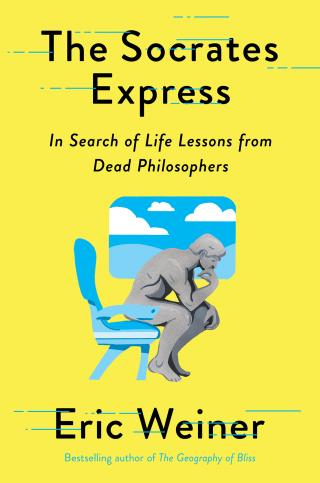
The Socrates Express
- Автор: Вейнер Эрик
- Год: 2020
- Язык: английский
- Год: Avid Reader Press / Simon & Schuster
- Жанр: География, путевые заметки

Электронная книга - «The Socrates Express». Краткое содержание книги:
We contemplate for the same reasons we travel: to see the world from a different perspective, to unearth hidden beauty and find new ways of being. We want to learn how to embrace wonder. Face regrets. Sustain hope.
Eric Weiner, *New York Times* bestselling author of *The Geography of Bliss* , combines his twin passions for philosophy and global travel in a pilgrimage that uncovers surprising life lessons from philosophers around the world, from Marcus Aurelius to Arthur Schopenhauer, Confucius to Montaigne. Traveling by train (the most thoughtful mode of transport) he traversed thousands of miles, making stops in Athens, Delhi,...
Tom likes living here, though he tires of the covert preening, the glut of beautiful people—and the utter lack of grit.
Grit is important, I agree. Never trust a place without grit.
Tom steers us to a little café. The menu is simple and inexpensive. Capital-E Epicurean. I order a sandwich called “Settin’ the Woods on Fire,” intrigued by the prospect of Oaxaca cheese and reminded of something I had read about Thoreau. He and a friend accidentally set a sizable parcel of Walden Woods on fire, much to their chagrin.
“Do you want anything to drink with that?” asks the woman who takes our order.
I look at my watch: 11:00 a.m.
“Is it too early for wine?” I ask.
Tom and she exchange a knowing glance. We’ve got a tourist on our hands. In Napa, it is never too early, or too late, for wine.
I order a pinot noir that Tom recommends. We settle into a table outside, the sun warm, the sky a flawless California blue. No grit in sight. A Tesla floats by.
As we wait for our food, I dive into my question—which, when I wasn’t looking, multiplied again into questions.
How did you find Epicurus, I ask Tom, or did Epicurus find you?
Tom explains that he’s always been an “idea person.” He dabbled in philosophy as an undergraduate, but it wasn’t until later, as a graduate student, that he dove deep. It was the 1960s. A good time to be an idea person.
Tom read Spinoza and Kant and others but was drawn to Epicurus and his focus on pleasure. “To me, pleasure is so all-encompassing—even more so than happiness,” he tells me, between sips of wine.
Tom never tires of correcting the record on Epicurus. The philosopher was no foodie, and would be appalled to find a culinary website named after him. He valued the simple life. The low-hanging fruit tastes the best.
I wonder aloud how Tom reconciles the idea of simple living with the reality of living in Napa, a place where the low-hanging fruit is likely a pampered grape bound for a two-hundred-dollar bottle of Merlot and a simple roof over your head can easily set you back a cool million.
It’s not easy, concedes Tom, but it’s possible. You need to do the math.
I wince at the mention of math. For me, math and geometry are right up there with the gods and death in the fear department. I would never have stepped foot in Plato’s Academy, with his strict entry requirement.
All pleasures are good, and all pain bad, explains Tom, but that doesn’t mean we should always choose pleasure over pain. Certain pleasures might lead to future pain and thus should be avoided. The pain of lung cancer outweighs the pleasure of smoking. Likewise, certain pains lead to future pleasure and thus should be endured. The pain of the gym, for instance.
As odd as it may sound, we can reason our way to pleasure, Epicurus taught. If we are unhappy, it is not because we are lazy or flawed. We have simply miscalculated. We have failed to deploy prudence, “sober reasoning,” when appraising pleasure and pain.
Tom is constantly doing the math, “checking his pleasure,” as he puts it. Does the benefit of a given pleasure outweigh the pain exacted?
A few days ago, explains Tom, he noticed that a play he hoped to see was coming to San Francisco. Should he go? On one side of the ledger was the pleasure of watching the performance, but he weighed that against the pain of the ticket price and the agony of California freeway traffic. In the end, Tom decided, that yes, in this case the pleasure outweighed the pain. He bought the tickets.
“Very few things are unadulterated pleasures,” he says. “That’s why this philosophy is perfect for me. I’m a very indecisive person.”
I, too, am flummoxed by choice. Oddly, it is not life’s big decisions—Which career should I pursue?—that stump me but the small ones: Should I order the Guatemalan or Sumatran coffee? At the root of my indecisiveness, I realize, is fear. The fear of making the wrong choice. Choosing the good instead of the best.
As Tom and I sip our Pinot Noir, I’m beginning to see the appeal of Epicureanism. Yet something continues to nag: ataraxia, the lack of mental disturbance that Epicurus considered the highest good. It seems like such a passive form of pleasure. What is wrong with actively satisfying desires? I ask Tom.
“Consider this french fry,” he says, waving one in the air as if it were a wand.
“Okay,” I say, not sure where he is going with this.
“If you have a desire for french fries, it starts with a pain. An absence of the item. A craving. A seeking. An itch.”
“So the pleasure is the scratching of the itch?”
“Right, but it is not something you ever reach because there will always be other pains, others itches that you have to scratch.”
This sounds awful, this endless cycle of itching and scratching. I’m getting itchy just thinking about it. We get a taste of caviar and it is pleasurable, which is good, but then we crave caviar again, and this is problematic. The caviar will never taste as good as the craving hurts. What began as a pleasure ends as pain. The only solution is to minimize those desires.
Inevitably, the conversation swerves to wine. I assume Tom, denizen of Napa, is something of a wine snob. I am wrong. Tom Merle, resident of Napa, amateur oenologist, stakeholder in a catering firm called “Splendor in a Glass,” drinks Two-Buck Chuck. The wine, by Charles Shaw, sells for two dollars a bottle, and sells well.
“Really, Tom? The cheap stuff?”
“It’s table wine, and it’s not bad. To spend thirty-five dollars on something that is consumed, swallowed, then gone, is nuts. There’s a reason Charles Shaw is successful. Two-Buck Chuck is decent wine. It’s what I call ‘good-enough wine.’ ”
“Good enough?”
“Yes. I would say good enough is good enough. It leaves you time for the more important parts of life. Besides, nothing is enough for the man to whom enough is too little,” says Tom, channeling Epicurus.
I stop mid-sip. How much is enough? I’ve rarely stopped to ask that question. I’ve always assumed the answer is “more than I have now.” It turns out that “more” is a moving target. Psychologists call it the “hedonic treadmill.” This quirk of human nature explains why that third crème brûlée never tastes as good as the first or second. It explains why the new car that thrilled us on the test drive bores us after a month on the road. We acclimate to new pleasures, rendering them neither new nor quite as pleasurable.
We’re particularly susceptible to what I call Just-a-Bit-More-ism. We don’t need a lot more—money, success, friends—in order to be happy. Just a bit more. When we get that bit more, we recalibrate and calculate we need… just a bit more. We don’t know how much is enough.
Good enough doesn’t mean settling. Good enough isn’t a cop-out. Good enough represents an attitude of deep gratitude toward whatever happens at you. Not only is the perfect the enemy of the good but the good is the enemy of the good enough. Follow the creed of good enough for long enough and something remarkable happens. The “enough” drops away, like a snake sloughing its skin, and what remains is simply the Good.
Epicurus considered friendship one of life’s great pleasures. “Of all the things which contribute to a blessed life, none is more important, more fruitful, than friendship,” he said. Friends, he added, are essential during meals, like the one Tom and I are enjoying. To eat and drink without a friend is “to devour like the lion and the wolf.”
Epicurus’s emphasis on friendship seems to contradict his pleasure-first principle. Genuine friendship, after all, means sometimes placing a friend’s pleasure above your own. Doesn’t that throw off the hedonic calculus? No, says Epicurus. Friendship, taken as a whole, alleviates pain and promotes pleasure. Whatever pain is associated with friendship is more than offset by its pleasures.