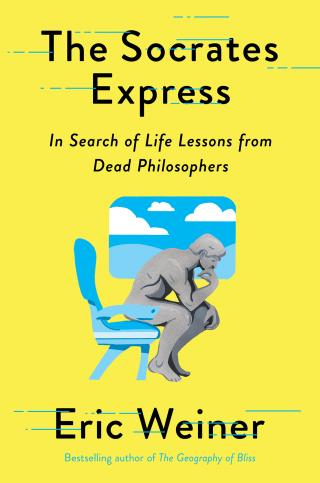
The Socrates Express
- Автор: Вейнер Эрик
- Год: 2020
- Язык: английский
- Год: Avid Reader Press / Simon & Schuster
- Жанр: География, путевые заметки

Электронная книга - «The Socrates Express». Краткое содержание книги:
We contemplate for the same reasons we travel: to see the world from a different perspective, to unearth hidden beauty and find new ways of being. We want to learn how to embrace wonder. Face regrets. Sustain hope.
Eric Weiner, *New York Times* bestselling author of *The Geography of Bliss* , combines his twin passions for philosophy and global travel in a pilgrimage that uncovers surprising life lessons from philosophers around the world, from Marcus Aurelius to Arthur Schopenhauer, Confucius to Montaigne. Traveling by train (the most thoughtful mode of transport) he traversed thousands of miles, making stops in Athens, Delhi,...
It dawns on me that Tom and I are having an Epicurean moment. A simple meal, paired with a good-enough wine. The luxury of friendship, and time. The pleasure of painlessness, of ataraxia. I register my agreeable state of mind but don’t dwell on it, lest I fall prey to the Pleasure Paradox. Happiness contemplated is happiness lost.
As we say good-bye, I ask Tom if he can recommend a coffee shop. I’m hoping he suggests a quirky local place where dedicated staff lovingly craft each cup. A special place.
“There’s a Starbucks down the road,” he says.
I am disappointed, but stop and ask myself, “What would Epicurus do?” He would go to Starbucks, of course. So I do.
It is not quirky. It is not staffed by loving baristas. It is not special. It is good enough.
In other words, perfect.
7. How to Pay Attention like Simone Weil
8:24 a.m. Wye Rail Station, United Kingdom, waiting to board the Southeastern Limited bound for Ashford. Total travel time: seven minutes. Total waiting time: nine minutes.
It is early, and the station is lovely. The simple wooden building, little more than a glorified shack, exudes an air of warmhearted community and quiet efficiency. A small bulletin board informs me the local book club is meeting next Thursday and it would be nice if I brought potato salad or maybe some scones. A nearby sign declares Wye an “area of outstanding natural beauty.” And it is. Endless meadows and rolling hills, emerald green.
I sit in the small waiting room and let the wonderful absurdity of that term sit with me. Waiting room. A room built for the sole purpose of engaging in the nonactivity of waiting. I rock on my heels. I glance at my watch. Eight more minutes. I survey the small library, really just a few shelves of well-thumbed paperbacks.
I glance at the small departures board. Seven more minutes. I fidget. I pace. I finger my ticket: Wye to Ashford, Return Journey. I prefer that to the American “round-trip.” A round-trip sounds bloated and pointless.
I check the departures board again. Six minutes. I sigh. What to do with a parcel of time like this? Too short to accomplish anything meaningful, yet too long to blink away. I know, six minutes is nothing. But it adds up. I read in the Daily Telegraph that the average Briton spends over the course of his or her lifetime six months standing in line.
Six months is not a speck. Six months is the bulk of a pregnancy. Six months is a short marriage, or a long fling. Six months is a good chunk of a life. And that’s only the time spent queuing. We also wait for a pot of water to boil, a doctor to see us, a website to download, a customer service representative to pick up already, a pot of coffee to brew, a toddler to fall asleep, a traffic jam to clear, the right word to materialize, our daughter who is never, ever this late getting home to walk through the front door, popcorn to pop, ice cubes to freeze, snow to melt.
Six minutes. If I had more time, I’d read. I’ve packed some appropriate literature for my short train ride. A collection of haikus and Seneca’s essay “On the Shortness of Life.” Some two thousand years later, Ferris Bueller, on his day off, echoed Seneca: “Life moves pretty fast. If you don’t stop and look around once in a while, you could miss it.”
Speed breeds impatience. Our capacity for waiting diminishes in inverse proportion to the velocity of life. Why is the Internet connection so slow? Where is my pizza already? Impatience is a greediness for the future. Patience is a generous attitude toward time.
The dot in the distance grows steadily larger until at last the Southeastern locomotive edges into tiny Wye station, and I step aboard with coiled alacrity. Settling into my window seat, I am about to glance at my watch when I stop myself. Instead, I look out the window, and I wait.
The train accelerates, each passing second bringing me a smidgeon closer to Ashford, the final resting place of a philosopher who thought a lot about waiting and about time and who, in one of those sad ironies that seem to befall philosophers disproportionately, was granted so little of it herself.
Philosophy doesn’t coddle. It challenges. It makes demands. The best philosophers are the most demanding. Socrates demands we question assumptions, especially our own. Marcus Aurelius demands we honor our duties.
Simone Weil’s entreaty is simpler but no less difficult. She demands we pay attention. Not any sort of attention, either. Weil’s notion of attention is unlike any I’ve encountered.
I’m looking at a black-and-white photograph of Simone Weil. She’s in her early twenties, I guess. I first notice her jet-black hair, thick and unruly, then the glasses, almost comical in their chunkiness. She is all hair and glasses, I think.
Then I notice the eyes. Dark and steady, they simultaneously exude warmth and a fierce, preternatural wisdom. These are wounded eyes. Serious eyes. Thoreauvian eyes. Everyone remarked on them. One friend recalled “her piercing look through the thick glasses.” Another was struck by how “in her presence all ‘lies’ were out of the question… her denuding, tearing and torn gaze would grasp and render helpless the person she was looking at.”
She is dressed in a capacious, unflattering outfit, consistent with the complete disregard for fashion she displayed throughout her life. She wore shabby clothes, always black, and flat-heeled shoes. “A real ragamuffin,” recalled one friend. “A medieval hermit,” said another.
The philosopher of attention didn’t want any directed at her. She wanted to see but not be seen. Whether riding a train or working on a factory floor, her goal was anonymity—“merging into the crowd and disappearing among them, so that they show themselves as they are,” she said. Yet she always stood out. How could she not? Intellectual. Awkward. Jewish.
Weil was born in Paris in 1909 to a fiercely secular and highly intellectual family. From a young age, she found solace, and inspiration, in books. By age fourteen, she knew much of Blaise Pascal’s Pensées by heart. She read works in the original Sanskrit and Assyro-Babylonian. (“Such a ridiculously easy language!” she told a friend.) She could go for days at a time without food or sleep.
While she excelled at school, she never valued knowledge for its own sake. “The only serious aim of schoolwork is to train the attention,” she said. That single word—attention—would come to possess her. It was the thread that held her sprawling philosophy, and her life, together.
The ability to pay attention is, along with the ability to walk upright and open pickle jars, what makes us human. Every brilliant scientific discovery, every great work of art, every kind gesture, traces its source to a moment of pure, selfless attention.
Attention matters. More than anything else, it shapes our lives. “For the moment, what we attend to is reality,” said the American philosopher William James. Something only exists for us if we attend to it. This is not a metaphor. It is a fact. As many studies reveal, we do not see that to which we don’t pay attention.
The quality of our attention determines the quality of our lives. You are what you choose to pay attention to and, crucially, how you pay attention. Looking back at your life, which memories bubble to the surface? Maybe it’s something big, like your wedding day, or maybe something small, that unexpectedly kind exchange with the person standing behind you on the ridiculously long post office line. Chances are, though, it’s moments when you were most attentive. Our lives are no less and no more than the sum of our most rapt moments. “The highest ecstasy,” said Weil, “is the attention at its fullest.”
During these rare moments, we enter a state of mind—a state of being—that Weil calls “extreme attention” and psychologist Mihaly Csikszentmihalyi calls “flow.” When in a state of flow, you shed any semblance of self-consciousness, and experience an altered perception of time and a heightened sense of reality. Everything seems more real than real. Unlike so much in life, flow is “a condition so rewarding as to be sought out for its own sake,” says Csikszentmihalyi.
People immersed in flow are not self-absorbed, for there is no self to be absorbed. No musician, only music. No dancer, only dancing. Here is how an avid sailor describes being in flow. “One forgets oneself, one forgets everything, seeing only the play of the boat with the sea, the play of the sea around the boat, leaving aside everything not essential to that game.” You don’t need to sail the Atlantic or climb Everest to experience flow. You just need to pay attention.