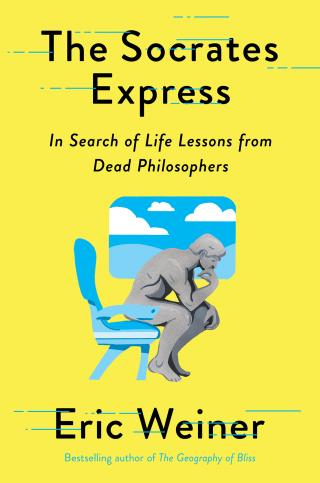
The Socrates Express
- Автор: Вейнер Эрик
- Год: 2020
- Язык: английский
- Год: Avid Reader Press / Simon & Schuster
- Жанр: География, путевые заметки

Электронная книга - «The Socrates Express». Краткое содержание книги:
We contemplate for the same reasons we travel: to see the world from a different perspective, to unearth hidden beauty and find new ways of being. We want to learn how to embrace wonder. Face regrets. Sustain hope.
Eric Weiner, *New York Times* bestselling author of *The Geography of Bliss* , combines his twin passions for philosophy and global travel in a pilgrimage that uncovers surprising life lessons from philosophers around the world, from Marcus Aurelius to Arthur Schopenhauer, Confucius to Montaigne. Traveling by train (the most thoughtful mode of transport) he traversed thousands of miles, making stops in Athens, Delhi,...
Like others I’ve encountered on my journey, Epicurus was a philosopher of the body as well as the mind. The body, he believed, contains the greatest wisdom.
Epicurus was an Empiricist. We know the world, he believed, through our senses and only our senses. The senses may not be perfect, but no other reliable source of knowledge exists, and anyone who tells you otherwise is either deluded or selling something.
Epicurus honed his own senses. He was a keen observer of human behavior. He surveyed Athens, and everywhere he saw people who had enough: enough food, enough money, and certainly enough culture. Why weren’t they happy?
Epicurus approached this mystery like a physician treating a patient with unexplained symptoms. Philosophy, he said, should be dispensed like medicine for the soul. The first four of his Principal Doctrines are known as the tetrapharmakos, the “Four-Part Cure.” Like medicine, philosophy must be ingested at regular intervals, and at prescribed dosages. Like medicine, there are potential side effects: dizziness, disorientation, and, occasionally, manic episodes.
The medical approach was no accident. Epicurus lived during the peak of therapeutic philosophy. During the time, an era known as the Hellenistic Age, people chose a school of philosophy with the same ardent deliberation people today choose a spouse or a wireless plan. The stakes were high. You weren’t making an academic choice, Princeton over Stanford. You were making a life choice that would shape your character, and therefore your destiny.
The schools were combination university, health club, self-help seminar, and, in the case of Epicurus, hippie commune. Teachers focused on ethics. Derived from the Greek word for “character,” ethics was the study of the good life: eudaimonia. Some philosophers thought only the gods and the blessed few could achieve this elevated state of happiness. Epicurus thought anyone could. Meditate on these teachings “night and day,” he told his students, and you will “live like a god among men.”
Examining the sickly body politic of Athens, Epicurus posited a simple diagnosis: we fear what is not harmful and desire what is not necessary. What do we fear the most? he asked. The gods and death. (Presumably taxes were not a major stressor in ancient times.) He had answers for both. The gods, he said, exist but couldn’t care less about human affairs. Why should they? They’re too busy being gods. For Epicurus, the gods were like celebrities. They lead enviable lives, free of worries, always able to get a reservation.
As for death, Epicurus tells us to relax. Yes, dying can be painful, Epicurus acknowledges, but such pain is self-limiting. It won’t last forever. Either it subsides, or you die. Either way, there’s nothing to fear.
I find this idea, like much of Epicurus’s philosophy, sound in theory but problematic in practice. I don’t fear the gods, but the prospect of nonexistence freaks me out. I suspect it always will.
Relax, says Epicurus, and enjoy. He advocated pleasure as “the beginning and the end of the happy life,” adding provocatively: “I do not know how I shall conceive of the good if I take away the pleasure of taste, if I take away sexual pleasure, if I take away the pleasure of hearing, and if I take away the sweet emotions that are caused by the sight of a beautiful form.”
No wonder Epicurus was so maligned. Pleasure is suspect. It resides in the shadows, behind closed doors. When we speak of “secret” or “hidden” pleasures, we’re acknowledging the shame attached to this most basic of human instincts.
Epicurus thought otherwise. He considered pleasure the highest good. Everything else—fame, money, and even virtue—mattered only to the extent they furthered pleasure. “I spit upon the honorable and those who vainly admire it,” he wrote, in his typically provocative style. Pleasure is the only thing we desire for its own sake. Everything else, even philosophy, is a means to that one end.
The primacy of pleasure, Epicurus said, was self-evident. What does a child respond to? Pleasure and pain. You don’t need to teach her that fire is hot and candy tasty; she knows it. Seeking pleasure and avoiding pain is as natural, and automatic, as breathing.
Epicurus defined pleasure differently from the way most of us do. We think of pleasure as a presence, what psychologists call positive affect. Epicurus defined pleasure as a lack, an absence. The Greeks called this state ataraxia, literally “lack of disturbance.” It is the absence of anxiety rather than the presence of anything that leads to contentment. Pleasure is not the opposite of pain but its absence. Epicurus was no hedonist. He was a “tranquillist.”
Some psychologists take exception with Epicurus’s focus almost exclusively on pain relief. “Happiness is definitely something other than the mere absence of all pain,” sniffs the Journal of Happiness Studies. Before reading Epicurus, I would have agreed. Now I’m not so sure. If I’m honest with myself, I recognize that what I crave most is not fame or wealth but peace of mind, the “pure pleasure of existing.” It’s nearly impossible to describe such a state in terms other than that of absence.
Avoiding pain is sound advice—I’m all for it—but isn’t it an awfully thin basis for a philosophy? Not if you’re in pain, Epicurus thought. Imagine you’ve fallen from a horse and broken your leg. A doctor is summoned and promptly offers you a bowl of grapes. What’s wrong? The grapes are pleasurable, aren’t they?
This absurd situation is the one many of us find ourselves in, Epicurus believed. We scoop trivial pleasures atop a mountain of pain, and wonder why we’re not happy. Some of us suffer the sharp shock of physical pain, others the dull ache of mental pain or the I want-to-die pain of a broken heart, but pain is pain, and we must address it if we hope to achieve contentment. “We are only born once—twice is not allowed,” he said. Every human life, Epicurus believed, is the fortuitous product of chance, a swerve in atomic motion, a miracle of sorts. Shouldn’t we celebrate that?
I decamp from the site of what may or may not have been the Garden, and retreat behind the walls of an inviting café. I order a Mythos beer and contemplate the many pleasures of Epicurus. He didn’t merely celebrate pleasure. He dissected it, developing an entire taxonomy of desire.
At the top of the ladder were the “natural and necessary” desires. A glass of water, for instance, after a trek through the desert. Next came “natural but not necessary” desires. A glass of simple table wine after drinking the water after trekking across the desert. Finally, at the bottom of the pyramid, are desires that are neither natural nor necessary, what Epicurus calls “empty” desires. A pricey bottle of champagne after imbibing the table wine after drinking the water after trekking across the desert. These empty desires cause the most suffering, Epicurus thought, since they are difficult to obtain. “It is better for you to lie upon a bed of straw and be free of fear, than to have a golden couch and an opulent table, yet be troubled in mind.”
I sip my beer—natural but not necessary—and take silent inventory of my various desires. I don’t like what I find. I devote energy—too much, I know—chasing mirages. I devote a lot of energy to bags. I love bags (satchels, mainly, but also backpacks and briefcases) and, like all loves, this one consumes me. Epicurus would take one look at my outsize bag collection (I have a problem) and declare it, at best, a natural but not necessary desire. Yes, we need something to carry our stuff, but we don’t need fifty-four bags of various vintages and leather-and-canvas configurations. A simple rucksack will do.
Not only are there different kinds of pleasures, Epicurus says, but they operate at different speeds. Here he differentiates between static and kinetic pleasures. The act of slaking our thirst with a glass of chilled water is a kinetic pleasure. The sated feeling—the lack of thirst—we experience afterward is a static pleasure. Or, put another way, drinking is a kinetic pleasure, having drunk a static one.