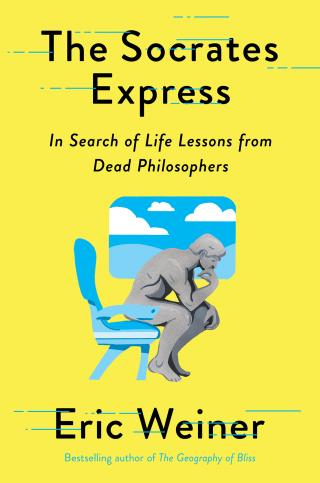
The Socrates Express
- Автор: Вейнер Эрик
- Год: 2020
- Язык: английский
- Год: Avid Reader Press / Simon & Schuster
- Жанр: География, путевые заметки

Электронная книга - «The Socrates Express». Краткое содержание книги:
We contemplate for the same reasons we travel: to see the world from a different perspective, to unearth hidden beauty and find new ways of being. We want to learn how to embrace wonder. Face regrets. Sustain hope.
Eric Weiner, *New York Times* bestselling author of *The Geography of Bliss* , combines his twin passions for philosophy and global travel in a pilgrimage that uncovers surprising life lessons from philosophers around the world, from Marcus Aurelius to Arthur Schopenhauer, Confucius to Montaigne. Traveling by train (the most thoughtful mode of transport) he traversed thousands of miles, making stops in Athens, Delhi,...
While other philosophers attempted to explain the world out there, Schopenhauer was more concerned with our inner world. We can’t know the world if we don’t know ourselves. This fact strikes me as incredibly obvious. Why do so many philosophers—otherwise intelligent folk—miss it? Partly, I think, it’s because it’s easier to examine the external. We’re like the proverbial drunk looking for his keys in a lighted alleyway.
“Did you lose them here?” asks a passerby.
“No. I lost them over there,” he says, pointing to a dark parking lot.
“Then why are you looking here?”
“This is where the light is.”
Not Schopenhauer. He searched where it is darkest. You might disagree with his gloomy outlook or bleak metaphysics, but you can’t ding him for half measures. He is all in. A heroic philosopher.
Every fetish suggests an equal and opposite revulsion, and every passion a complementary annoyance. And so it was with Schopenhauer. His intense love of music begot a corresponding loathing of noise.
“Knocking, hammering and banging have been throughout my life a daily torment to me,” he writes in his essay “On Din and Noise.” He especially disliked the “sudden sharp crack” of a whip against the side of a horse, a sound “which paralyzes the brain, tears and rends the threat of reflection, and murders all thoughts.” I wonder if Schopenhauer, lover of animals, was feeling the horse’s pain.
At night, he jumped at the slightest noise and reached for the loaded pistol he always kept at his bedside. In Frankfurt, he wrote to the theater manager, urging him to do something about the racket: control the crowd, install cushioning on the doors and hinged seats, anything. “The Muses and the audience will be grateful to you for improving matters,” he wrote.
For Schopenhauer, noise was more than an annoyance. It was a barometer of character. One’s tolerance for noise, he believed, is inversely proportional to his intelligence. “Therefore, when I hear dogs barking unchecked for hours in the courtyard of a house, I know what to think of the inhabitants.”
I’m with Schopenhauer. My train of thought is rickety, easily derailed. Even the sound of a ticking clock can upend my concentration. My wife’s hair dryer, an evil little fucker called the Bio Ionic PowerLight, has been known to sabotage an entire day. And don’t get me started on leaf blowers.
Recent research reveals the insidious effect noise pollution has on our physical and mental well-being. According to one study published in the Southern Medical Journal, noise pollution can lead to “anxiety, stress, nervousness, nausea, headache, emotional instability, argumentativeness, sexual impotence, changes in mood, increase in social conflicts, neurosis, hysteria, and psychosis.” Another study found that the roar of planes taking off and landing causes our blood pressure to spike, heartbeat to race, and stress hormones to release—even while sound asleep.
Schopenhauer would find confirmation but little pleasure in these studies, for they fail to account for another, more insidious type of noise: mental. Mental noise does more than disturb. It masks. In a noisy environment, we lose the signal, and our way. Some 150 years before email, the cluttered inbox worried Schopenhauer.
In his essay “On Authorship,” the philosopher foreshadows the mind-numbing clamor that is social media, where the sound of the true is drowned out by the noise of the new. “No greater mistake can be made than to imagine that what has been written latest is always the more correct; that what is written later on is an improvement on what was written previously; and that every change means progress.”
We make this mistake every time we click mindlessly, like a lab rat pulling a lever, hoping for a reward. What form this reward will take we don’t know, but that is beside the point. Like Schopenhauer’s hungry readers, we confuse the new with the good, the novel with the valuable.
I am guilty of this. I’m constantly checking and rechecking my digital vital signs. While writing this paragraph, I have checked my email (nothing), opened my Facebook page (Pauline’s birthday, must remember to send her a note), placed a bid for a nice leather backpack on eBay, checked my email again (still nothing), ordered a disturbingly large quantity of coffee, upped my bid for that backpack, and checked my email again (still nothing).
The encyclopedia was the Internet in Schopenhauer’s day, and nearly as seductive. Why puzzle over a problem when the solution is readily available in a book? Because, answers Schopenhauer, “it’s a hundred times more valuable if you have arrived at it by thinking for yourself.” Too often, he said, people jump to the book rather than stay with their thoughts. “You should read only when your own thoughts dry up.”
Substitute “click” for “read” and you have our predicament. We confuse data with information, information with knowledge, and knowledge with wisdom. This tendency worried Schopenhauer. Everywhere he saw people scrambling for information, mistaking it for insight. “It does not occur to them,” he wrote, “that information is merely a means toward insight and possesses little or no value in itself.” I’d go a step further. This excess of data—noise, really—has negative value and diminishes the possibility of insight. Distracted by the noise, we don’t hear the music.
I’m walking back to my hotel, having left Stephen Roeper and the sad Schopenhauer Archives to fend for themselves in this, “the worst of all possible worlds.”
Strolling along Frankfurt’s leafy boulevards, the air soft and pliant, it doesn’t feel that way. It’s a pleasant evening, the sort Schopenhauer favored for his afternoon constitutionals. I listen to the street sounds, garbled Teutonic resonances, and to my own inner voice. I’m alarmed to discover that it, too, is muddled. Schopenhauer was right. Fill your head with the ideas of others and they’ll displace your own. I make a mental note to evict these uninvited voices.
Back in my room, I decide, out of boredom or reflex (or some perverse combination), to log on. I’m clicking away, mindlessly, when it dawns on me: the Internet is Schopenhauer’s Will made manifest in the digital age. Like the Will, the Internet is omnipresent, and purposeless. It is always striving, never sated. It devours everything, including our most precious resource: time. It offers the illusion of happiness but delivers only suffering. As with the Will, the Internet offers two ways to escape its clutch: the path of the ascetic and that of the aesthete. Meditation or music.
I choose music. Rossini, naturally. I pour a hot bath and a Scotch. Taking a swig of the single malt, I close my eyes, and listen. I follow the melody the way the Dalai Lama must follow the news, disinterested but not uninterested. Attentive yet not reactive. I let the music wash over me, as warm and soothing as the bathwater. Sound without words. Emotion without content. Signal without noise.
This, I realize, is what Schopenhauer saw in music: not a respite from the world but an immersion in another, richer one.
PART TWO
NOON
6. How to Enjoy like Epicurus
7:35 p.m. Somewhere in Montana. On board Amtrak’s Empire Builder, en route from Chicago to Portland, Oregon.
We travel to escape the tyranny of habit. We humans, though, are lost without structure and, after two days on board Amtrak, I’m craving just that. I read, and I think. I read about thinking and I think about reading. I rearrange my roomette, moving luggage from nook to cranny then back to nook again. For hours I position myself at the stern of the train and, peering out a small window, watch the world retreat, like a movie that’s perpetually ending but never does. Mostly, I wait for a chirpy Amtrak voice, Miss Oliver, beckoning me to the dining car.