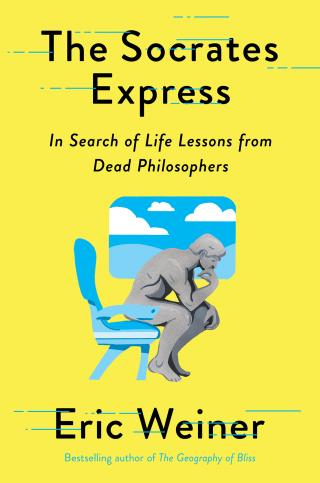
The Socrates Express
- Автор: Вейнер Эрик
- Год: 2020
- Язык: английский
- Год: Avid Reader Press / Simon & Schuster
- Жанр: География, путевые заметки

Электронная книга - «The Socrates Express». Краткое содержание книги:
We contemplate for the same reasons we travel: to see the world from a different perspective, to unearth hidden beauty and find new ways of being. We want to learn how to embrace wonder. Face regrets. Sustain hope.
Eric Weiner, *New York Times* bestselling author of *The Geography of Bliss* , combines his twin passions for philosophy and global travel in a pilgrimage that uncovers surprising life lessons from philosophers around the world, from Marcus Aurelius to Arthur Schopenhauer, Confucius to Montaigne. Traveling by train (the most thoughtful mode of transport) he traversed thousands of miles, making stops in Athens, Delhi,...
For Rousseau, walking was like breathing. “I can scarcely think when I remain still; my body must be in motion to make my mind active.” As he walked, he’d jot down thoughts, large and small, on playing cards that he always carried with him. Rousseau was not the first philosopher to walk but he was the first to philosophize so extensively about walking.
The walking philosopher gives the lie to one of the discipline’s greatest myths: that it is a mental pursuit wholly divorced from the body. From Archimedes’s eureka moment in the bath to Descartes’s masterful fencing to Sartre’s sexual escapades, philosophy has a swift corporeal current running through it. There are no disembodied philosophers, or philosophies. “There is more wisdom in your body than in all of your philosophy,” said Nietzsche.
Consider an emotion like anger. When you are outraged, where does “anger” reside? In your mind, yes, but also in your body, as the French philosopher Maurice Merleau-Ponty explains: “I could not imagine the malice and cruelty which I discern in my opponent’s looks, separated from his gestures, speech and body. None of this takes place in some other-worldly realm, in some shrine located beyond the body of the angry man.” Likewise, when we philosophize we do so not only with our minds, but with our bodies, too.
Back at the crêperie, I plunge again. Same wine, different Rousseau: his final and unfinished work, Reveries of the Solitary Walker. It is an odd yet endearing volume, “a book that is and is not about walking,” as Rebecca Solnit points out in her history of walking. Then again, walking itself is and is not about walking.
Reveries is my favorite of Rousseau’s writings. It pulses with the moral clarity and leavened wisdom of a man who, having been expelled, stoned, and ridiculed, no longer gives a fuck. This is not Rousseau the contrarian, or Rousseau the confessor or Rousseau the reformer. This is Rousseau at rest.
The book is arranged in a series of ten walks, or reveries. In each, Rousseau embarks on an outing, but that is merely the vehicle, so to speak, for the real subject of the book: memory. How do we retrieve life’s sweet moments, and do they taste as sweet, or sweeter even, on the second bite?
In the fifth walk, Rousseau recalls his time living on a small island called Saint-Pierre, his refuge from the stone throwers of Môtiers. It was his paradise. “The happiest time of my life,” he recalls.
I read those words and nearly spit up my chardonnay. Rousseau, connoisseur of his own pathologies, wasn’t exactly prone to bouts of happiness. I want to see this island for myself.
I walk toward the train station. It is not a Rousseauvian walk. Too rushed, I say to myself. Too mindless. Focus, damn it, I say, out loud this time, startling the Swiss passersby.
At Neuchâtel’s small but busy station, I board a regional express bound for Rousseau’s happy isle. It departs on time, naturally. Swiss trains deserve their reputation for exceptional punctuality, but their cold efficiency seems at odds with the messy, emotive life of the country’s greatest philosopher.
It’s a short ride, just a few stops, but I decide to sample Reveries. “Everything is in constant flux on this Earth,” Rousseau writes, echoing the Greek philosopher Heraclitus’s dictum: “All is flux.” The river we step in is never the same twice, nor are we.
The train glides along the tracks so smoothly that, were it not for the changing scenery, I’d swear we weren’t moving at all. And movement, Rousseau tells me, is vital. It must be of a certain kind, though. “If the movement is irregular or too violent it arouses us from our dreams.”
Rousseau’s mention of violent movement reminds me of my Amtrak journey across the United States, in the company of that insomniac philosopher-emperor Marcus. Somewhere in North Dakota, bored by the monotonous scenery, I needed to do something, anything.
On the hard rails of Amtrak, routine activities are fraught with difficulty. Shaving, for instance. (My one attempt left me a bloody mess.) Walking, too. I teetered and tottered like a drunkard at sea. This made sense from an evolutionary perspective. We humans come from the sea, a fact reflected in the etymology of the word “walk.” In the eleventh century, it meant “to roll about, toss” like the sea. It wasn’t until the thirteenth century that “walking” came ashore, toweled off, and acquired its contemporary meaning. Words evolve.
Not me. As I attempted to walk, I was devolving, straight back to the eleventh century. I rolled and tossed down the aisles. I careened into luggage. I body-slammed strangers.
“You’ve got to dance with the train,” said an older woman witnessing my incompetence.
She was right. I had been fighting the train. I needed to dance with it. Let the train lead. It took me a while, but I got the hang of it. The secret, I learned, is to stay loose. The train pitched left then right, and so did I. No resistance. Finally, I made it to my destination, the lounge car, as elated as if I had summited K2.
About six million years ago, early hominids got off their knuckles, stood up straight, and walked on two feet. This new, erect posture had many unexpected benefits. It freed up hands for toolmaking, as well as pointing, caressing, gesturing, hand-holding, bird-flipping, nose-picking, and nail-biting. Walking is about more than walking, and always has been.
Walking may be natural but that doesn’t mean it comes easily. Here Joseph Amato, in his encyclopedic history of walking, On Foot, describes the physiology of a single stride. “It requires spending three-fourths of one’s time on one foot or the other. As one strikes the ground with one stiff leg after another, all of one’s weight is set against a descending heel, only to be transferred to the big toe as one rotates hips and redirects the plane of foot and leg.” All of this happens automatically, of course. Think about the biomechanics too much and you might fall on your face, as I nearly did after reading the above passage.
We walk on two feet but we do so on a skeleton designed for four. This disconnect between ancient anatomy and modern usage keeps podiatrists in business. Flat feet, swollen feet, blisters, bunions, and hammertoes are just a few of the podiatric prices we pay for our bipedal existence. Rousseau suffered from painful corns most of his life. He walked on his heels, defiantly.
Rousseau was a devoted walker but not a heroic one. He walked slowly, owing to his corns, and could “never jump an ordinary ditch.” He did not carry a loaded rucksack, or other accoutrements. He did not fend off thieves or wild dogs. He did not rescue those in distress, damsels or otherwise. He just walked, without judgment or expectation. When we walk like this, the experience approaches the sacred.
The train pulls into a small station a short bus ride from Saint-Pierre. It is an island full of surprises. For starters, it is no longer an island. Since Rousseau’s time, a small land bridge has formed, connecting it to the mainland. All is flux.
I step onto the island that is no longer an island and see why Rousseau was so fond of it. It’s idyllic in an unpretentious way, lush but not luscious, green but not too green. From nearly every vantage point, there’s a view of Lake Bienne. This view is nature at her best, what the poet Philip Larkin called “serious earth.”
I can picture Rousseau taking long and aimless walks here, accompanied by his beloved dog, Sultan, or perhaps collecting plant samples. I find the path that traverses Saint-Pierre, and I walk. One foot in front of the other, I say to myself, just as I’ve been doing all my life, only better. I translate “better” into “faster” and soon I’m moving at a ridiculous clip. I catch myself and compensate by slowing to elephant speed. Why can’t I find my middle gear? What is wrong with me?