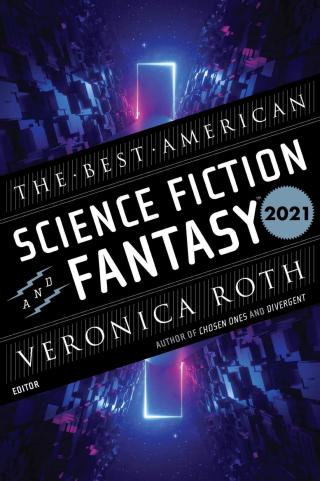
The Best American Science Fiction and Fantasy 2021
- Автор: Рот Вероника, Адамс Джон Джозеф
- Год: 2021
- Язык: английский
- Год: HMH Books : Mariner
- ISBN: 9780358470076
- Жанр: Малые литературные формы прозы

Электронная книга - «The Best American Science Fiction and Fantasy 2021». Краткое содержание книги:
This year’s selection of science fiction and fantasy stories, chosen by series editor John Joseph Adams and bestselling author of the Divergent series Veronica Roth, showcases a crop of authors that are willing to experiment and tantalize readers with new takes on classic themes and by exchanging the ordinary for the avant-garde. Folktales and lore come alive, the dead rise, the depths of space are traversed, and magic threads itself through singular moments of love and loss, illuminating the circulatory nature of life, death, the in-between, and the hereafter.
The Best American Science Fiction and Fantasy 2021 captures the all-too-real cataclysm of human nature, claiming its place in the series with compelling prose, lyrical composition, and curiosity’s never-ending pursuit of discovering the unknown.
“The boy got his learner’s permit on the very first day he was allowed. He skipped school for it rather than wait another second. He had saved his paper route money for driving lessons and a used motorbike. As soon as he had his full license, he did what he had always wanted to do: he drove as fast as he could down the highway, past all the cars, and then he kept driving forever. The end.”
Uncle Bob shifted back in his chair as he finished. Dan watched him for a little longer, then launched himself again, circling the scattered toys and children faster than before.
Jeff sat back as well. “What kind of story was that?”
Stella frowned. “A deeply messed-up one. That kid with the airplane—Dan Heller—drove off the interstate the summer after junior year. He was racing someone in the middle of the night and missed a curve.”
“Oof. Quite the coincidence.”
“Yeah . . .”
Uncle Bob started telling another story, this one about a vole living in a hole on a grassy hillside that started a conversation with the child sleeping in the hole next door.
“Do you want to watch the whole episode? Is this the one you need?”
“I think I need to look at a couple more?” She didn’t know what she was looking for. “Sorry for putting you out. I don’t mean to take up so much time.”
“It’s fine! This is interesting. The show is terrible, from any standpoint. The story was terrible, the production is terrible. I can’t even decide if this whole shtick is campy bad or bad bad. Leaning toward the latter.”
“I don’t think there’s anything redeeming,” Stella said, her mind still on Dan Heller. Did his parents remember this story? “Can we look at the next one? October thirtieth?”
“Coming up.” Jeff appeared to have forgotten she’d said she was looking for something specific, and she didn’t remind him, since she still couldn’t think of an appropriate detail.
Little Stella was second through the door this time, behind Tina, whose last name she didn’t remember. She paused and looked out past a camera, probably looking for her mother, then kept moving when she realized more kids were coming through behind her. Head for the toys. Claim what’s yours. Brontosaurus and T. rex and a blue whale. Whales were almost as cool as dinosaurs.
Tina had claimed a triceratops and looked like she wanted the brontosaurus. They sat down on the edge of the toy pit to negotiate. Uncle Bob watched them play, which gave Stella the eeriest feeling of being watched, even though she still felt like the kid on the screen wasn’t her.
“So what was it like?” Jeff asked, but Stella didn’t answer. Uncle Bob had started a story. He looked straight into the camera. This time it felt like he was truly looking straight at her. This was the one. She knew it.
“Once upon a time, there was a little girl who didn’t know who she was. Many children don’t know who they will be, and that’s not unusual, but what was unusual in this case was that the girl was willing to trade who she was for who she could be, so she began to do just that. Little by little, she replaced herself with parts of other people she liked better. Parts of stories she wanted to live. Nobody lied like this girl. She believed her own stories so completely, she forgot which ones were true and which were false.
“If you’ve ever heard of a cuckoo bird, they lay their eggs in other birds’ nests, so those birds are forced to raise them for their own. This girl was her own cuckoo, laying stories in her own head, and the heads of those around her, until even she couldn’t remember which ones were true, or if there was anything left of her.”
Uncle Bob went silent, watching the children play. After a minute, he started telling another story about the boy in the hill, and how happy he was whenever he had friends over to visit. That story ended, and a graphic appeared on the screen with an address for fan mail. Stella pulled a pen from her purse and wrote it down as the theme music played out.
“Are you sending him a letter?” The archivist had dropped his headphones and was watching her.
She shrugged. “Just curious.”
“Is this the one, then?”
“The one?”
He frowned. “You said you wanted a copy for your mother.”
“Yes! That would be lovely. This is the one she mentioned.”
He pulled a DVD off a bulk spindle and rewound the tape. “You didn’t say what it was like. Was he weird off camera too?”
“Yes,” she said, though she didn’t remember. “But he kept to himself. Just stayed in his dressing room until it was time to go on.”
Jeff didn’t reply, and something subtle changed about the way he interacted with her. What if there hadn’t been a dressing room? He might know. When had she gotten so sloppy with her stories? Maybe it was because she was distracted. Her mother had told the truth: she’d been on a creepy TV show of which she had no memory. And what was it? Performance art? Storytelling? Fairy tales or horror? All of the above? She thanked Jeff and left.
She had just walked into her parents’ house when Marco called. “Can you come back? There’s something I need to show you.”
She headed out to Denny’s house. She paused on the step, realizing she was in nicer clothes this time. Hopefully she wouldn’t be there long.
“Hey,” she said when Marco answered the door. Even though she braced for the odor, it hit her hard.
He waved her in, talking as he navigated the narrow path he’d cleared up the stairs. “I thought I’d work on Denny’s bedroom today, and, well . . .”
He held out an arm in the universal gesture of “go ahead,” so she entered. The room had precarious ceiling-high stacks on every surface, including the floor and bed, piles everywhere except a path to an open walk-in closet. She stepped forward.
“What is that?”
“The word I came up with was ‘shrine,’ but I don’t think that’s right.”
It was the sparest space in the house. She’d expected a dowel crammed end to end with clothes, straining under the weight, but the closet was empty except for—“shrine” was indeed the wrong word. This wasn’t worship.
The most eye-catching piece, the thing she saw first, was a hand-painted Uncle Bob doll propped in the back corner. It looked like it had been someone else first—Vincent Price, maybe. Next to it stood a bobblehead and an action figure, both mutated from other characters, and one made of clay and plant matter, seemingly from scratch. Beside those, a black leather notebook, a pile of VHS tapes, and a single DVD. Tacked to the wall behind them, portraits of Uncle Bob in paint, in colored pencil, macaroni, photo collage, in, oh god, was that cat hair? And beside those, stills from the show printed on copier paper: Uncle Bob telling a story; Uncle Bob staring straight into the camera, an assortment of children. Her own still was toward the bottom right. Marco wasn’t in any of them.
“That’s the thing that guts me.”
Stella turned, expecting to see Marco pointing to the art or the dolls, but she’d been too busy looking at those to notice the filthy pillow and blanket in the opposite corner. “He slept here?”
“It’s the only place he could have.” Marco’s voice was strangled, like he was trying not to cry.
She didn’t know what to say to make him feel better about his brother having lived like this. She picked up the notebook and paged through it. Each page had a name block-printed on top, then a dense scrawl in black, then, in a different pen, something else. Not impossible to read, but difficult, writing crammed into every available inch, no space between words even. She remembered this notebook; it was the one teenage Denny always had on him.
“Take it,” Marco said. “Take whatever you want. I can’t do this anymore. I’m going home.”