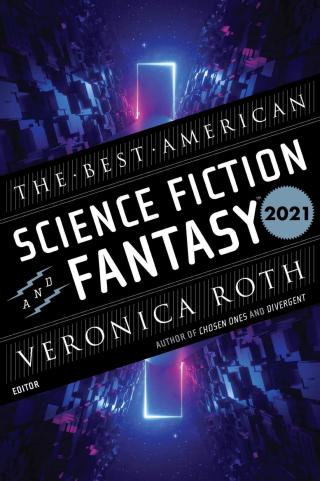
The Best American Science Fiction and Fantasy 2021
- Автор: Рот Вероника, Адамс Джон Джозеф
- Год: 2021
- Язык: английский
- Год: HMH Books : Mariner
- ISBN: 9780358470076
- Жанр: Малые литературные формы прозы

Электронная книга - «The Best American Science Fiction and Fantasy 2021». Краткое содержание книги:
This year’s selection of science fiction and fantasy stories, chosen by series editor John Joseph Adams and bestselling author of the Divergent series Veronica Roth, showcases a crop of authors that are willing to experiment and tantalize readers with new takes on classic themes and by exchanging the ordinary for the avant-garde. Folktales and lore come alive, the dead rise, the depths of space are traversed, and magic threads itself through singular moments of love and loss, illuminating the circulatory nature of life, death, the in-between, and the hereafter.
The Best American Science Fiction and Fantasy 2021 captures the all-too-real cataclysm of human nature, claiming its place in the series with compelling prose, lyrical composition, and curiosity’s never-ending pursuit of discovering the unknown.
Marco did the same. “The weird thing is I haven’t found a cat. I’m hoping maybe it was indoor-outdoor or something . . .”
Stella didn’t know how to respond, so she said, “Hmm,” and resolved to be extra careful when sticking her hands into anything.
The built-in bookshelves on the back wall held tubs and tubs of what looked like holiday decorations.
“What do you want to do with holiday stuff?” Stella pulled the nearest box forward on the shelf and peered inside. Halloween and Christmas, mostly, but all mixed together, so reindeer ornaments and spider lights negotiated a fragile peace.
“I’d love to say toss it, but I think we need to take everything out, in case.”
“In case?”
He tossed her a sealed package to inspect. It held two droid ornaments, like R2-D2 but different colors. “Collector’s item, mint condition. I found it a minute ago, under a big ball of tinsel and plastic reindeer. It’s like this all over the house: valuable stuff hidden with the crap. A prize in every fucking box.”
The size of the undertaking was slowly dawning on her. “How long are you here for?”
“I’ve got a good boss. She said I could work from here until I had all Denny’s stuff in order. I was thinking a week, but it might be more like a month, given everything . . .”
“A month! We made good progress today, though . . .”
“You haven’t seen upstairs. Or the garage. There’s a lot, Stella. The dining room was probably the easiest other than the kitchen, which will be one hundred percent garbage.”
“That’s if he didn’t stash more collectibles in the flour.”
Marco blanched. “Oh god. How did I not think of that?”
Part of her wanted to offer to help again, but she didn’t think she could stomach the stench for two days in a row, and she was supposed to be spending time with her parents, who already said she didn’t come home enough. She wanted to offer, but she didn’t want him to take her up on it. “I’ll come back if I can.”
He didn’t respond, since that was obviously a lie. They returned to the task at hand: the ornaments, the decorations, the toys, the games, the stacks of DVDs and VHS tapes and records and CDs and cassettes, the prizes hidden not in every box, but in enough to make the effort worthwhile. Marco was right that the dining room had been easier. He’d decided to donate all the cassettes, DVDs, and videotapes, but said the vinyl might actually be worth something. She didn’t know anything about records, so she categorized them as playable and not, removing each from its sleeve to examine for warp and scratches. It was tedious work.
It took two hours for her to find actual equipment Denny might have played any of the media on: a small television on an Ikea TV stand, a stereo and turntable on the floor, then another television behind the first.
It was an old set, built into a wooden cabinet that dwarfed the actual screen. She hadn’t seen one like this in years; it reminded her of her grandparents. She tried to remember if it had been down here when they were kids.
Something about it—the wooden cabinet, or maybe the dial—made her ask, “Do you remember The Uncle Bob Show?”
Which of course he didn’t, nobody did, she had made it up on the spot, like she often did.
Which was why it was so weird that Marco said, “Yeah! And the way he looked straight into the camera. It was like he saw me, specifically me. Scared me to death, but he said, ‘Come back next week,’ and I always did because I felt like he’d get upset otherwise.”
As he said it, Stella remembered too. The way Uncle Bob looked straight into the camera, and not in a friendly Mr. Rogers way. Uncle Bob was the anti–Mr. Rogers. A cautionary uncle, not predatory, but not kind.
“It was a local show,” she said aloud, testing for truth.
Marco nodded. “Filmed at the public broadcast station. Denny was in the audience a few times.”
Stella pictured Denny as she had known him, a hulking older teen. Marco must have realized the disconnect, because he added, “I mean when he was little. Seven or eight, maybe? The first season? That would make us five. Yeah, that makes sense, since I was really jealous, but my mom said you had to be seven to go on it.”
Stella resized the giant to a large boy. Audience didn’t feel like exactly the right word, but she couldn’t remember why.
Marco crossed the room to dig through the VHS tapes they’d discarded. “Here.”
It took him a few minutes to connect the VCR to the newer television. The screen popped and crackled as he hit play.
The show started with an oddly familiar instrumental theme song. The Uncle Bob Show appeared in block letters, then the logo faded and the screen went black. A door opened, and Stella realized it wasn’t dead-screen black but a matte black room. The studio was painted black, with no furniture except a single black wooden chair.
Children spilled through the door, running straight for the camera—no, running straight for the secret compartments in the floor, all filled with toys. In that environment, the colors of the toys and the children’s clothes were shocking, delicious, welcoming, warm. Blocks, train sets, plastic animals. That was why audience had bothered her. They weren’t an audience; they were half the show, half the camera’s focus. After a chaotic moment where they sorted who got possession of what, they settled in to play.
Uncle Bob entered a few minutes later. He was younger than Stella expected, his hair dark and full, his long face unlined. He walked with a ramrod spine and a slight lean at the hips, his arms clasped behind him giving him the look of a flightless bird. He made his way to the chair, somehow avoiding the children at his feet even though he was already looking straight into the camera.
He sat. Stella had the eeriest feeling, even now, that his eyes focused on her. “How on earth did this guy get a TV show?”
“Right? That’s Denny there.” Marco paused the tape and pointed at a boy behind and to the right of the chair. Her mental image hadn’t been far off; Denny was bigger than all the other kids. He had a train car in each hand, and was holding the left one out to a little girl. The image of him playing well with others surprised Stella; she’d figured he’d always been a loner. She opened her mouth to say that, then closed it again. It was fine for Marco to say whatever he wanted about his brother, but it might not be appropriate for her to bring it up.
Marco pressed play again. The girl took the train from Denny and smiled. In the foreground, Uncle Bob started telling a story. Stella had forgotten the storytelling, too. That was the whole show: children doing their thing, and Uncle Bob telling completely unrelated stories. He paid little attention to the kids, though they sometimes stopped playing to listen to him.
The story was weird. Something about a boy buried alive in a hillside—“planted,” in his words—who took over the entire hillside, like a weed, and spread for miles around.
Stella shook her head. “That’s fucked up. If I had a kid I wouldn’t let them watch this. Nightmare city.”
Marco gave her a look. “I thought you said you had a kid?”
“I mean if I’d had a kid back when this was on.” She was usually more careful with the lying game. Why had she said she had a son, anyway? She’d be found out the second Marco ran into her parents.
It was a dumb game, really. She didn’t even remember when she’d started playing it. College, maybe. The first chance she’d had to reinvent herself, so why not do it wholesale? The rules were simple: never lie about something anyone could verify independently; never lose track of the lies; keep them consistent and believable. That was why in college she’d claimed she’d made the varsity volleyball team in high school, but injured her knee so spectacularly in practice she’d never been able to play any sport again, and she’d once flashed an AP physics class, and she’d auditioned for the Jeopardy! Teen Tournament but been cut when she accidentally said “fuck” to Alex Trebek. Then she just had to live up to her reputation as someone who’d lived so much by eighteen that she could coast on her former cool.