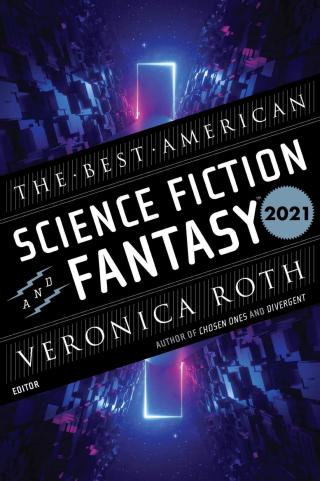
The Best American Science Fiction and Fantasy 2021
- Автор: Рот Вероника, Адамс Джон Джозеф
- Год: 2021
- Язык: английский
- Год: HMH Books : Mariner
- ISBN: 9780358470076
- Жанр: Малые литературные формы прозы

Электронная книга - «The Best American Science Fiction and Fantasy 2021». Краткое содержание книги:
This year’s selection of science fiction and fantasy stories, chosen by series editor John Joseph Adams and bestselling author of the Divergent series Veronica Roth, showcases a crop of authors that are willing to experiment and tantalize readers with new takes on classic themes and by exchanging the ordinary for the avant-garde. Folktales and lore come alive, the dead rise, the depths of space are traversed, and magic threads itself through singular moments of love and loss, illuminating the circulatory nature of life, death, the in-between, and the hereafter.
The Best American Science Fiction and Fantasy 2021 captures the all-too-real cataclysm of human nature, claiming its place in the series with compelling prose, lyrical composition, and curiosity’s never-ending pursuit of discovering the unknown.
How had Denny broken his story? He’d refused it. Whether his life was better or worse for it remained a different question. To break her story, she’d have to walk back down the hill and reconstruct herself the right way round. She thought of the cuckoo girl, the lost girl, the cuckoo girl, so many stories to keep straight.
The soil reached her forearms now, her calves. The top layer was sun-warmed, and underneath, a busy cool stillness made up of millions of insects, of the roots of the grass, of the rhizomes of the boy who had called this hillside home before she had. She’d walk back to town when she was ready, someday, maybe, but she was in no hurry. She’d heard worse stories than hers, and anyway, if she didn’t like it she’d make a new one, a better one, a true one.
DARYL GREGORY
Brother Rifle
The rehabilitation of Corporal Rashad Williams began like a magic trick. “Pick a card,” his doctor said. “Any card.”
Rashad considered the five cards on the table: yellow X, red circle, green triangle, blue square, orange rectangle. The symbols and their colors didn’t mean anything to him.
Two years before, a bullet had entered Rashad’s right occipital lobe, destroying the eye and ripping through the orbitofrontal cortex. Before that moment, he was a person who made things happen. Then, suddenly, he became an object that things happened to.
He was passed from doctor to doctor like a package with an unreadable address, until he arrived here, in Berkeley, at the lab of Dr. Subramanian, a lanky, East Asian, T-shirt-wearing dude, clearly civilian. The first thing he’d said when he shook Rashad’s hand was, “Thank you for your service.” The second was, “Call me Dr. S.” Rashad hadn’t been sure how he felt about that.
Rashad reached toward the yellow X with his right hand, then withdrew. A minute passed. Then two.
“Take your time,” Dr. S said. Rashad couldn’t decide if his smile was sincere or hiding his impatience. Sitting beside him was Alejandra, his grad student and assistant. She was a small woman, only a year or two older than Rashad, with glossy black hair pulled back so tight he thought she might be ex-military. So far she’d said very little, her attention on the tablet in her hands.
She was reading his mind.
The wires in Rashad’s Deep Brain Implant exited the skull but didn’t break the skin; they ran down his neck like artificial veins to a lump nestled a few inches from his right collarbone. This device, 98 percent battery and the rest a cluster of computer chips, controlled the DBI and spoke wirelessly to her tablet.
Rashad tapped his fingers at the edge of the table, near the red circle. He looked at Alejandra. She lifted her chin, and they shared a moment of eye contact before she returned her attention to the screen. Her eyes were very dark. Did she know which card he was supposed to pick?
He shook his head. “I’m sorry, sir. Ma’am.”
“There’s nothing to be sorry for,” the doctor said. “We’re just establishing a baseline. The first step to getting you back to your old self.”
Alejandra glanced at the doctor, but said nothing. Her face had not changed expression. He wondered what she was thinking, but the flow of information went only one way.
“Why don’t you try again?” the doctor suggested.
“Yes, sir.”
Rashad wondered what, exactly, he was being tested for. Did the symbols have secret meanings? Or were the colors significant? Perhaps red meant no. Could he ask to look through the remaining cards in the deck, or was that against the rules?
Dr. Subramanian shifted in his seat. Alejandra tapped at her screen. The test had been going on for fifteen minutes.
“I’m sorry,” Rashad said again. “I can’t decide.”
Once, Rashad had been very good at making decisions. Even that first month in Jammu and Kashmir, with insurgents firing at them from every rooftop and IEDs hiding under the road, he’d rarely hesitated and was usually right.
The man he’d been before the wound—a person he thought of as RBB, Rashad Before Bullet—was a systems operator in a fifteen-marine squad, responsible for the squad’s pocket-sized black hornet drones and his beloved SHEP unit. Good name. It was like a hunting dog on wheels, able to follow him or forge ahead, motoring through the terraced mountain villages, swiveling that .50 caliber M2 as if it were sniffing out prey. The sensors arrayed across its body fed data to an ATLAS-enabled AI, which in turn beamed information to the wrap screen on Rashad’s arm. Possible targets were outlined like bad guys in a video game: a silhouette in a window, on a roof, behind a corner.
But the SHEP wasn’t allowed to take the shot—that was Rashad’s decision. He was the man in the loop. Every death was his choice.
When a target popped up on his screen, all he had to do was press the palm switch in his glove and the silhouette would vanish in an exclamation of dust and noise, eight rounds per second. The AI popped up the next target and if he closed his fist just so, another roar ripped the body to shreds.
Hold. Bang. Hold. No and Yes and No.
“Aw sweetie, why don’t you go to bed?” It was Marisa, his sister-in-law. Rashad realized that for some time he’d been pacing. His hands ached, and he was surprised to see that his fists were clenched tight.
She touched his elbow, and he relaxed his hand. She was a white woman, and a Christian, but as kind and devout as Rashad’s mother. “Come on, I’ll take you.”
Rashad followed others now. He lived with Marisa and his brother, Leo, eating what they ate, waking up and going to bed when they did, watching the same shows. When he stayed too long on the patio Leo told him to come inside. When Marisa found him standing in front of an open closet, frozen by possibilities, she put the clothes in his hand. And when they found him pacing the house in the middle of the night—sweating, pulse racing for no reason—they guided him back to bed.
He lay down on top of the covers, as was his habit. Marisa put her hand on his forehead, over his eye patch, and said, “We ask for your healing, Lord.” When she said amen, he echoed her.
He’d become as obedient as the SHEP, but without any purpose. He could offer up no targets, protect them from no threats.
The next morning, Leo told him to shave and pull on a collared shirt, and then he drove Rashad the ninety minutes between Stockton and Berkeley. Rashad had appointments at the neuro lab every Tuesday and Thursday. This was week eight.
“Does it feel like it’s working?” Leo asked. Rashad didn’t know what to say. What did “working” mean? Some days he felt a shift in the way thoughts percolated through his brain; certain images and ideas took on a disruptive tinge, like the rasp of the bow under a violin note. Or perhaps he was imagining it. He knew Leo wanted the old Rashad to come back, the smart, cocky kid who laughed easily and threw himself into challenges. That Rashad had vanished into a world of acronyms—USMC, LeT, J&K, LOC, SHEP—and came back with a new one: TBI. It was Leo who’d signed the papers to enroll Rashad in Dr. Subramanian’s experimental program, and after two months, he seemed no closer to getting his little brother back.
Ten miles later, Leo shook his head. “Never mind.” He put his hand on Rashad’s shoulder. “Don’t worry about it, bro.”