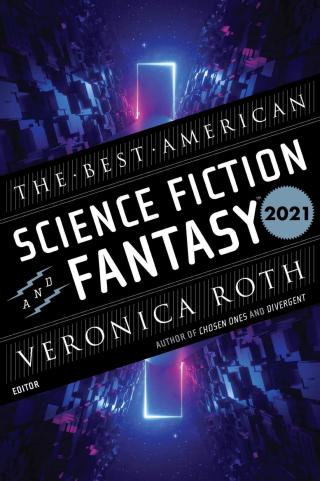
The Best American Science Fiction and Fantasy 2021
- Автор: Рот Вероника, Адамс Джон Джозеф
- Год: 2021
- Язык: английский
- Год: HMH Books : Mariner
- ISBN: 9780358470076
- Жанр: Малые литературные формы прозы

Электронная книга - «The Best American Science Fiction and Fantasy 2021». Краткое содержание книги:
This year’s selection of science fiction and fantasy stories, chosen by series editor John Joseph Adams and bestselling author of the Divergent series Veronica Roth, showcases a crop of authors that are willing to experiment and tantalize readers with new takes on classic themes and by exchanging the ordinary for the avant-garde. Folktales and lore come alive, the dead rise, the depths of space are traversed, and magic threads itself through singular moments of love and loss, illuminating the circulatory nature of life, death, the in-between, and the hereafter.
The Best American Science Fiction and Fantasy 2021 captures the all-too-real cataclysm of human nature, claiming its place in the series with compelling prose, lyrical composition, and curiosity’s never-ending pursuit of discovering the unknown.
Uncle Bob’s story was still going. “They dug me out of the hillside on my thirteenth birthday. It’s good to divide rhizomes to give them room to grow.”
“Did he say ‘me’?”
“A lot of his stories went like that, Stella. They started out like fairy tales, but somewhere in the middle he shifted into first person. I don’t know if he had a bad writer or what.”
“And did he say ‘rhizome’? Who says ‘rhizome’ to seven-year-olds?” Stella hit the stop button. “Okay. Back to work. I remember now. That’s plenty.”
Marco frowned. “We can keep working, but I’d like to keep this on in the background now that we’ve found it. It’s nice to see Denny. That Denny, especially.”
That Denny: Denny frozen in time, before he got weird.
Stella started on the boxes in the back, leaving the stuff near the television to Marco. Snippets of story drifted her way, about the boy’s family, but much, much older than when they’d buried him. His brothers were fathers now, their children the nieces and nephews of the teenager they’d dug from the hillside. Then the oddly upbeat theme song twice in a row—that episode’s end and another’s beginning.
“Marco?” she asked. “How long did this run?”
“I dunno. A few years, at least.”
“Did you ever go on it? Like Denny?”
“No. I . . . hmm. I guess by the time I’d have been old enough, Denny had started acting strange, and my parents liked putting us into activities we could both do at the same time.”
They kept working. The next Uncle Bob story that drifted her way centered on a child who got lost. Stella kept waiting for it to turn into a familiar children’s story, but it didn’t. Just a kid who got lost and when she found her way home she realized she’d arrived back without her body, and her parents didn’t even notice the difference.
“Enough,” Stella said from across the room. “That was enough to give me nightmares, and I’m an adult. Fuck. Watch more after I leave if you want.”
“Okay. Time to call it quits, anyway. You’ve been here like nine hours.”
She didn’t argue. She waited until they got out the front door to peel off the mask and gloves.
“It was good to hang out with you,” she said.
“You, too. Look me up if you ever get to Boston.”
She couldn’t tell him to do the same with Chicago, so she said, “Will do.” She realized she’d never asked what he did for a living, but it seemed like an awkward time. It wasn’t until after she’d walked away that she realized he’d said goodbye as if she wasn’t returning the next day. She definitely wasn’t, especially if he kept bingeing that creepy show.
When she returned to her parents’ house she made a beeline for the shower. After twenty minutes’ scrubbing, she still couldn’t shake the smell. She dumped the clothes in the garbage instead of the laundry and took the bag to the outside bin, where it could stink as much as it needed to stink.
Her parents were sitting on the screened porch out front, as they often did once the evenings got warm enough, both with glasses of iced tea on the wrought-iron table between them as if it were already summer. Her mother had a magazine open on her lap—she still subscribed to all her scientific journals, though she’d retired years before—and her father was solving a math puzzle on his tablet, which Stella could tell by his intense concentration.
“That bad?” Her mother lifted an eyebrow at her as she returned from the garbage.
“That bad.”
She went into the house and poured herself a glass to match her parents’. Something was roasting in the oven, and the kitchen was hot and smelled like onions and butter. She closed her eyes and pressed the glass against her forehead, letting the oven and the ice battle over her body temperature, then returned to sit on the much cooler porch, picking the empty chair with the better view of the dormant garden.
“Grab the cushion from the other chair if you’re going to sit in that one,” her father said.
She did as he suggested. “I don’t see why you don’t have cushions for both chairs. What if you have a couple over? Do they have to fight over who gets the comfortable seat versus who gets the view?”
He shrugged. “Nobody’s complained.”
They generally operated on a complaint system. Maybe that was where she’d gotten the habit of lies and exaggeration: she’d realized early that only extremes elicited a response.
“How did dinner look?” he asked.
“I didn’t check. It smelled great, if that counts for anything.”
He grunted, the sound both a denial and the effort of getting up, and went inside. Stella debated taking his chair, but it wasn’t worth the scene. A wasp hovered near the screen and she watched it for a moment, glad it was on the other side.
“Hey, Ma, do you remember The Uncle Bob Show?”
“Of course.” She closed her magazine and hummed something that sounded half like Uncle Bob’s theme song and half like The Partridge Family theme. Stella hadn’t noticed the similarity between the two tunes; it was a ridiculously cheery theme song for such a dark show.
“Who was that guy? Why did they give him a kids’ show?”
“The public television station had funding trouble and dumped all the shows they had to pay for—we had to get cable for you to watch Sesame Street and Mister Rogers’ Neighborhood. They had all these gaps to fill in their schedule, so anybody with a low-budget idea could get on. That one lasted longer than most—four or five years, I think.”
“And nobody said, ‘That’s some seriously weird shit’?”
“Oh, we all did, but someone at the station argued there were plenty of peace-and-love shows around, and some people like to be scared, and it’s not like it was full of violence or sex, and just because a show had kids in it didn’t mean it was a kids’ show.”
“They expected adults to watch? That’s even weirder. What time was it on?”
“Oh, I don’t remember. Saturday night? Saturday morning?”
Huh. Maybe he was more like those old monster movie hosts. “That’s deeply strange, even for the eighties. And who was the guy playing Uncle Bob? I tried looking it up on IMDb, but there’s no page. Not on Wikipedia either. Our entire world is fueled by nostalgia, but there’s nothing on this show. Where’s the online fan club, the community of collectors? Anything.”
Her mother frowned, clearly still stuck on trying to dredge up a name. She shook her head. “Definitely Bob, a real Bob, but I can’t remember his last name. He must’ve lived somewhere nearby, because I ran into him at the drugstore and the hardware store a few times while the show was on the air.”
Stella tried to picture that strange man in a drugstore, looming behind her in line, telling her stories about the time he picked up photos from a vacation but when he looked at them, he was screaming in every photo. If he were telling that story on the show, he’d end it with, “and then you got home from the drugstore with your photos, but when you looked at them, you were screaming in every photo too.” Great. Now she’d creeped herself out without his help.
“How did I not have nightmares?”
“We talked about that possibility—all the mothers—but you weren’t disturbed. None of you kids ever complained. It was a nice break, to chat with the other moms while you all played in such a contained space.”