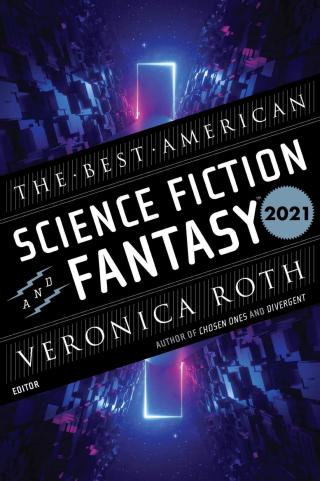
The Best American Science Fiction and Fantasy 2021
- Автор: Рот Вероника, Адамс Джон Джозеф
- Год: 2021
- Язык: английский
- Год: HMH Books : Mariner
- ISBN: 9780358470076
- Жанр: Малые литературные формы прозы

Электронная книга - «The Best American Science Fiction and Fantasy 2021». Краткое содержание книги:
This year’s selection of science fiction and fantasy stories, chosen by series editor John Joseph Adams and bestselling author of the Divergent series Veronica Roth, showcases a crop of authors that are willing to experiment and tantalize readers with new takes on classic themes and by exchanging the ordinary for the avant-garde. Folktales and lore come alive, the dead rise, the depths of space are traversed, and magic threads itself through singular moments of love and loss, illuminating the circulatory nature of life, death, the in-between, and the hereafter.
The Best American Science Fiction and Fantasy 2021 captures the all-too-real cataclysm of human nature, claiming its place in the series with compelling prose, lyrical composition, and curiosity’s never-ending pursuit of discovering the unknown.
There was a vast difference between “never complained” and “weren’t disturbed” that Stella would have liked to unpack, but she fixated on a different detail. “Contained space—you mean while we watched TV, right?”
“No, dear. The studio. It looked much larger on television, but the cameras formed this nice ring around three sides, and you all understood you weren’t supposed to leave during that half hour except for a bathroom emergency. You all played and we sat around and had coffee. It was the only time in my week when I didn’t feel like I was supposed to be doing something else.”
It took Stella a few seconds to realize the buzzing noise in her head wasn’t the wasp on the screen. “What are you talking about? I was on the show?”
“Nearly every kid in town was on it at some point. Everyone except Marco, because his brother was acting up by the time you two were old enough, and Celeste pulled Denny and enrolled both boys in karate instead.”
“But me? Ma, I don’t remember that at all.” The idea that she didn’t know something about herself that others knew bothered her more than she could express. “You aren’t making this up?”
“Why would I lie? I’m sure there are other things you don’t remember. Getting lice in third grade?”
“You shaved my head. Of course I remember. The whole class got it, but I was the only one whose mother shaved her head.”
“I didn’t have time to comb through it, honey. Something more benign? Playing at Tamar Siegel’s house?”
“Who’s Tamar Siegel?”
“See? The Siegels moved to town for a year when you were in second grade. They had a jungle gym that you loved. You didn’t think much of the kid, but you liked her yard and her dog. We got on well with her parents; I was sad when they left.”
Stella flashed on a tall backyard slide and a golden retriever barking at her when she climbed the ladder and left it below. A memory she’d never have dredged up unprompted. Nothing special about it: a person whose face she couldn’t recall, a backyard slide, an experience supplanted by other experiences. Generic kid, generic fun. A placeholder memory.
“Okay, I get that there are things that didn’t stick with me, and things that I think I remember once you remind me, but it doesn’t explain why I don’t remember a blacked-out TV studio or giant cameras or a creepy host. You forget the things that don’t stand out, sure, but this seems, I don’t know, formative.”
Her mother shrugged. “You’re making a big deal of nothing.”
“Nothing? Did you listen to his stories?”
“Fairy tales.”
“Now I know you didn’t listen. He was telling horror stories to seven-year-olds.”
“Fairy tales are horror stories, and like I said, you didn’t complain. You mostly played with the toys.”
“What about the kids at home watching? The stories were the focus if you weren’t in the studio.”
“If they were as bad as you say, hopefully parents paid attention and watched with their children and whatever else the experts these days say comprises good parenting. You’re looking through a prism of now, baby. Have you ever seen early Sesame Street? I remember a sketch where a puppet with no facial features goes to a human for ‘little girl eyes.’ You and your friends watched shows, and if they scared you, you turned them off. You played outside. You cut your Halloween candy in half to make sure there were no razor blades inside. If you want to tell me I’m a terrible parent for putting you on that show with your friends, feel free, but since it took you thirty-five years to bring this up, I’m going to assume it didn’t wreck your life.”
Her father rang the dinner gong inside the house, a custom her parents found charming and Stella had always considered overkill in a family as small as theirs. She and her mother stood. Their glasses were still mostly full, the melting ice having replaced what they’d sipped.
She continued thinking over dinner, while she related everything she and Marco had unearthed to her mildly curious parents, and after, while scrubbing the casserole dish. What her mother said was true: She hadn’t been driven to therapy by the show. She didn’t remember any nightmares. It just felt strange to be missing something so completely, not to mention the questions that arose about what else she could be missing if she could be missing that. It was an unpleasant feeling.
After dinner, while her parents watched some reality show, she pulled out a photo album from the early eighties. Her family hadn’t been much for photographic documentation, so there was just the one, chronological and well labeled, commemorating Stella at the old school playground before they pulled it out and replaced it with safer equipment, at a zoo, at the Independence Day parade. It was true, she didn’t recall those particular moments, but she believed she’d been there. The Uncle Bob Show felt different. The first time she’d uttered the show’s name, she’d thought she’d made it up.
She texted Marco: “Did Denny have all the Uncle Bob episodes on tape or only the ones he was in? Thanks!” She added a smiley face, then erased it before she hit send. It felt falsely cheery instead of appreciative. His brother had just died.
She settled on the couch beside her parents. While they watched TV, she surfed the web looking for information about The Uncle Bob Show, but found nothing. In the era of kittens with Twitter accounts and sandwiches with their own Instagrams and fandoms for every conceivable property, it seemed impossible for something to be so utterly missing.
Not that it deserved a fandom; she just figured everything had one. Where were the ironic logo T-shirts? Where was the episode wiki explaining what happened in every Uncle Bob story? Where were the “Whatever happened to?” articles? The tell-alls by the kids or the director or the camera operator? The easy answer was that it was such a terrible show, or such a small show, that nobody cared. She didn’t care either; she just needed to know. Not the same thing.
The next morning, she drove out to the public television station on the south end of town. She’d passed it so many times, but until now she wouldn’t have said she’d ever been inside. Nothing about the interior rang a bell either, though it looked like it had been redone fairly recently, with an airy design that managed to say both modern and trapped in time.
“Can I help you?” The receptionist’s trifocals reflected her computer’s spreadsheet back at Stella. A phone log by her right hand was covered with sketched faces; the sketches were excellent. Grace Hernandez, according to her name plaque.
Stella smiled. “I probably should have called, but I wondered if you have archives of shows produced here a long time ago? My mother wants a video of a show I was on as a kid and I didn’t want her to have to come over here for nothing.”
Even while she said it, she wondered why she had to lie. Wouldn’t it have been just as easy to say she wanted to see it herself? She’d noticed an older receptionist and decided to play on her sympathies, but there was no reason to assume her own story wasn’t compelling.
“Normally we’d have you fill out a request form, but it’s a slow day. I can see if someone is here to help you.” Grace picked up a phone and called one number, then disconnected and tried another. Someone answered, because she repeated Stella’s story, then turned back to her. “He’ll be out in a sec.”
She gestured to a glass-and-wood waiting area, and Stella sat. A flat screen overhead played what Stella assumed was their station, on mute, and a few issues of a public media trade magazine called Current were piled neatly on the low table.
A small man—a little person? Was that the right term?—came around the corner into reception. He was probably around her age, but she would have remembered him if he’d gone to school with her.