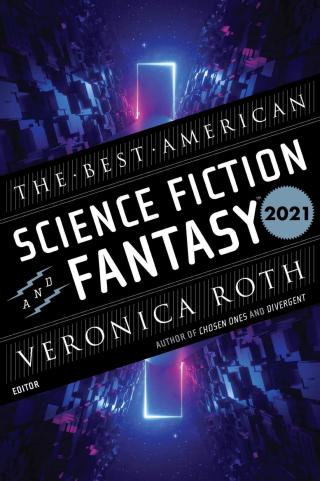
The Best American Science Fiction and Fantasy 2021
- Автор: Рот Вероника, Адамс Джон Джозеф
- Год: 2021
- Язык: английский
- Год: HMH Books : Mariner
- ISBN: 9780358470076
- Жанр: Малые литературные формы прозы

Электронная книга - «The Best American Science Fiction and Fantasy 2021». Краткое содержание книги:
This year’s selection of science fiction and fantasy stories, chosen by series editor John Joseph Adams and bestselling author of the Divergent series Veronica Roth, showcases a crop of authors that are willing to experiment and tantalize readers with new takes on classic themes and by exchanging the ordinary for the avant-garde. Folktales and lore come alive, the dead rise, the depths of space are traversed, and magic threads itself through singular moments of love and loss, illuminating the circulatory nature of life, death, the in-between, and the hereafter.
The Best American Science Fiction and Fantasy 2021 captures the all-too-real cataclysm of human nature, claiming its place in the series with compelling prose, lyrical composition, and curiosity’s never-ending pursuit of discovering the unknown.
Alejandra came out to the waiting room, neutral ground where she and his brother could transfer custody. “I’ll have him back to you in four hours,” she said to Leo.
She led Rashad through a confusion of corridors. Once he’d had a reliable sense of direction, but the bullet had destroyed that, too. In the lab he sat automatically at his usual seat, and she knelt and wired up the fingers of his left hand, connecting them to various recording devices. The controller in his chest, of course, was already whispering its secrets.
She looked up at him and smiled. “Ready for the slide show?”
“Yes, ma’am.” He knew she was just being polite, and not really asking for a decision. Acquiescence was his default.
She positioned the monitor and aimed the camera at his eye. Images popped up on the screen for half a second or less, a mix of animals, buildings, people, objects. In one burst he saw a brown horse, then a gray concrete building, the blue rectangle, a white woman in a green dress, an army PFC in desert camo holding an M4, a white sailboat. Blink, and another burst: green triangle, Labrador retriever puppy, yellow X, black M007 pistol, yellow X again. The card symbols came as frequently as punctuation.
Rashad had to do nothing but keep his left hand steady on his knee and his eye fixed on the screen; his body and brain reacted, sending data to Alejandra’s devices without bothering to notify him. Every twenty minutes she called for a short break, and every hour she brought him water or a cup of coffee—she decided which.
Dr. S was two steps into the room when he said, “Knock knock! How’s it going in here?” Alejandra paused the slide show. The doctor shook Rashad’s hand.
He usually stopped by for a few minutes during each appointment, like a dentist checking on a patient being worked on by a hygienist. Alejandra handed him the tablet. He jabbed and swiped at it, nodding and humming. Finally he sat beside Rashad and said, “I think we’re ready to start the experiential phase.”
Alejandra’s head turned sharply to look at the doctor, but Dr. S didn’t react. He said to Rashad, “Let me explain what I mean by experiential—it’s means we’re finally going to start bypassing the damage.”
The damage. The bullet had destroyed the link between Rashad’s limbic system and his frontal cortex, so that he no longer experienced emotions. But this wasn’t because his body lacked the machinery to create them. His amygdala and thalamus and hypothalamus continued to churn away, sending hormones coursing through his bloodstream, and his body responded: his pupils dilated and contracted, his heart raced and slowed. But these effects didn’t spark pain or bring him pleasure. He might as well have been reading about them on Alejandra’s tablet, each abrupt increase in his heartbeat another spike on a graph, each microburst of perspiration a data point. His body was throwing up indicators of a brain that had entered a particular state. But pain, pleasure? Those were things that didn’t exist without a consciousness to perceive them.
His lack of emotions didn’t turn him into a hyper-rational Mr. Spock; just the opposite. He’d become a tourist wandering through a foreign city where every street looked the same. When he was presented with the cards, a thought would come to him: pick the yellow X. But the thought had no weight, no rightness to it. The next thought came: pick the red circle. But that thought, too, was another soap bubble, easily popped.
It wasn’t that logic had become inaccessible. He could grind his way through a puzzle, he could solve math problems. But even with simple questions—what’s twelve times twelve?—when the answer arrived it seemed to tiptoe into the room, apologizing. He doubted its veracity. Nothing rang true.
Dr. S told him they were training his implant to pass the messages from the limbic system to the part of his brain that made decisions. “The DBI’s a black box—signals come in one side, and leave the other, getting reinforced or weakened in the middle. Or at least they will—nothing’s coming out the other side yet. All we’ve been doing so far is training the system.”
“He understands neural networks,” Alejandra said.
In the field, the SHEP’s AI was always learning from Rashad, recording which path he took through an environment, noting which shots he took and which he avoided, trying to become a better helper. The DBI was simply an artificial neural network planted inside his own broken one—one trying to become more like Rashad. The images weren’t merely pictures: they were triggers for a host of emotions and concepts and memories already primed in Rashad’s brain.
“What’s the algorithm?” he asked. “How does it decide which signals to strengthen?”
Dr. S’s eyebrows raised—a signal of surprise. Alejandra tilted her head. That gesture, however, was opaque to him.
“A great question,” the doctor said. “It starts with your body.” He talked about somatic markers, the residue of previous decisions by which the body felt its way to a new choice. “We monitor your heart rate, your oxygen levels, your galvanic skin resistance—everything we can think of—and of course the activity itself recorded by your implant. We try to match it to the firehouse of data coming through the DBI. Say that we’ve just shown you a picture of a puppy, that seems like it would be a positive emotional response, yes? So we assign a value to that moment of input and tag it.”
They’re guessing, Rashad thought. And then another thought came: They must know what they’re doing. Then: They’re guessing.
“Perhaps a picture of an attractive person makes your eyes dilate,” the doctor said. “Male or female, we’ll tag!” He chuckled, and Alejandra looked away. Was she embarrassed? Rashad couldn’t tell.
“Who decides what to tag?” Rashad asked. “You? Alejandra?”
“No, no. Well, yes. We have software that makes all the initial associations and applies a rudimentary score, based on data we’ve gotten from several hundred volunteers who’ve watched the same slides. Alejandra reviews the data entering your DBI, and can make corrections where necessary, based on your own history and known preferences.”
He thought, They know my history. But of course they did. His medical records would be on file: every detail from before the injury and from the aftermath, his diet of antibiotics and opioids, maybe even his psychologist’s therapy notes. For all he knew, both of them had gone back and read his evaluations from boot camp through deployment.
He wondered, idly, what Alejandra thought of him. Was she upset by what he’d done in the J&K? He tried to replay her reactions to him, but it was like watching a movie without sound.
“Rashad? Rashad.” The doctor was waiting for his response. “Are we good to go?”
Alejandra said, “You can’t ask him that. And in my opinion—”
“Yes, sir,” Rashad said.
“Excellent.” And then Dr. S was gone. Rashad turned back to the screen, ready to resume the slides.
Alejandra touched his arm to get his attention. “Do you have a therapist?”
That was an odd question. “No,” he said. “Not anymore.” For a few months after he was discharged from the hospital he met with a psychiatrist, but the sessions went nowhere.
“I’ll talk to your brother,” she said. “He should get you an appointment before next week.”
“Why?”
“You’re going to start feeling things.”
Pierce died first. He was a Black cowboy from Montana, a thing Rashad hadn’t known existed. Pierce said the mountains above Tartuk reminded him of home. They were severe and snow-capped, but the valley was alive with burbling creeks, lush trees, brilliant flowers, emerald fields. In this terraced village, every narrow street switched back to reveal another row of stone houses, another bridge, another burst of green. Another shooting gallery.