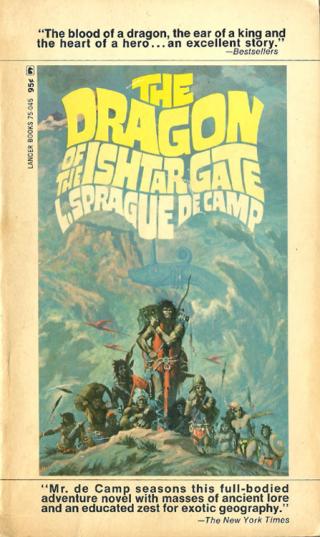
The Dragon of the Ishtar Gate
- Автор: Де Камп Лайон Спрэг
- Год: 1968
- Язык: английский
- Год: Lancer Books
- Жанр: Научная фантастика

Электронная книга - «The Dragon of the Ishtar Gate». Краткое содержание книги:
Dragon is probably closest in mood to de Camp's fantasy novels, while Bronze God and Arrows are closer to his science fiction, with their description of engineering problems, and personality clashes among researchers and engineers. Dragon also reflects de Camp's then-recent acquaintance with the Conan stories and other works of Robert E. Howard. Bessas, the huge Persian nobleman, is not only a close match for Conan in physique, but his mood swings, fixation on his mother, and tendency to toss of verses, seems a reflection of Howard himself. (Fortunately, his poems reflect de Camp's verbal dexterity and wit, not Howard's melancholy.)
"It is the nyuki."
"The what?"
Dzaka indicated a creature the length of a finger joint. "Bz-z-z-z! Bz-z-z-z!" he said, moving his index finger in circles. Then he touched himself and cried: "Eh! Eh!"
"I think he means a bee or wasp," said Myron.
"Bees?" said Bessas. "Aye, it might be. With all the other beasts, one can fight, bluff, run, hide, or climb, but none of these acts avails against a swarm of angry bees. Mithra grant that we stumble not upon such! Now tell me, Master Dzaka, where the Astasobas—the River as these folk call it—comes from."
When this had been translated, Dzaka said: Yes, the Astasobas did indeed flow out of a great lake, the Lutta Nzigé, or Shining Slayer of Locusts. Many other streams flowed into this lake and others in the region, so no man could say just where the Astasobas started, as the water from all these streams mingled into one.
"I see," said Myron. "We dispute over the question of where some river rises. But the question really means nothing, because a river rises in as many places as it has tributaries."
"Well, we can truthfully say we have been to the head-waters of the Nile," said Bessas, "even if we do not trace every tributary back to its source. Master Dzaka, have you heard of the stone castle of King Takarta?"
Yes, said Dzaka; he knew of the castle and its guardian demon. But the Tikki-Tikki had not looked into the matter, because they had no reason to- think they could slay the demon or, even if they could, that it would prove edible.
Bessas said: "A practical-minded race—Myron, my jravashi tells me we are followed. Now, I could run five leagues with this little fellow on my shoulders and not tire. But the shaykh and the girls are near exhaustion. So what in the seven Babylonian hells shall we do?"
"Keep on walking, I suppose," said Myron. "They haven't caught us yet. In fact, we don't even know that they are pursuing us."
"Let us hope—" began Bessas, but then Dzaka spoke:
"I hear the barking of dogs behind us."
Nobody else could hear the sound. They straggled on for another hour. Then Bessas said:
"I hear it, too. You were too quick with your hopes, O Myron."
Myron asked: "Could it be a pack of these piebald wild dogs that we have seen pursuing antelope?"
"Nay," said Dzaka. "Wild dogs do not bark like that."
When they climbed a rise, Bessas sent Merqetek up a tree to spy. The Dankala stood in a crotch, shading his eyes against the sun. At last he called down: "I see them, far away. There are at least a hundred, with dogs ... Now they are out of sight again."
"Come down," said Bessas. The Bactrian stamped and swore in a fury of frustration. "May worms eat their guts! May the Corpse Fiend gnaw their bones! May they all be kinless! If there were a few more of us, or less of them, or if we had horses, I would chance a fight. Or, in a barren mountainous land, like Gandara, it were easy to find some rocky point that a handful could hold against a multitude struggling up from below. In thick jungle, such as I have seen in Hind, one can ofttimes give the pursuer the slip, as by walking in a stream bed. But here ..." He helplessly waved towards the gently rolling, parklike landscape. "One can neither fight, nor hide, nor fly. By myself I could outrun them, but of this company only Ajang could keep up with me, and I cannot abandon my comrades."
"Would to Zeus that we had the Tower of the Snail here," said Myron. "That was an excellent fortress. How about Takarta's castle? How far is the Locust Killer?"
"Nine days' march," said Dzaka. Myron grunted.
"Could we climb trees?" asked Kothar.
"Certes," said Bessas, "until they shot us out of the branches or burnt the trees down. Keep marching!"
Another hour passed. Now all could hear the barking.
"Ere long," said Bessas grimly, "they will sight us. O Shaykh, shall we slay the women rather than let them fall into these devils' hands?"
"These women," said Salimat, "will die fighting beside their men, if you will give us weapons to fight with."
"You shall have your chance," said Bessas.
"If we could find a dense thicket," panted Shaykh Zayd, "we could creep in, and then they could come at us only a few at a time."
"They'd set the thicket afire," said Myron.
"But the plants hereabouts are wet from last night's rain. Perchance the trees would not burn."
"Could we hold them off by archery?" said Myron. "We outrange them, because I doubt if these unfeathered African arrows are accurate."
"We haven't enough arrows left," growled Bessas. "Keep marching!"
The barking came louder.
Dzaka said: "There is a stream in these parts. I had thought to see it long since."
"Couldn't we walk along the stream bed to throw the dogs off the scent?" said Myron.
"If they were not so close upon us, belike," said Bessas. "As it is, they would espy us at our wading."
As they topped the next rise, a chorus of yells, tiny with distance, broke out behind them. Myron looked back. Atop the last rise, two or three furlongs back, swarmed a mass of human figures, looking like small black ants at the distance.
"Well," said Bessas, "that does it. They have seen us. Now we must run, casting about for some defensible place. A clump of large trees, if their trunks be close enough together, were better than this open greensward. Yâ ahî!"
Off went the Bactrian at a trot, with Dzaka bouncing on his shoulders.
XVII – The Mountains of the Moon
Myron ran, stumbled, and ran some more. His heart pounded and his knees shook. He gasped for breath. An iron band seemed to compress his lungs. He brushed a bee away from his face and ran on.
At that, he ran better than some. Bessas led the flight; next behind him loped the towering Ajang. Then Merqetek and the surviving Arabs—Labid, Umayya, and Abras—ran in a knot. Myron panted after them. Behind him came Kothar, Phyllis, and Salimat. Old Zayd tottered at the tail of the procession.
At the top of the next rise, Bessas halted. Myron thought it was simply to let the others catch up, but then he saw that Dzaka was excitedly pointing and jabbering. When Myron reached the crest, he perceived that the stream of which Dzaka had spoken lay just beyond, cutting through a narrow cleft. This was about one reed wide but shallow, gurgling around projecting rocks.
"There's hope," said Bessas gruffly. "See you yonder tree?"
"Yes," said Myron.
"Well, run your eye up to a height of ten cubits. See you those great holes in the trunk?"
"Yes."
"See you aught else?"
"I see what appears to be a cloud of insects buzzing around the holes."
"Well, those, says Master Dzaka, are bees. An arrow in one of those holes would rouse the horde. Now, peer over the bank of the stream. See you where that big tree has fallen half over, so that its roots are bared?"
Myron saw the corner of a natural cave created by the fall of the tree. The stream had eroded away the earth supporting the tree until a wind had toppled it. But it failed to fall completely, because its branches tangled in those of its neighbors. The huge half disk of roots, projecting up at an angle from the bank of the stream, formed the roof of the cave, and the undisturbed earth its floor.
Bessas tenderly handed Dzaka to Ajang. "Get down in that cave, all of you. Cover yourselves as best you can."
"If we had our tents—" grumbled Kothar.
"Hold your tongue and obey orders!" snapped Bessas. "Leave space for me, as I shall come in haste."
Ajang began to lay Dzaka in the cave, then backed out with a startled yell. "Nyoka mkubwa!" cried the Pygmy.
"What's the matter? Mice?" said Bessas.
"Big snake!" said Merqetek.