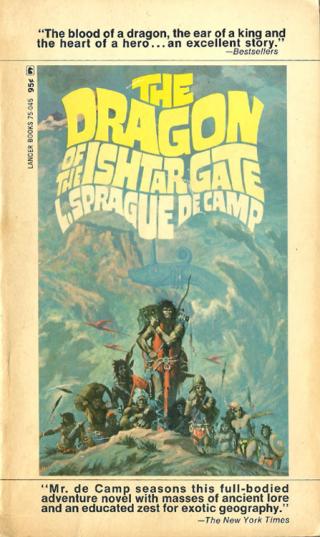
The Dragon of the Ishtar Gate
- Автор: Де Камп Лайон Спрэг
- Год: 1968
- Язык: английский
- Год: Lancer Books
- Жанр: Научная фантастика

Электронная книга - «The Dragon of the Ishtar Gate». Краткое содержание книги:
Dragon is probably closest in mood to de Camp's fantasy novels, while Bronze God and Arrows are closer to his science fiction, with their description of engineering problems, and personality clashes among researchers and engineers. Dragon also reflects de Camp's then-recent acquaintance with the Conan stories and other works of Robert E. Howard. Bessas, the huge Persian nobleman, is not only a close match for Conan in physique, but his mood swings, fixation on his mother, and tendency to toss of verses, seems a reflection of Howard himself. (Fortunately, his poems reflect de Camp's verbal dexterity and wit, not Howard's melancholy.)
"Tayyib!"
"Now you shall swear allegiance to Bessas for the rest of this journey, as if he were already your shaykh. Find me a sharp stone."
A flint-headed spear dropped by one of the Akulangba in flight served the purpose. Bessas sat close to Zayd, facing the three young Arabs, with seven stones between them. With the spear, Zayd made a slight cut in the palm of the hand of each, at the base of the middle finger. Zayd touched the corner of Bessas' shirt to Bessas' wound and touched the bloodstained cloth to the seven stones. Then he did the same for each of the Arabs, saying:
"If any of the parties to this pact shall forswear and violate it, may the curse of al-Ilah and al-Ilat descend upon him; may his camels die of the murrain; may the demons of the waste play games with his bones ..."
When Zayd had finished, each of the Arabs in turn kissed the hem of Bessas' shirt, promising him loyalty and obedience. Bessas in turn promised them protection, justice, and a fair share of the loot of all raids and robberies. When that was over, Bessas kissed his bride tenderly and looked around, saying:
"What next, dear friends?"
Myron had- been writing. Now he handed a scrap of parchment to Phyllis, saying:
"Before these witnesses I, Myron Perseôs of Miletos, do hereby completely and irrevocably free and manumit you, Phyllis daughter of Philippos of Aineia, without restriction or reservation of any kind. Here is a written statement to that effect." In a hurried undertone he added: "Please guard it carefully, because it has part of my notes on the religions of Egypt on the other side, and I want to copy these notes when we get back to civilization. Now, let's see, will somebody lend me some money? This is to be a Greek ceremony, which means that Phyllis must have a dowry."
Zayd handed his daric to Myron, who handed it to Phyllis. He said:
"O Bessas son of Phraates, before these witnesses, I, Myron Perseôs, acting in lieu of the father of Phyllis daughter of Philippos, who is unable to perform this office, do hereby give this my freedwoman, the said Phyllis, to you as your wife. I also give into your care her dowry, being one daric stater of gold. This property, you shall have the management and the usufruct of. But it shall revert to her in the event of divorce or widowhood; or, if she predecease you, it shall descend to her children. Love, cherish, and respect her, and may Zeus and Hera and Hymen and Aphrodite and Artemis and the other gods and goddesses bless your union and grant you many happy years together. Now repeat after me: 'Before these witnesses, I, Bessas son of Phraates ..."'
Bessas cleared his throat. "Before these witnesses, I ..."
"Now," said Myron when Bessas had finished his bath, "we sing a hymn to Hymen. As Phyllis and I are the only ones who know it, and as I cannot carry a tune, I think one stanza will suffice us. Do you know Tune the lyre and hang the garlands green, Phyllis?"
"Yes."
"Then here we go":
In her nervousness Phyllis sang, "Hang the lyre and tune the garlands green," but nobody noticed save Myron. The company prayed to its various gods. The suggestion of a dance to celebrate the wedding was quickly squelched for fear the noise should draw enemies, and they turned in early.
They made the shaykh, who seemed to have largely recovered, as comfortable as they could. Myron privately asked him: "What led you to change your mind about purity of blood, O Zayd?"
"My daughter made up her mind. Also, the gods whispered into my ear: 'O Zayd, you may not survive this journey, so it were well to put your house in order.' Such advice is not to be slighted, although I hope for many years yet."
But next morning the old man was dead. They buried him, wept for him briefly, and hurried on.
During the next day's march, Myron—one side of his face swollen like a melon from the bee sting—asked Bessas: "Did you enjoy your drinking bout with King Ravonga?"
"If you don't mind their constant manslaying and their curious taste in victuals, the Akulangba are gentlemen of a sort. They have a strict code of manners and morals; and Ravonga means to see that they keep to it, if he must have every man in his kingdom clubbed and thrown to the crocodiles.
"As he explained to me, after the banana wine had gone to his head: 'Most men are bad. They lie, cheat, steal, fornicate, and disobey the king whenever they think they can do so without punishment. Those whom men call good are mainly those too weak or too timid to be bad. Therefore the king must make himself feared if he is to exact any sort of moral conduct from his subjects. That is why I am strict with my people, and they respect me for it.'
"Belike there is something in what he says. At least, I shall bear his words in mind when I become shaykh. I have known worse drinking companions than Ravonga, but 'tis well that we did not prolong our stay. It would have taken but the slightest whim or flash of ire to have changed us from honored guests into the main course at dinner."
Having run out of writing materials, Myron lost track of the date. However, from the phase of the moon, he judged that they were in the second half of Kislimu when, toiling over an endless grassy plain, they came to the top of a long undulating incline. This slope led down for another league to a great inland sea, which sparkled like quicksilver. To the travelers' right rose a range of massive, jungle-covered mountains. To the left, the plain dipped slightly into a great papyrus marsh, through which the Astasobas, emerging from the lake, wound its way. Bessas asked:
"Dzaka, is this the Locust Killer?"
"Aye."
"Are those the Mountains of the Moon?" The Bactrian pointed to the range on the right.
"Hapana. The Mountains of the Moon lie beyond the Locust Killer, another moon's journey." The Pygmy pointed southwestward, towards the knife edge of the far horizon, where the steel-gray sea met the sky.
"Where is the castle of Takarta?"
Dzaka pointed south, towards the place where the shelving eastern shore of the lake vanished over the curve of the sea. "Five or six days' journey."
"Then must we cross the Astasobas again?"
"Ndiyo sana."
"Well, it won't hurt us to get wet once more. Off we got"
As they marched south along the eastern shore of the great lake, the water widened until they could no longer see the other shore line. Now and then they sighted, on the opposite side, a silvery thread of a waterfall descending the rugged slopes of the mountain range, or an equally slender thread of blue smoke rising from some human habitation.
Although men were few in this land, they passed, about once a day, a squalid little fishing village, redolent of drying fish. These fishermen, whom Dzaka called Vakovi, also took water from the lake to make salt by filtering and evaporation. Bessas traded meat he had shot and some of their few remaining trinkets for fish and salt.
Dzaka continued a practice that he had begun soon after their escape from the Akulangba. Whenever they halted near a fallen tree that had lain long enough for its heartwood to have rotted out, he would squat by it, with his injured leg sticking awkwardly out, and pound elaborate rhythms on the hollow log with billets of wood.
"I talk to my people," he said.
The lake sparkled endlessly on their right, save when sudden, violent thunderstorms whipped its surface to froth and drenched the travelers. Floating islands of papyrus reed, torn loose from marshes by the storms, wafted about its surface. Hippopotami lay in great herds in the shallows. At night they came ashore to wander the land like ghostly black clouds, grunting and chomping the long grass.
On the fourth day after they reached the Locust Killer, two small brown naked figures rose out of the scrub, shouting, "Dzaka!"