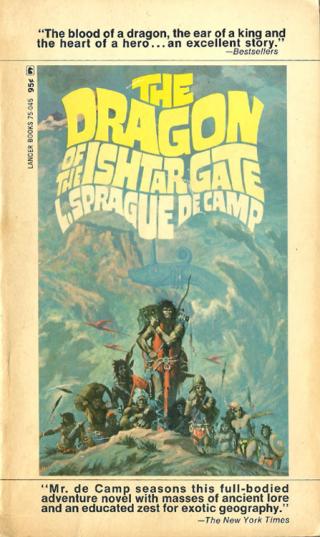
The Dragon of the Ishtar Gate
- Автор: Де Камп Лайон Спрэг
- Год: 1968
- Язык: английский
- Год: Lancer Books
- Жанр: Научная фантастика

Электронная книга - «The Dragon of the Ishtar Gate». Краткое содержание книги:
Dragon is probably closest in mood to de Camp's fantasy novels, while Bronze God and Arrows are closer to his science fiction, with their description of engineering problems, and personality clashes among researchers and engineers. Dragon also reflects de Camp's then-recent acquaintance with the Conan stories and other works of Robert E. Howard. Bessas, the huge Persian nobleman, is not only a close match for Conan in physique, but his mood swings, fixation on his mother, and tendency to toss of verses, seems a reflection of Howard himself. (Fortunately, his poems reflect de Camp's verbal dexterity and wit, not Howard's melancholy.)
"These oafs won't mind my whacking them now and then if I let them have their fun. You cannot run an expedition as if it were a lecture course." Then he went off to join the dance, whooping and capering with the best.
During this time, Myron moved like a man in a daze, for all he could think and talk about was his wonderful new theory of the shape of the earth. At last, during a noonday halt, Bessas said:
"O Myron, yours may indeed be the discovery of the age. But you are becoming as bad, in ever talking about your conceit, as you say I am about horses. Besides, it makes me dizzy to think of hanging head down from the bottom of the earth. So pray give that flapping tongue a rest. Set yourself, instead, to master the speech of the savages, in case some accident befall our sorcerous Syrian."
So Myron conversed with Merqetek, Ajang, and Yilthak, picking up smatterings of their languages and learning much about the men and beasts of this unknown land. For instance, he learnt to distinguish the two kinds of rhinoceros: the smaller and more dangerous kind, which browsed, and the larger, grazing kind, which merely blinked stupidly as the travelers passed.
"Have you ever heard of serpents big enough to swallow elephants, whereof they told us in Kush?" said Myron.
The interpreters laughed. "Nay," said Ajang. "In the Great Forest grow serpents big enough to engulf a man or a cow, but never big enough to swallow an elephant. You, master, have been swallowing lies."
"Then, save for venomous serpents, I do not see that the beasts of this land are greatly to be feared, for all their size and abundance, provided one exercises prudent caution and stays with one's comrades. I am more concerned with the men known as the Eaters, because I do not think I should enjoy being cut up and roasted by human beings any more than I should like being swallowed by a snake. It seems to me that we are headed towards the Eaters' country."
"Fear not," said Ajang. "We would not be eaten, either. Yonder"—he threw out an arm to westward—"lie the lands of the Eaters, many days' journey hence. Yonder"—he pointed southwest—"lies the Great Forest, where dwell little men no higher than your knee. Yonder"—he pointed south—"stand the Mountains of the Moon. Yonder"—he pointed southeast—"the River flows out of the lakes that lie at the foot of these mountains. And that way"—he jerked a thumb to the east—"dwell the Mattitae, with whom King Gau is at war. So, you see, you cannot really get lost. We can always find the River by marching eastward. Now, however, we shall march to the southeast, so that ..."
The Alab's voice died. On both sides of the safari stood a long line of spearmen, who had silently sprung from the shrubbery.
The march came to a stumbling halt. Some of the Ptoemphani dropped their loads and made as if to run. However, they found that they were surrounded by the newcomers. Moreover, Bessas, an arrow nocked, threatened to shoot the first man who ran.
The new Africans were men of ordinary stature, about that of Myron himself. They were of stocky, muscular build, very black, very flat of nose and full of lip. Unlike the naked tribes of the Astasobas, they wore kilts of goatskin or tree-bark cloth. They had the tails of cows and other beasts fastened to the backs of their skirts, and antelopes' horns affixed to their heads, which gave them a wild and fiendish look. They also bore well-made weapons of polished stone.
The thing that most struck Myron about these men was their discipline. In this respect they differed from the turbulent Anderae, the impulsive Alabi, and the unmannerly Ptoemphani. They stood like so many ebony statues until their officers told them to move.
A man wearing a mantle of black and white monkey fur stepped forward and spoke. Ajang presented Bessas to Ongosi, general of the great king, Ravonga son of Mbomu.
"Bessas!" said Myron. "In the name of Zeus, tell him you're a son of Xerxes!"
Bessas scowled at the lie but let himself he presented as a son of the Great King, on his way to pay his respects to King Ravonga.
"That is good," said Ongosi. "You shall come with us to our city of Ravonga. Our king, the stamp of whose foot causes mountains to crumble, will be pleased to see such outlandish creatures as yourselves."
The general smiled, showing a set of teeth filed to points. He barked an order, and the spearmen closed up around the travelers.
As he resumed his march, Myron cast a glance at Ajang. The Alabi interpreter's eyes bulged, his mouth hung slack, and he shambled along with drooping shoulders. The man looked terrified.
"What is the matter?" said Myron.
Ajang stuttered: "The-these are the Akulangba—the Eaters!"
"Oh!" Myron whistled. "I thought they dwelt several days' march to the west?"
"So did I!" wailed Ajang. "I do not understand how they come to dwell in this land. I know nothing!" The Alab began to blubber, as if he had lost whatever sense he possessed.
The country blazed with an intense, aggressive greenness. Huge trees were laden with flowers of flame red and flowers of gold. The sun beat down fiercely from high overhead, although the air was mild and springlike.
The city of Ravonga spread out over several low hills near a sluggish river. It was not a city in the sense in which Myron would have used the word. Rather, it was a royal stronghold surrounded by the scattered huts and garden patches of several thousand of King Ravonga's subjects. Myron was struck by the neatness and good order of these huts.
The king's compound stood on the largest of the hills, surrounded by a wooden stockade. Myron's eyes widened as they approached the stockade. Among the Astasobas, he had become used to seeing a few poles topped by skulls at the entrances to villages. King Ravonga, however, used these ominous objects as an artistic motif. Every alternate stake of the stockade bore a skull. There must have been over a thousand of them, all grinning outwards.
Ongosi pointed to a row of empty huts, explaining that these were for the use of the party. Ajang interpreted:
"He says: Get ready to visit the king. A man will come for you when the king is ready."
A guard of spearmen were posted around the huts. Myron and Bessas took one of the huts and spent a lively time chasing out the resident snakes, lizards, scorpions, centipedes, spiders, and huge red crickets, while listening to the horrified laments of the rest of the company. Their comrades' courage had vanished utterly on learning that they had fallen into the hands of the dreaded Eaters.
"We are lost!" wailed Zayd. "My lads fear not to face death, so that they have a good chance of decent burial. But they cannot bear the hideous fate that now confronts us!"
Bessas grunted. "What recks it whether you are eaten by worms or by other men? You're dead either way. The Derbikkai of Hyrkania get rid of their old people thus, and it always seemed sound sense to me."
Kothar, equally agitated, protested: "My lords, to scoffing skeptics like you—if you will pardon the expression—the fate of your bodies may seem of small moment. But to pious persons like myself and the shaykh, such a fate were worse than death. We know that our souls would be condemned to wander, homeless and comfortless, for aye, perchance to be enslaved by some wicked witch and forced to commit nameless abominations at his behest."
"Rubbish! Anyway, nobody has eaten us yet. We have escaped from worse coils, and we shall get out of this one whole. You shall see."
When the others had gone, Bessas and Myron clad themselves in their only remaining presentable tunics and got out gifts for King Ravonga. Bessas muttered:
"Would that I truly felt as confident as I sounded just now!"
"They haven't asked for tribute yet," said Myron.
"True, but it may be that Ravonga plans to devour us and possess himself of all we have. So why should he ask, when he knows he can take?"