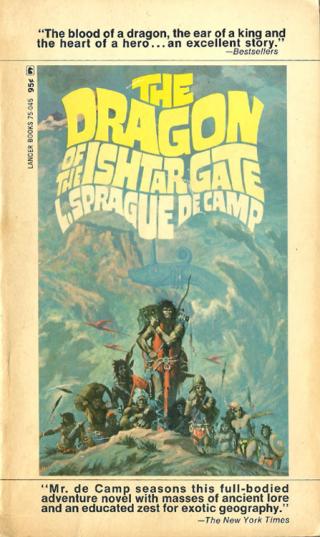
The Dragon of the Ishtar Gate
- Автор: Де Камп Лайон Спрэг
- Год: 1968
- Язык: английский
- Год: Lancer Books
- Жанр: Научная фантастика

Электронная книга - «The Dragon of the Ishtar Gate». Краткое содержание книги:
Dragon is probably closest in mood to de Camp's fantasy novels, while Bronze God and Arrows are closer to his science fiction, with their description of engineering problems, and personality clashes among researchers and engineers. Dragon also reflects de Camp's then-recent acquaintance with the Conan stories and other works of Robert E. Howard. Bessas, the huge Persian nobleman, is not only a close match for Conan in physique, but his mood swings, fixation on his mother, and tendency to toss of verses, seems a reflection of Howard himself. (Fortunately, his poems reflect de Camp's verbal dexterity and wit, not Howard's melancholy.)
During his watch, Myron heard the drumming again. His viscera crawled at the sound, and he threw more wood on the fire. When his time to rest came, he tossed and turned. When he did get to sleep, it seemed to him that he stood at the entrance to the castle, and an African god, fanged and taloned, rushed out and chased him over the savanna. He awoke with a yell as the thing's claws sank into him.
Bessas, Myron, Kothar, Merqetek, Ajang, and the Arabs cautiously picked their way along the hog-backed ridge that led out to the point on which Takarta's castle stood. Bessas strode like a man without fear. Behind him, Kothar carried his African idol in one hand and a looped cross, made of twigs, in the other. He never ceased to mumble spells and prayers. The others all looked terrified. Myron, bringing up the rear, had to speak sharply to keep them moving.
Utter silence reigned over the stronghold of the fugitive Kushite king. As he neared, Myron saw that it was made of unmortared, unshaped fieldstone. The stones, ranging in size up to that of a man's head, were roughly fitted together. It was a redoubt of the sort that men, knowing stone construction but stranded in a wild country and forced to depend for labor on simple primitives, would build.
Nevertheless, it was an imposing structure. The walls were irregularly curved, following the contours of the peak. If the castle had been square, it would have measured about twenty-five or thirty paces on a side. The outer wall rose to a height of eight to ten cubits, varying because of the irregularities of the ground. Taller construction could be seen within its confines.
A gap in the wall before them showed where the main gate had stood. Bessas hesitated before this aperture, an arrow nocked on his bowstring. The others crowded up behind, curiosity vying with terror. All stood quietly, listening. Myron noticed crumbling fragments of wood, relics of the gate. Termites and mold had destroyed all the rest of the portal.
"I hear nought," muttered Bessas. "Kothar, perform your office."
Kothar raised his hands, chanting:
Although his heart pounded with nervousness, Myron could not help the wry thought that part of the art of exorcism was to bore the hostile spirit to death. Kothar droned on and on, describing all the things that would happen to the demon if it did not clear out:
Kothar ended with a tremendous curse:
"That," said Kothar at last, "ought to do it."
"Come on," said Bessas, and stepped through the entrance.
As he passed through the opening, Myron observed that the outer wall was tremendously thick, with a pronounced batter. From the inner side of this wall, several partitions of stone had been extended to form chambers. Gaps in the upper courses of these partitions showed where wooden beams had been set to hold up a roof.
In the center of the inclosure rose a two-story building, the upper story being a mere penthouse. All the rooms gaped roofless to the sky. In several places the partitions had slumped, piling up irregular heaps of stones on the ground. A curious musky odor, which Myron could not identify, hung over the stronghold.
A contrast of color caught Myron's eye. From the stone-paved flooring of the courtyard he picked up an ivory sword hilt, with a pommel carved in the form of a vulture's head. The blade had rusted away to a faint red-brown stain on the stones, and the ivory was discolored by weathering. But the weapon had once been a handsome one. Others picked up similar relics: a small golden earring, a copper amulet green with corrosion, a bronzen buckle ...
"Athtar love us, but what is this?" said one of the Arabs.
He pointed to a scattering of human bones, lying near the corner of the inner structure. Bessas bent over.
"They don't seem to have been broken or crushed, as by a wild beast," grunted the Bactrian. "But if the wight simply lay down and died, how did his bones get so scattered? Here are some of the ribs. There are more. There's the skull, as if somebody had kicked it in play—"
A high, horrible, ear-splitting yell smote their ears, making them leap convulsively. As Myron turned, he saw a sight that nearly stopped his heart. All cried out.
Around the end of one of the partition walls came a creature. Although this thing walked on all fours, it possessed an enormous manlike form. Long black hair, shot with gray, covered it save on the face. The skin of its face was black, below a skull that peaked to a high, hairy crest. Small, deepset eyes glared out from beneath huge bony eyebrow ridges. Its nose was wide, flat, and flaring, with forward-opening nostrils.
The monster rose to its hindlegs. Although these legs were shorter than those of a man, its arms were far longer, and its stature was that of a tall man. It drummed on its chest with the flats of its hands, making the booming sound that Myron had heard during the night.