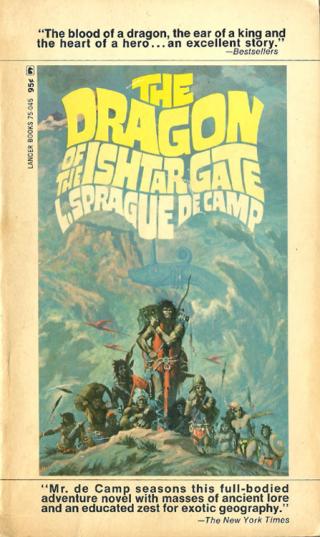
The Dragon of the Ishtar Gate
- Автор: Де Камп Лайон Спрэг
- Год: 1968
- Язык: английский
- Год: Lancer Books
- Жанр: Научная фантастика

Электронная книга - «The Dragon of the Ishtar Gate». Краткое содержание книги:
Dragon is probably closest in mood to de Camp's fantasy novels, while Bronze God and Arrows are closer to his science fiction, with their description of engineering problems, and personality clashes among researchers and engineers. Dragon also reflects de Camp's then-recent acquaintance with the Conan stories and other works of Robert E. Howard. Bessas, the huge Persian nobleman, is not only a close match for Conan in physique, but his mood swings, fixation on his mother, and tendency to toss of verses, seems a reflection of Howard himself. (Fortunately, his poems reflect de Camp's verbal dexterity and wit, not Howard's melancholy.)
They bore small bows, each with a featherless arrow nocked. The points of these arrows were smeared with a black tarry substance, and the arrows in their quivers were carefully covered lest their points touch the bearers. Bone daggers were thrust through their waist strings.
"Put me down," said Dzaka to Bessas. Hopping on one leg and holding the giant's hand, Dzaka called to the Pygmies. A swift rush of talk convinced the latter that they had nothing to fear.
"I told you I talked to my people," said Dzaka. "These men are not of my band, but they know of the Eaters' attack upon us. My people have fled in that direction." He pointed northwest. "They will follow on our trail when they learn whither I have gone."
The Pygmies examined the travelers, fingering the remnants of their clothes and their shabby equipment. They reached up and patted Bessas' midriff.
"They say you are a good man," said Dzaka. "Now Jogo goes to find my band, and Adimoku stays with us. If you need meat, he will kill it for you."
Bessas started a rumbling laugh but checked it at once, so that it came out as a snort. "That will be good," he said. He spoke to Myron in Greek: "I almost laughed at the idea of this little whoreson's being a better hunter than I. But then it struck me that he makes his living thus, and those envenomed shafts are not to be despised. Besides, our own arrows are nearly exhausted."
They marched on to the south. As the lake widened, the nature of the eastern shore changed, rising from the water to bold cliffs and headlands. Adimoku proved as good as his word.
"I thought I knew stalking," said Bessas after he had gone out to hunt with the Pygmy, "but forsooth I know nought. This fellow wriggles through the grass like a serpent to within spitting distance of an antelope. Then—ping!—the little poisoned arrow pierces the animal's neck, and down it goes."
In addition, Adimoku proved a marvelous forager, producing strange tubers, fungi, lizards, and other unfamiliar foods by the basketful. Dzaka said:
"The stupid Mbabantu put seeds in the ground, and plants grow up, and they eat the plants. Then one year all the plants die, and the Mbabantu die, too, because they know not how to get food in other ways. We Tikki-Tikki never go hungry."
"Except," said Myron, "that a lion sometimes makes a repast off you, does he not?"
Dzaka thought. "That is true. But then, lions get hungry, too."
As they marched, Myron became aware of a new feature in the landscape. To the southwest, where the lake met the skyline, a pattern appeared in the sky, just above the horizon. At first it was no more than a tiny sugges-tion of distant clouds. But as they marched it grew and became more stable.
At last Myron realized that he was looking at a distant range of enormous snow-capped mountains. Most of the time they were so obscured by clouds that the snowy peaks could not be seen. But sometimes, especially early in the morning, they stood naked and clear, white above and deep blue beneath. To Myron they looked mysterious and menacing. Although he doubted the tale of the salt giants, he supposed that the mountains might be the abode of Zeus-only-knew what strange beings.
At the same time he found a certain stark beauty in the sight. He kept this feeling to himself, knowing that all sensible men would regard as mad a man who saw beauty in snow-covered mountains.
"Aye," said Dzaka, "those are the Kilima Mwezi—the Mountains of the Moon. See you the salt on top?"
Myron began to explain the nature of snow but thought better of it. Instead, he said:
"You see, Bessas, this proves my theory about the earth. Have you observed how these mountains seem to rise out of the lake as we near them? So the surface of the earth must indeed be curved like a sphere. I hope I survive the journey to report this discovery to Xerxes."
"Tell me more about this Great King," said Dzaka from his seat on Bessas' shoulders. The Pygmy seemed endlessly fascinated by stories of life in the Persian Empire, and it gave Myron a chance to improve his command of the elaborately inflected Mbabantu tongue.
"You say this Great King stops the little kings from fighting one another," said Dzaka. "Could he stop the Akulangba and the Mbabantu from killing the Tikki-Tikki?"
"I do not know," said Myron. "Hitherto, his rule has not extended to this country. He cannot command where his soldiers cannot go."
"But Bessas is one of his warriors," said Dzaka, pointing to his mount. "And he comes to this land."
"Well, I suppose we could ask the king about protecting the Tikki-Tikki."
Bessas grumbled: "Don't let us in for any more monstrous tasks! Capturing a dragon that seemingly is not and finding a demon-haunted royal treasure are quite enough, without trying to open diplomatic relations between Persepolis and the Mountains of the Moon!"
"Speaking of demon-haunted castles," said Myron, "what's that yonder, on that point?"
Under a gray overcast, a promontory jutted out into the waters of the Locust Killer, rising to a peak at its outer end. Steep cliffs fell away sheerly to the water on all sides of the peak, except for the narrow ridge that ran out from the land. On the tip of the peak, a small dark eminence, more regular than a natural formation of rock, indicated human construction.
"That's it," said Bessas grimly.
The Pygmies chattered in the Tikki-Tikki tongue. Dzaka said:
"Adimoku says, if you please, he will not enter the stone house. Although he has slain an elephant, demons are beyond his ken. I do not wish to enter this place, either."
"I think we can excuse you," said Bessas. "For that matter, 'tis too late in the clay to assail that stronghold. It would be dark ere we readied it, and I am for fighting demons by daylight, if one must fight them at all."
They camped on the lip of a ravine, through which a stream trickled down from the plain to the Locust Killer. A furlong away, Takarta's castle frowned down upon them, a crude dark mass, sharp in outline but vague in detail. The overcast persisted. A moonless night came down upon them, blotting out everything beyond range of their campfire.
Myron could not remember a darker night. Standing near the edge of the bluff, he could barely make out the ghostly pallor of the surface of the Locust Killer below. From afar came the snorting of hippopotami and the trumpeting of an elephant.
Beside him, Bessas stared into the unyielding darkness towards the unseen castle. "I feel," muttered the Bactrian, "that we are being watched from up yonder."
"If so," said Myron, "they are not human watchers. Men would show a light. Perhaps they have flaming eyeballs like your Ahriman to light the darkness. What's Kothar up to?"
"Exorcisms. I told him that, if he knew any really good spells against demons, now was the time to use them."
They stared towards the Syrian, who squatted in front of a small fire. He had set up a hideous little ivory image, which he had obtained in one of the African towns, and was muttering and making signs with his hands.
Bessas whirled to face the castle again, head lifted like that of a wild beast listening. "Hear you that?"
"No. What?"
"A drumming comes from the castle."
"Oh. Now I hear it," said Myron.
Out of the darkness, over the buzz and chirp of nocturnal insects, came a roll or tattoo of impact sounds, as if somebody or something were beating rapidly against a large resonant object with the palms of its hands.
"There is something—" said Bessas. He listened, then said: "Let's go closer!"
"My dear fellow!" said Myron. "Though I believe less in demons than you do, I'm sure I should blunder off the edge of a cliff in this murk."
"Belike you're right." The Bactrian sounded almost relieved; as if, having shown his courage, he welcomed an excuse not to exercise it to the full. "It is your turn to take first watch."