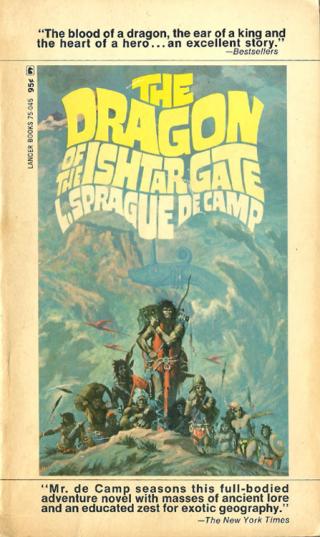
The Dragon of the Ishtar Gate
- Автор: Де Камп Лайон Спрэг
- Год: 1968
- Язык: английский
- Год: Lancer Books
- Жанр: Научная фантастика

Электронная книга - «The Dragon of the Ishtar Gate». Краткое содержание книги:
Dragon is probably closest in mood to de Camp's fantasy novels, while Bronze God and Arrows are closer to his science fiction, with their description of engineering problems, and personality clashes among researchers and engineers. Dragon also reflects de Camp's then-recent acquaintance with the Conan stories and other works of Robert E. Howard. Bessas, the huge Persian nobleman, is not only a close match for Conan in physique, but his mood swings, fixation on his mother, and tendency to toss of verses, seems a reflection of Howard himself. (Fortunately, his poems reflect de Camp's verbal dexterity and wit, not Howard's melancholy.)
Bessas' face showed an inner struggle. Racial pride and his Bactrian bias towards truthfulness struggled with prudence. At last Myron spoke:
"Tell the king that it is hard to judge the relative sizes of two such buildings unless one can place them side by side. We invite him to come to Persepolis and compare palaces with his own eyes."
"The king says he would like to do that, though many hostile nations imperil the way. After the feast, when the sun has set, he asks that King Bessas join him in the palace to drink pombé. He may bring one interpreter."
The king swaggered off.
The travelers dined well, though some had been fearful lest they eat human flesh unawares. Myron snorted.
"I'll wager this is nothing but good old beef—and from one of our own oxen, at that. Besides, what if you did swallow a mouthful of man? The man is dead, so it cannot matter to him."
"You are a desperate rogue, O Myron," said Zayd, pulling his long gray beard with his bony hand. "We cannot all face these horrors so cold-bloodedly as you do."
Myron hid a smile. "Bessas, why did you give up the oxen so easily? They'd have been useful—"
"Because they are all down with this sickness they call nagana and so will soon be dead anyway." Bessas rose, wiping his mouth. "Now I must go to drink pombé with our kindly king."
"Don't forget what happened with General Pu—"
"Yes, teacher. Belike Kothar knows a spell against drunkenness; eh, sir wizard? If so, start mumbling!"
Bessas departed. Within and without the royal stockade, the Akulangba capered in endless dances to the tune of drums and reed flutes. The flutes played the same simple phrase over and over, while the drums emitted complex and ever-shifting rhythms.
Myron paced nervously. He cursed King Ravonga, who had not invited him to this evening's drinking bout so that he could keep an eye on Bessas. He cursed Bessas, who would probably try to drink down his host and end up in a snoring stupor. He cursed himself for getting into such a fix, and he cursed Phyllis for making him feel guilty about exposing her to such perils. Would it not be a fine irony, he thought, if the man who had made the greatest discovery of the age were chopped up and broiled to sate the hunger of savages?
Hours later, heavy breathing sounded outside. Bessas loomed in the doorway. The Bactrian stooped to enter, holding a large object cradled in his arm with his cloak wrapped around it. He spoke with quiet intensity:
"Merqetek, Ajang, stand in the doorway to block it! Look what I have!"
He unwrapped the object, which gave a groan. It was the oldest of the three Pygmies whom they had seen in the pit that morning.
"Divinity!" breathed Myron. "How did you ever get him?"
"I slipped out the back door of the palace whilst all the Akulangba were drunken, broke down the fence, and clambered down into the pit. They had taken all of those we saw but two Pygmies. I couldn't take both, so I chose the one most likely to be of use to us: the chief."
"What of the king?"
"Snoring soundly. He tried to drink me down. You need not look at me in that disapproving way. I chewed a fistful of kahawa berries, so it would take more than this wishy-washy banana juice to fuddle me. But I'm so full of pombe' that I splash inside as I walk.
"Now, barken! We leave tonight. Most of the Akulangba have fallen asleep, and our guards will do the same. I have seen to it that they, too, got a ration of pombé. We shan't be able to carry much, as we may be pursued. Let each of you go over his gear and take what is most essential; all weapons, for instance, but no tents, beads, or extra garments. Do not try to carry more than half a talent.
"Meanwhile, I shall set this little fellow's leg; I know enough field surgery for that. Fetch me some walking sticks to make a splint and straps to tie it fast with."
Dawn saw twelve figures hurrying across the meadows and through the groves of the land to the south of Ravonga. Small antelope bounded out of their way; large ones raised their heads to gaze in wonder. Grotesque wart hogs trotted off, their tails held stiffly erect. A lion trailed the company for a while but slunk away when Bessas roared at it and waved a spear.
All the company bore packs on their backs. Besides his pack, Bessas carried the Pygmy chieftain on his shoulders. The little man's broken leg was swollen and discolored under the crude splint. Nevertheless, though the jarring must have greatly pained him, he gave no sign of his feelings save an occasional grunt.
When the Pygmy learnt that he was not to be eaten, he became talkative. Besides his tribal tongue, he also spoke Mbabantu, the common speech of this region, so that Ajang and Merqetek could translate.
The Pygmy was Dzaka, chief of the eastern Tikki-Tikki. Ajang explained:
"He says: My band set up a hunting camp at a safe distance, they thought, from Ravonga. We went there because the Akulangba are unskillful hunters, and game is therefore plentiful in their land. But a war party of Akulangba found our camp and rushed us. I and two others tried to fight whilst the rest of the band fled into the bush, but the big men threw a net over us and caught us as if we had been so many bush pigs. They also caught one child, which they butchered and ate on the spot.
"Then they trussed us and carried us back to Ravonga, arriving two days ago. They broke one leg of each of us and threw us into that pit. Now, I am happy not to be eaten. But, if you do not mean to eat me, why then did you take me from the Akulangba?"
"Tell him a man cannot have too many friends in this wild country," said Bessas. "So we thought that if we res-cued him, he might do us some good. We need guidance to the place we are going, and belike he can persuade his fellow tribesmen to help us."
"He says he will surely do that. But he knows not whither the rest of his band have gone, and you will need help ere he can find them. For the Akulangba will pursue you with dogs, and he cannot talk to his people because the Akulangba would hear the sound."
"What means he, talk to his people?"
"With a drum."
Bessas and Myron questioned Dzaka about his band and his way of life. They were purely hunters, although they sometimes traded meat to the Mbabantu for vegetable foods and implements.
About the habits of animals, they discovered, Dzaka was a mine of sober, factual information. There were no sirrushes and no elephant-eating serpents, he assured them, at least within twenty or thirty leagues of where they were. He had roamed this entire country and knew it as well as he knew the palm of his hand.
And speaking of animals, said Dzaka, they had better make a detour to the left.
"Why?" said Bessas.
"Mbogo."
Myron peered through the long grass but could not see any buffalo. Then, as the marchers wound their way in the direction that Dzaka showed them, there was a huge black bull, standing with its muzzle up and staring at them from a hundred paces off. As the party drew away, the bull resumed its grazing.
"You see," Dzaka explained, "a single buffalo is more dangerous than a herd and should therefore be given ample room."
"Why is that?" asked Bessas.
"Because," replied the Pygmy, "if you run at a herd, shouting and waving your arms, they will nearly always run away. In a herd there is sure to be at least one cowardly animal, and when it runs the others run, too. But a single buffalo may not be a coward, and it can kill you if you annoy it."
Bessas asked: "What would you deem the most dangerous beast in this land?"
Dzaka thought awhile, then chuckled. "Guess," he said.
"The lion?"
"Nay."
"The elephant?"
"Nay ..."
When he had run through all the larger African animals that he knew of, Bessas gave up. "Well, what is it, then? Some monster that we have not yet met?"