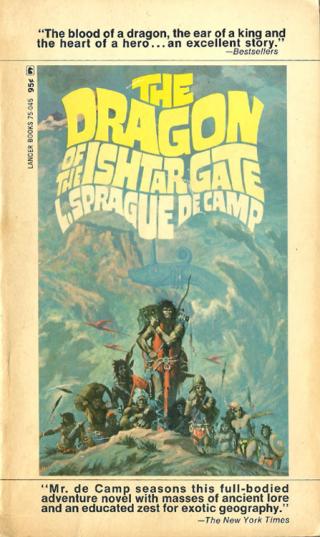
The Dragon of the Ishtar Gate
- Автор: Де Камп Лайон Спрэг
- Год: 1968
- Язык: английский
- Год: Lancer Books
- Жанр: Научная фантастика

Электронная книга - «The Dragon of the Ishtar Gate». Краткое содержание книги:
Dragon is probably closest in mood to de Camp's fantasy novels, while Bronze God and Arrows are closer to his science fiction, with their description of engineering problems, and personality clashes among researchers and engineers. Dragon also reflects de Camp's then-recent acquaintance with the Conan stories and other works of Robert E. Howard. Bessas, the huge Persian nobleman, is not only a close match for Conan in physique, but his mood swings, fixation on his mother, and tendency to toss of verses, seems a reflection of Howard himself. (Fortunately, his poems reflect de Camp's verbal dexterity and wit, not Howard's melancholy.)
"What think these folk of Ravonga?"
"They worship him. They say he is the greatest king among the Akulangba for ten generations, since the divine Basenga, who was the son of the god Mboli."
"Why does he waddle?" Bessas imitated Ravonga's strut.
"He mimics the walk of the lion, to show his people that he has a lion's might and ferocity."
Myron turned to see another procession emerging from the royal stockade. Men walked in pairs, each pair carrying a corpse by wrists and ankles. They bore the man who had been haggled to death for adultery, and the youth whom the king had beheaded, and four others; two men and two women. These last four had all had their skulls bashed in.
"What happens yonder?" said Myron.
"Those," said Ajang, "are the people who have today displeased King Ravonga. Their bodies are thrown into the river for the crocodiles to eat. When the great king has time, he causes felons to be bound and thrown into the river alive. Then he and his court walk downstream, following the victims, until they reach the place where the crocodiles seize them and twist off their limbs by rolling over and over in the water."
"You are right, O Myron," said Bessas. "I am hardly a simpering milksop, but this place is too violent for me. If the gods will, we shall march on the morrow."
Before dawn, Myron awoke from a dream of earthquakes to find Ajang shaking him.
"Great chiefs!" cried Merqetek, waking Bessas. "The Ptoemphani are gone!"
Bessas leaped up with a roar. "Gone? What mean you, man?"
"They stole away during the night. All, even Yilthak, have vanished."
Myron yawned and rubbed his eyes. "No doubt they heard about the forthcoming feast. Knowing their hosts, they foresaw that they might be served up as the main course, so they decamped. Perhaps they were wiser than we."
"Know you what they did?" said Ajang. "They saved up their pombé, drinking none themselves, and plied the sentries with it until these oafs all went to sleep."
"Well, that spills the perfume into the soup!" snarled Bessas. "That means that when we leave here—"
"If we do," murmured Myron.
"—we shall have to carry such gear as we can take on our own backs. That leaves—let me see—eleven of us, counting the women and these black lads. We can carry no gifts to barbarian princes and only enough food for a few days. Nor do I think that old Zayd can endure this pace much longer."
A royal page put his head in at the door of the hut and spoke. Ajang said: "It is time to go to the king, my masters."
The sun was rising redly over the broken landscape of savanna patched with jungle, when King Ravonga issued from his palace. Again, Ravonga's subjects threw themselves flat in the dirt, while Bessas and his people bowed.
"The king asks if you have more presents for him."
Bessas produced more beads and bangles.
"The king knows that you have two women. The king wishes them as gifts, also."
Bessas and Myron exchanged glances. Bessas said: "Tell the king that these women are not in condition to give to such a great man as he. We must clean and deck them first." He added in an undertone to Myron: "This means we clear out as soon as we can."
"The king understands. He has also learnt that your porters all fled during the night."
"That is true."
"Then, says the king, since you will not be able to carry with you the other gifts you have brought, you might as well give them to him now."
"Tell His Majesty that we will do our best; but that some of these things we must keep to enable us to travel."
"Then, says the king, you must give him those oxen you brought with you, as otherwise there may not be enough meat to go round at the feast tonight."
"I gladly give the king these oxen. Now may I ask the king some questions?"
Bessas asked about the sirrush and was assured that no such creature dwelt near Ravogna. About the elephant-eating serpents he received the same reply. The king had heard of the demon-haunted stone castle on the edge of a lake at the foot of the Mountains of the Moon but could not add to what the explorers already knew.
"The king would like to show you his palace and grounds. Will you come with him?"
King Ravonga waddled back into the thatched palace. The explorers trailed after him, amid a buzz of translation: "... Here is the king's private retiring room ... Here is the shrine to Mboli, where he leads his wives and children in prayer ..."
They rambled into the women's section of the palace. A young woman, naked and apparently a little drunk, approached the king, giggling foolishly, The king barked for his executioner, who rushed up, threw a cord about the woman's neck, and dragged her off, wailing piteously.
Unmoved, King Ravonga continued his tour. He led his visitors out the rear entrance of the palace. Here a large area was devoted to many purposes connected with the palace. There were huts for the royal servants, the execution ground, the king's private vegetable garden, a playground for the royal children, and a huge pit with a low fence around it.
"What is this?" said Bessas. Myron, looking over the fence, felt another prickle of horror.
In the steaming sunlight lay seven human beings. All were alive, all were naked, and all had had one or both legs broken. Four were Negroes, three men and a woman, much like the Akulangba in physical type.
The remaining three were small men, about four feet in height and of a slightly lighter brown than the Akulangba. Myron thought that they were the ugliest little men he had seen, with their potbellies and scrawny limbs. Their wide mouths, receding chins, and button noses gave them a simian look. Seven pairs of eyelids rose and seven pairs of eyes looked dully up at the spectators.
"What are those people doing there?" inquired Bessas.
"The king says they are some foreigners whom his men have lately captured. They are being saved for tonight's feast."
Myron felt a surge of excitement. "Tell the king that I have heard of the Pygmies from afar, although I had expected them to be even smaller. The greatest poet of my people mentions them!"
"Oh?" said the king. "Does this poet mention me?"
"No."
The king frowned ominously. "Then he cannot be much of a poet."
Myron hastily said: "Tell His Majesty that this poet lived long ago, before our time."
"The king understands. He also says he fears the older two of the Tikki-Tikki are too scrawny and tough. The one with the gray hair is a chief, but that will make him no more toothsome." King Ravonga laughed heartily at his own humor.
Myron could not resist saying: "If the king executes so many of his subjects, why must he hunt abroad for human flesh?"
Bessas scowled a warning, but too late. When the question had been translated, King Ravonga's eyes widened with horror.
"The king says: Are you suggesting that we eat our fellow tribesmen? That were a bad thing to dot Do you eat your fellow tribesmen at home?"
"No. We do not eat men."
"The king says: King Bessas has told him what mighty warriors his Persians are, and what great wars they wage. If the dead are not eaten, then what is done with them?"
"Nought," said Bessas, "unless the victorious general can take the time to bury his fallen."
"The king says that you must indeed be a wicked folk, to wage war without a good reason!"
Bessas looked at Myron. "Do you know, old man, I never thought of it that way before? Tell the king he may well be right."
King Ravonga led them around to the front of the palace. "The king asks: Is the palace of your father, the Persian king, any larger or grander than mine?"