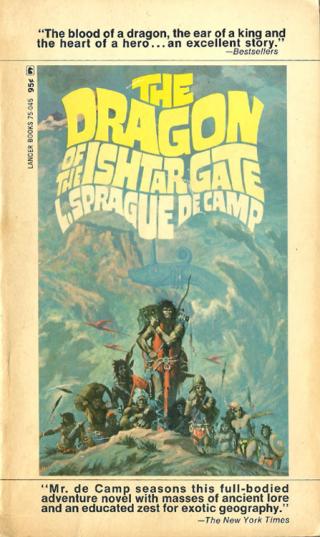
The Dragon of the Ishtar Gate
- Автор: Де Камп Лайон Спрэг
- Год: 1968
- Язык: английский
- Год: Lancer Books
- Жанр: Научная фантастика

Электронная книга - «The Dragon of the Ishtar Gate». Краткое содержание книги:
Dragon is probably closest in mood to de Camp's fantasy novels, while Bronze God and Arrows are closer to his science fiction, with their description of engineering problems, and personality clashes among researchers and engineers. Dragon also reflects de Camp's then-recent acquaintance with the Conan stories and other works of Robert E. Howard. Bessas, the huge Persian nobleman, is not only a close match for Conan in physique, but his mood swings, fixation on his mother, and tendency to toss of verses, seems a reflection of Howard himself. (Fortunately, his poems reflect de Camp's verbal dexterity and wit, not Howard's melancholy.)
He paced back and forth, ignoring the roar of a lion. He bit his lips and beat his head with his knuckles. He threw himself down and beat the earth with his fists. Then he leaped up with a yelp, because he had thrown himself on top of a nest of stinging ants. While he was picking the angry insects out of his clothes and skin, a touch on his arm made him start.
It was Umayya. "They sent me to fetch you back," said the Arab. "Elephants are all around, and they feared for your safety."
"Elephants?" said Myron, bringing his mind with an effort back to present reality.
A tree as thick as a man's thigh went over with a crash a few reeds away, and a pair of tusks showed pale against the starlit darkness. Another great black form eclipsed the campfire. A shrill trumpet blast made Myron jump. From all around came other elephantine noises: Squeals, grunts, groans, grumbles, snorts, snores, and the rumble of elephantine stomachs. Mixed with these was the swish of grass and the crackle and crash of branches torn off and trees overthrown.
"Ye gods and spirits!" said Myron. "There do seem to be a few of them. Let us—"
"Yalla!" screamed Umayya, and ran.
Myron smelled elephant and glimpsed a flapping ear that blotted out the stars. The beast, looking as big as the Ishtar Gate, was almost on top of him.
Myron ran after Umayya, following the Arab by the pallor of his loincloth. Although he ran headlong into a baby elephant and mistook a grown one for a tree, he at last arrived back at the camp. Bessas said:
"How in the name of Mithra did you fail to hear them? They've been making a fiendish alarum around us for hours."
"I was thinking about the stars," panted Myron.
"Well, if that's what it is to be a philosopher, I will stick to my sword and bow. Of what avail great thoughts if they allow the thinker to be squashed like an insect?"
But Myron could not give up his private quest. The following day, they halted by the banks of a stream. Myron went off to find a place to wash a dirty shirt.
A clump of trees spread their branches over the stream; from these branches hung masses of globular nests. Hundreds of yellow weaver birds clambered and fluttered about these nests, casting the din of their chatter abroad.
As Myron approached, they flew up in golden clouds. He passed the clump and found a half-submerged boulder that would serve for laundering. Little by little the birds returned to their city.
Myron's gaze rested upon the weaver-bird colony. Thinking of the odd ways of men and beasts, Myron watched as one of the golden birds scrambled upside down about the lower half of its bag-shaped nest.
Myron's mind wandered to similar scenes from the world of nature. He thought of a fly creeping about a fruit, running sure-footedly over the lower as well as the upper surface; or the lizards that swarmed in the Negroes' huts, scuttling upside down across the ceilings of thatch. Now, suppose the world were like such a fruit—spherical, as Bessas had once jestingly suggested—and men were like the fly. Then they could walk on all sides, bottom as well as top, without falling off.
But how would this be possible? Well, how did a fly manage? No doubt a fly had sticky feet, and men did not. But the forces that bound men fast to the earth's surface might work down towards the center of such a ball-earth from all sides. In that case, the direction of "down" would be one of those relative things whereof Herakleitos hinted. Why should one believe that there is any universal direction of "down," the same for gods and men? Why indeed, save that it was one of those things one had always taken for granted?
My "down," he thought, need not be the same as your "down," nor is my "up" your "up." It all depends upon where we stand. If we stand on opposite sides of this fantastic ball-earth, your "down" is my "up" and vice versa.
Myron leaped up and began to pace, striking his palm with his fist. The theory seemed at first utterly insane. But, the longer one thought about it, the more sense it made. Why did one see different stars, the farther south one went? Because one was farther around the bulge of the sphere. Where did the sun go at night? Why, around to the other side of the sphere. Why could one not see clear to the edge of the earth from a high mountain? Because one could not see around the curvature of the sphere. Why did the sun pass directly overhead in this clime, but not farther north? Because this was the part of the earth directly beneath the path of the sun, whereas in Hellas one viewed the sun from outside this zone.
Myron started back for the camp, so filled with his marvelous idea that twice he tripped over buttress roots and fell. At the camp, men were napping or performing small chores. Bessas looked up casually; then his deep-set eyes hardened as he saw that something was up.
"Heurêka auto!" cried Myron.
"You have found what?"
"I know! I know it! At last! It's wonderful!"
"Have you gone mad?"
Myron caught his breath. "The shape of the earth! I have found it! I know it! My dear fellow, this is the greatest d-day of my life!" He seized Bessas' massive arm and squeezed, shaking the arm as a dog shakes its prey. "It is shaped like a ball, a sphere! It is round! This explains everything! I am a made man! At last!"
He poured out a stream of impassioned Greek, arguing and explaining, shaking his fists, slapping Kothar's back, kissing Phyllis, hugging a startled Zayd, then leaping and capering about the camp like one bereft of his senses. He threw himself on the ground and rolled, laughing and crying.
"It's wonderful, wonderful, wonderful, wonderful ..."
Zayd asked Bessas: "Have the gods taken away our poor friend's wits?"
Bessas shook his head. "Nay. This is a seizure of what the Hellenes call philosophy."
"Is it then a kind of religious frenzy?"
"You might say so, though this religion has no temples. If we pay him no heed, it will pass." Bessas blew his whistle. "Time to pick up our loads! Jump to it, whoresons!"
"I—I was just washing my shirt," said Myron, "and watching these little yellow birds, when—where in Tartaros is my shirt, anyway? I must have left it by the stream!"
He ran off to recover the garment.
That night Myron said to Phyllis: "Come here, my girl."
With a small sigh she came. Afterwards he asked: "Didn't you enjoy it at all?"
"It did not hurt, master. You are a kind man."
"But you are really assotted with that roaring young friend of mine, who makes the ground smoke under him, eh?"
"What if I am, sir? I can do nought. A woman torn from her family is like an insect, floating on a chip which is tossed on a stormy sea, and a slave must obey her master." She wept.
"Well, some day we must do something for you; for you have made my life more pleasant. But for now, we have all we can do to stay alive."
XVI – The Land of the Eaters
South, south, south they wended. Three of the riding oxen died, but otherwise the company kept its health.
Myron found the Ptoemphani a trial. They were always shirking and quarreling, always finding a thousand excuses for putting off the start of the march in the morning and another thousand for ending it early in the afternoon. Then, having persuaded Bessas to let them stop before they dropped from exhaustion, as soon as the sun went down they began pounding a hollow log, clapping hands in rhythm, dancing, and singing at the tops of their lungs. This they would keep up for hours.
Myron, who liked a reasonable quiet in which to think and write, chafed with annoyance. But Bessas merely said: