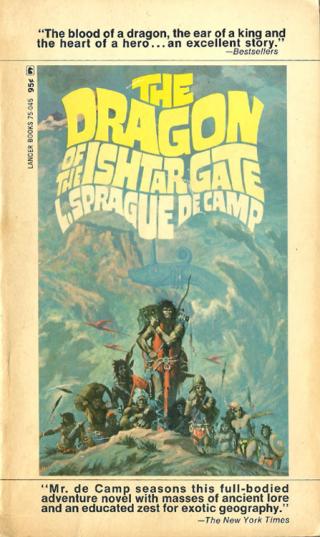
The Dragon of the Ishtar Gate
- Автор: Де Камп Лайон Спрэг
- Год: 1968
- Язык: английский
- Год: Lancer Books
- Жанр: Научная фантастика

Электронная книга - «The Dragon of the Ishtar Gate». Краткое содержание книги:
Dragon is probably closest in mood to de Camp's fantasy novels, while Bronze God and Arrows are closer to his science fiction, with their description of engineering problems, and personality clashes among researchers and engineers. Dragon also reflects de Camp's then-recent acquaintance with the Conan stories and other works of Robert E. Howard. Bessas, the huge Persian nobleman, is not only a close match for Conan in physique, but his mood swings, fixation on his mother, and tendency to toss of verses, seems a reflection of Howard himself. (Fortunately, his poems reflect de Camp's verbal dexterity and wit, not Howard's melancholy.)
Myron accompanied the king to the smelting pit, which Shimri, stripped to a loincloth, was lining with clay. A pair of Alabi helped him, though in a fumbling manner because they had hardly any words in common with him. Another pair appeared, bearing a pole whence a basket-load of iron ore from across the river was slung. They dumped the contents of the basket atop the growing pile of ore.
Shimri, his shoulders peeling from sunburn, wiped the sweat from his forehead and turned his red face up. "I have hunted all over this neighborhood without finding any good limestone for flux. Without flux, you lose half your iron in the slag." He gave his shrill, unbalanced laugh. "I know; I shall—ah—work a miracle! I am the great Dagon!" He resumed his work, singing a Dagonite hymn.
"Sometimes," said King Gau, "I think that some god or spirit has taken possession of Shimri." The king looked up, his eyes straining northward. "Your porters come."
Up the river, along the path that lined the eastern bank, came a procession of men with gaudy patterns of red and white painted on their sable skins. Led by Ajang, ' King Gau's tall, grave messenger, they appeared comparatively small and gaunt.
"Their crops have been bad," said King Gau.
The newcomers crowded together, giggling nervously as the Alabi pressed around them, uttering gibes and threats. Myron counted; there were forty-four instead of sixty.
"And withal," said Bessas' familiar growl, "many look not as if they could bear a full talent apiece. But we live as we can, not as we list, as the camel said who tried to fly. Who commands?"
Yilthak, leader of the Ptoemphani, was a mild, middle-aged Negro. When his crew began to scream demands that they be made spearmen instead of simple carriers, Yilthak proved unable to control them. Bessas had to knock a few heads together to restore quiet.
"You think spearmen will have life easy!" he cried. "Well, you shall take turns at these different duties. Myron, make a list of these men, so that we shall know who deserts or misbehaves."
Then Kothar spoke to Merqetek, who spoke to Ajang the messenger, who spoke to Yilthak, who spoke to the porters, who looked serious.
"I merely, told them," said Kothar, "that you had made a magic whereby any evildoer shall be eaten by large purple snakes that will grow in his intestines and devour him from the inside."
"King Gau!" said Bessas. "How many of those riding oxen, pray, are there? As all of our animals have died, we could make good use of such steeds."
"I have many," said the king. "Take such as you wish; it is only a fair return for Shimri's services to us."
Myron spent an hour learning to ride an ox. The animals' gait was easy enough, but they could not be controlled by the rider. Another man had to lead them.
The company also took time to worship Kwoth, the god of the Alabi. "It may do no good," said Bessas, "but we do not want to miss any chances."
"By Zeus the king!" swore Myron the following morning, as the sun rose over the wide green Alabian plain. "Bessas, if I ever thought Zayd's boys a little unruly, I now retract that opinion. They are demigods of order and discipline compared to these whipworthy rascals."
The twain had been trying for a Babylonian double hour to get the expedition under way. But the Ptoemphani made endless difficulties. Every man argued at the top of his lungs that his load was too heavy, or that he had a sore foot, or that his pay should be greater. Men were forever wandering off. They demanded that departure be postponed for an hour—a day—a month.
They threatened to throw down their loads, to refuse to move, to return home.
The Alabi stood on one leg, leaning on their spears, with smug aristocratic smiles on their faces.
"Hereafter," said Bessas, "I swear by Mithra's ten thousand eyes to do my exploring in decent lands, where they have camels and other proper beasts of burden to bear the loads. Trying to use these witlings for the purpose is like trying to pick fleas off a dog with mittens. Come on, you swabs, on the road! Last man gets a cut of the stick!"
A few whacks got the column into motion. There were half a dozen riding oxen, led by armed Ptoemphani; Zayd's four surviving Arabs, also armed and afoot; and the remaining Ptoemphani carrying gear in bags and long reed baskets on their heads and shoulders. Shimri, red of face and eye, stood in the crowd forlornly waving.
A fortnight later they were still marching. They crossed the Nile and struck southwest, into a country of broad plains broken by groups of low hills, of tree-dotted savanna interrupted by patches of solid' forest, in which long-tailed monkeys scampered and large black apes with bare behinds chattered and screamed and threw filth at the travelers.
On the higher ground, euphorbias lifted their many long green fingers heavenwards. Dragon trees bristled with sharp sword-shaped leaves. Enormous lobelias rose like the jade and emerald spires of ancient eastern temples, built back in the days when gods still walked the earth. The explorers plowed through stands of thick grass higher than their heads, where a man could see twenty feet along a trail and no more than five athwart it.
Ajang showed the travelers a small tree with glossy, dark-green leaves and clusters of red berries. When chewed, he explained, the berries of the kahawa tree had the property of banishing sleep.
The continuous rain at last let up, though they still encountered violent thunderstorms. Enormous storm clouds towered miles into the sky. Lightning flashed and thunder boomed as if quarrelsome gods were having it out.
Animals swarmed in the plains, and birds of strange forms and hues filled the air. Swarms of scarlet bee eaters incarnadined entire trees. Grotesque black hornbills flapped heavily past with raucous cries. Ring-necked crows cawed, slender little gray plovers daintily paced the grass for insects, and big brown eagle-hawks hung fearlessly about the company in hopes of offal. At night, cuckoos and barbets sounded the hours with bell-like notes.
The party shrank. Three Ptoemphani ran away, and Amr the Arab stepped on a thick-bodied venomous serpent and died of the bite.
Otherwise, compared with the haggard, exhausted state in which Bessas' people had come to Boron, they were in good health. Dinner seldom lacked a cut of antelope, brought down by Bessas' mighty bow. Besides too many kinds of antelope to remember, they saw herds of wild horses with gaudy black and white stripes.
"Is that the man-eating bull with the movable horns?" asked Myron, pointing.
Half a furlong away, scattered over a low hill, were a score of massive black wild cattle. Unlike the elephant, the rhinoceros, and the hippopotamus, which paid no heed to anything more than a plethron distant, the buffalo saw the travelers as soon as they came into sight. Up came all twenty heads to stare fixedly, so that both curling horns could be seen on the sides of each black muzzle. They stood like statues, except for the slow swing of their heads to keep the travelers in view.
"The horns do not look movable to me," said Bessas, reaching for his bow case. "But we might try cow steak for a change."
However, when the black interpreters saw what the Bactrian was up to, they loudly protested. This was no mere cow, they insisted. Although the buffalo usually let people alone, when wounded it was more to be feared than any other beast. It would trail its foe for leagues for a chance to kill him. At last Bessas sighed and put away his bow.
"This damned responsibility is making an old woman of me," he grumbled. "A year ago, 'twould have taken more than the plaints of a few fearful savages to turn me from my purpose."
One clear night, Myron climbed a hill and stood looking at the strange stars that circled the sky to the south. Long he stood, thinking. He felt that the answer to the problem of the shape of the earth was inside him, trying to burst from his heart—or from his head, if the Egyptians were right in locating the mind in the brain. His mind was pregnant with this solution, but somehow he could not quite bring it to birth.