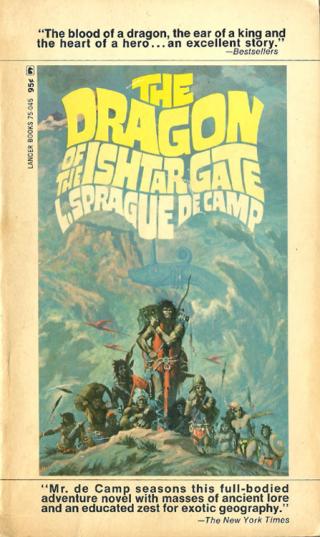
The Dragon of the Ishtar Gate
- Автор: Де Камп Лайон Спрэг
- Год: 1968
- Язык: английский
- Год: Lancer Books
- Жанр: Научная фантастика

Электронная книга - «The Dragon of the Ishtar Gate». Краткое содержание книги:
Dragon is probably closest in mood to de Camp's fantasy novels, while Bronze God and Arrows are closer to his science fiction, with their description of engineering problems, and personality clashes among researchers and engineers. Dragon also reflects de Camp's then-recent acquaintance with the Conan stories and other works of Robert E. Howard. Bessas, the huge Persian nobleman, is not only a close match for Conan in physique, but his mood swings, fixation on his mother, and tendency to toss of verses, seems a reflection of Howard himself. (Fortunately, his poems reflect de Camp's verbal dexterity and wit, not Howard's melancholy.)
"You couldn't help it. If you had stopped to think, I should have been dead, and what would Xerxes have done for his report?"
XV – The Hills of Iron
On the ninth of Tashritu, twelve human beings and four beasts of burden straggled across the green flatlands of Boron. The traveler's rags flapped loosely about their bodies, so that their wearers were not much better covered than the naked Alabi who, standing storklike on one leg and watching their cattle, stolidly looked around as they passed.
The wayfarers' skins were burnt to deep bronze, spotted by insects bites, and seamed by scratches from thorns. Their ribs showed, as Bessas had harried them on for several days without taking time to hunt fresh meat. All bore loads on their backs, and four led two mules and two camels. Of the thirty-five beasts of burden with which they had left Meroê, only these survived. In the last few days, one more camel had died, and a lion had taken the horse. The surviving animals moved slowly and feebly, with hanging heads, despite the plentiful grass of the country through which they had come.
Some of Bessas' party limped, and all reeled with fatigue as they pushed along with sticks cut from saplings. Bessas, who bore by far the heaviest load, ranged from one end of the column to the other like a sheepdog, barking:
"Close up there! Straighten up, Umayya! We near the city, and we must march as if we were strong and fearless. Hurry up, Merqetek, if you do not crave a cut of my stick! Shimri, what in Arallu are you doing?" '
The Judaean had paused, where the path crossed a stony patch of ground, to stoop under his load and pick up some reddish-black pebbles.
"Iron ore, by the Lord of die Waters!" he said, grinning up.
"What of it? We are not going into the ironmongery business. Get along!"
They passed through groves of small trees with enormous pale-green leaves, each leaf comprising a whole branch. From these trees hung huge bunches of finger-shaped fruits.
More and more of the Alabi—men who had been loafing and women who had been working the vegetable gardens—left their tasks to gape at the strangers. Soon the travelers were surrounded by a crowd of Negroes, pointing, gesticulating, and shouting. Children shrieked and dogs barked. Myron said to Bessas:
"I do not suppose that Ethiopians are more prone to violence than men of other races. But they are so noisy that it is difficult to ascertain whether they intend violence or not."
The Alabi were, like the Anderae, very tall and rather slender. They were coated with cow-dung ash and colored clays, which pigmented their bodies in an endless variety of hues—various shades of red, orange, yellow, gray, and white.
The Alabi, like the Anderae, removed the two lower center front teeth. Besides their ornaments of bone, wood, and ivory, their hair was dressed with the help of dried mud into bizarre horns, crests, and helmets. Ostrich plumes sprouted from many of these coiffures.
Ahead of the party, the stockade of Boron spread along the banks of the Astasobas. Skulls topped a dozen poles about the gate, from which a group of spearmen issued, marching towards the newcomers.
"Ground your loads in a circle," said Bessas. "Sit on them and keep these knaves from pilfering, but do not strike or wound one without my command."
The Alabi crowded round, poking at the loads, fingering the travelers' tattered garments, trying to thrust fingers into the visitors' ears and mouths, and laughing loudly. They showed neither hostility nor a desire to steal, but simple curiosity and vast amusement. Their heavy body odor offended Myron's nostrils.
Then the group from the town arrived. A man shouted and whacked a few shoulders with a stick, whereupon the crowd divided to let the dignitaries through. A tall, grave Alab with a necklace of cane-rat bones spoke in a sharp, authoritative tone. Merqetek said:
"I cannot understand him, for I have never been so far south."
"Try all the tongues you know," said Bessas.
At length someone fetched an Alab who had lived among the Nubae. Explanations began. He of the rat-bone necklace said:
"I am Dimo, general of King Gau of the Alabi."
Bessas told who he was, adding that he wished to stop at Boron to rest and then pass on through King Gau's dominions.
"In that case," said General Dimo, "you must give King Gau a hundred strings of beads, fifty iron spearheads, fifty iron hoes, and one man-load of salt."
Bessas said: "O Myron, you are a better haggler than I. Chaffer this knave down, for the tribute he demands would clean us out."
Myron addressed himself, through the interpreters, to the generaclass="underline" "Unfortunately we lost our salt in the Shaikaru country. We could give ten strings of beads ..."
The haggling went on for an hour. Dimo sometimes spoke threateningly, and the spearmen frowned and hefted their horn-tipped weapons. But the travelers, on Bessas' orders, remained calm. The Alabi surged about, laughing and gabbling. When one group drifted off, another took their place.
At length Dimo accepted a fraction of the tribute he had first demanded. He signaled a drummer, who struck up a rhythm to show that the travelers were now under the king's protection.
King Gau sat on an ivory-legged bench in the royal hut and looked at his visitors from under heavy lids. As nude as all the other Alabi, he wore a necklace of crocodile teeth and, on each wrist, a heavy bracelet of ebony set with ivory spikes. Spearmen stood about; messengers came and went. A page held a gourd and, at a signal from the king, presented the vessel so that the king might drink of the contents through a straw.
Gau fingered a short sword, one of several cheap blades that Bessas had bought in Meroê. In response to Bessas' question, he said:
"We have no such beast as this sirrush in our land, although I have heard of strange creatures in other countries, such as men without mouths, and men with serpents for legs. The only strange creatures in Alabia are witches, whereof we have a plenty; we have burnt thirty-seven in the last moon.
"For that matter, I was always told that the men who dwelt beyond Kush had noses like those of elephants. Yet now I see that this is not true, however strange you may appear."
"Are we then the first men of our race to reach your land, O King?"
"Aye. The Kushites come hither once or twice in a generation. Sometimes they come to trade, which we welcome; sometimes they come to steal our folk for slaves, in which case we fight them. Why do you men of the North need slaves, when you have beasts like those you brought with you to bear your burdens?"
"Because, I suppose, men like to compel others to do their will. And speaking of animals, we started out with many more, but sickness has struck them down."
"That is the nagana," said the king. "We never drive our cattle very far to the east or the south, because they then catch the nagana and die."
"Well, I see that we shall have to hire men to carry our baggage. Can your subjects be retained for this purpose, King?"
King Gau took a pull at his gourd. Other pages presented gourds to the visitors. Myron found the liquid to be a fermented fruit juice, sweet and bland.
"Have you never drunk banana wine before?" asked King Gau. "Now, about those porters—"
One of the ruler's women burst in and hurled a rattle of speech at him. With an angry roar, Gau leaped up, swung his arm, and smote the woman on the shoulder blade with one of his spiky bracelets. The woman screamed and ran out of the audience room with red blood starting from the wounds in her back. Myron glimpsed the scars of other such wounds.