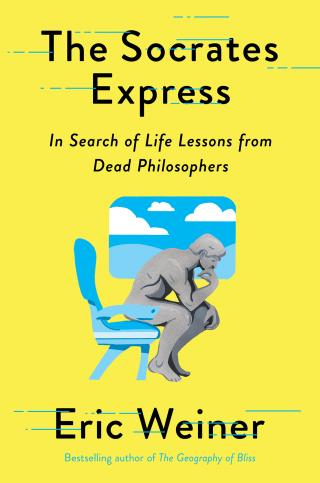
The Socrates Express
- Автор: Вейнер Эрик
- Год: 2020
- Язык: английский
- Год: Avid Reader Press / Simon & Schuster
- Жанр: География, путевые заметки

Электронная книга - «The Socrates Express». Краткое содержание книги:
We contemplate for the same reasons we travel: to see the world from a different perspective, to unearth hidden beauty and find new ways of being. We want to learn how to embrace wonder. Face regrets. Sustain hope.
Eric Weiner, *New York Times* bestselling author of *The Geography of Bliss* , combines his twin passions for philosophy and global travel in a pilgrimage that uncovers surprising life lessons from philosophers around the world, from Marcus Aurelius to Arthur Schopenhauer, Confucius to Montaigne. Traveling by train (the most thoughtful mode of transport) he traversed thousands of miles, making stops in Athens, Delhi,...
I dadsplain how life, like the bridge, consists of a series of endless choices. We select one direction but are always free to change course. We never stop choosing our ramps, our essence, and to pretend otherwise is an abdication of our agency. The bridge is existentialism rendered in steel.
“Dad?”
“Yes.”
“Do you know what a hysterical pregnancy is?”
“Um, no,” I reply, not sure where she is going with this.
“It’s when you have all the physical symptoms of pregnancy, only you’re not pregnant. You’ve just convinced yourself you are.”
“That’s interesting, Sonya, but I’m not sure what it has to do with—”
“You’re having a hysterical thought. You think this cool-looking bridge is a metaphor for some big idea, but I’m pretty sure it’s just a cool-looking bridge.”
Philosophers are prone to overreach. Eager for profundity, they run the risk of intellectual hallucination; sometimes the shimmering light is not an oasis but your mind’s eye playing tricks on you, and sometimes the simplest explanation is the best. This is why Socrates believed philosophy is best practiced in pairs. The buddy system. You need someone else, another mind, to keep you on track. Sonya is my Socrates. She questions my assumptions. She sows doubt.
Simone de Beauvoir, lover of cafés, was born above one. The family’s flat had a balcony overlooking the Café de la Rotonde on the Left Bank. One day, when their parents were away, Beauvoir convinced her younger sister they should sneak downstairs for a café crème. “The utter daring! The audacity!” recalls her sister, Helene.
Beauvoir was, by her own account, a “bossy little girl.” Curious, too. She devoured books—all kinds, but especially tales of voyages, sparking a wanderlust that would stay with her. Then one day a teacher suggested she study philosophy, and that was that. She was hooked.
At a young age, before she was an existentialist, before the term existed, Beauvoir said, “My life would be a beautiful story come true, a story I would make up as I went along.” This is existentialism. There is no script to follow, no stage directions. We are author, director, and actor of our own life story.
Beauvoir passed the demanding agrégation exam in philosophy at the age of twenty-one, the youngest ever to do so, finishing second, behind Sartre. Beauvoir was so industrious, and humorless, one classmate dubbed her Castor, the Beaver. The nickname stuck. She wore it as a badge of honor. The word “work,” say her French biographers, “seems to have some magic in it, it rings out with a special brilliance, a special tone. It has been her password to life.”
Beauvoir was always working on something, often several somethings simultaneously. When she was in a serious car accident, she worked while recuperating in the hospital. During Sartre’s long illness, she worked on her book about aging. “My defense is work,” she said. “Almost nothing can prevent me from working.”
Philosophy, as I said, has mostly ignored the subject of old age, but with one notable exception: Cicero. He was sixty-two years old and in terrible pain when he wrote his taut and optimistic essay “On Old Age.”
“Everyone hopes to reach old age, but when it comes, most of us complain about it,” he says. Why? Old age isn’t so bad. Advancing years makes our voice more melodious, our conversations more pleasurable. “There is no greater satisfaction to be had in life than a leisurely old age devoted to knowledge and learning,” he concludes.
Bollocks, says Beauvoir. She had no patience for Cicero’s cheery assessment. She was determined to stare down old age, and not blink. The result: The Coming of Age, a 585-page tome that is tough slogging. Here is a sample:
A limited future and a frozen past: such is the situation that the elderly have to face up to. In many instances, it paralyzes them. All their plans have been carried out or abandoned, and their life has closed about itself; nothing requires their presence; they no longer have anything whatsoever to do.
It gets worse. The elderly, she says, are “walking corpses… condemned to poverty, decrepitude, wretchedness, and despair.” Beauvoir enlists anthropology in her bleak cause, noting that the Nambikwara people have a single word for “young and beautiful” and another for “old and ugly.” She’s got history on her side, too. Old people have been mocked for as long as there have been old people and younger ones to mock them.
A thought experiment: Imagine a woman growing up on a desert island entirely alone. Does she age? She will develop wrinkles, and inevitably health problems. She will slow down. But is this aging? Beauvoir didn’t think so. For her, aging was cultural, a social verdict rendered by others. If there is no jury, there is no verdict. The girl on the island will experience senescence, biological deterioration, but she will not age.
Beauvoir’s grim treatise on aging was surely influenced by her own circumstances. She wrote the book at age sixty, when her health, until then “embarrassingly excellent,” began to flag. Her step slowed. She was often out of breath. She sneered when anyone mentioned “life’s golden years.” She was determined to write about old age “without glossing it over.”
Beauvoir fell into a cognitive trap, I think, a version of Hume’s Guillotine. Not an “is-ought” problem, but what I call a might-must problem. Just because I might expose my rear end in public like Rousseau doesn’t mean I must. Just because older people might slip into despair doesn’t mean they must. They have choices, something you’d think an existentialist like Beauvoir would recognize.
No wonder people like contemporary philosopher Martha Nussbaum reject Beauvoir’s grim fatalism. “I don’t recognize my own experience at all, nor that of my friends of similar age,” Nussbaum writes in her own book on aging.
Beauvoir, I think, overcompensated for Cicero’s sunniness. She traded the Roman’s rose-colored lenses for dark sunglasses. They protected her from harmful rays but also blocked the light. And there is light. Old age need not be the dismal slow-motion death Beauvoir makes it out to be. It can be a time of great joy and creative output. And the best person to make this case? Simone de Beauvoir.
One evening, over a meal of Le Nuggets, I broach the subject with Sonya. Talking to a thirteen-year-old about growing old is like talking to a mermaid about mountain climbing.
“It’s just not my thing,” she says, as if growing old were optional, like playing pachinko or attending the ballet. Something she might do if the mood strikes, but she just can’t see it striking.
I remind Sonya she’s getting old, too, just like me.
“Yeah, but you’re getting bad old and I’m getting good old.”
“Good old?”
“Yeah, soon I’ll be able to go to high school, and drive.”
“So what exactly is the difference between good old and bad old?”
“Good old is getting closer to liberty. Bad old is getting closer to death.”
I pursue a different line of questioning. I explain how I’m trying to find an upside to aging. Surely there’s an upside, right?
“No, actually, there isn’t,” she says.
“What about knowledge? Old people know stuff.”
“Not necessarily. Actually, young people know more because they have the old people’s knowledge along with the new knowledge.”
I change tack, again. “What about memories? Old people have more memories than young people. It’s like having a bigger selection of Netflix movies to choose from. Surely that’s good.”
“Not everything is worth watching, Old Man.”
Then, sensing my despair, she throws me a bone.