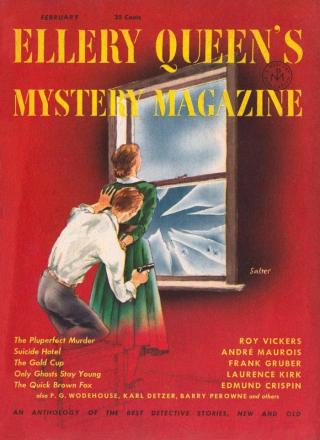
Ellery Queen’s Mystery Magazine. Vol. 19, No. 99, February 1952
- Автор: Грубер Фрэнк, Кемельман Гарри
- Год: 1952
- Язык: английский
- Год: American Mercury
- Жанр: Другие детективы

Электронная книга - «Ellery Queen’s Mystery Magazine. Vol. 19, No. 99, February 1952». Краткое содержание книги:
I sipped my beer in silence for a moment. I was wondering what the voice really did say. Was it “Hurry, hurry, hurry!” Or was it perhaps “Harry, Harry, Harry!” Or even “Hurry, Harry, hurry!”
“What kind of a voice is it?” I asked.
“A woman’s voice apparently.”
“Quite a young voice?”
“So they seem to think... Of course, we’re only just beginning to check up seriously. There wasn’t any reason to suppose that there was anything wrong with those Mayfair calls until they were all disputed. But now we do check up every single time. Callers sometimes give their own number wrong as well as the other, you know. So we ring the caller’s number back each time — while we’re trying to get the Mayfair number — and we always get a busy signal. It’s very odd.”
“Very odd,” I agreed.
“Of course it’s faulty wiring somewhere. We’ll fix it in time. But you see what we’re up against.”
I thought I knew what he was up against a good deal better than he did. But I saw no point in talking about ghosts to a man with all those technical letters after his name. Instead, I offered him another pint.
He shook his head and rose wearily to his feet.
“It’s enough to make any man take to drink,” he said. “But I’m not going to. I daren’t. I’ve got to get this thing fixed.”
It was then that I had my brainwave.
“Will you do me a favor?” I asked. “I mean, later on when you have got it all put right.”
“Why, certainly... You want to know how we fixed it?”
“No, no. I wouldn’t understand a word of that if you told me.”
“Then what?”
“When it’s all over I just want to know what the last Mayfair number was that was called.”
The engineer looked puzzled, but agreed to do as I wished.
About ten days later the engineer rang me up. His voice was quite different, just as though he had newly fallen in love, and I realized at once that something good had happened to him.
“We’ve got it!” he announced.
“You mean, the trouble at the exchange?”
“That’s it. Stumbled on it quite accidentally. Very interesting technically. I’d like to tell you.”
“I’d like to hear. But as I’ve already said, these things are quite beyond me. I can replace a fuse, and that’s all.”
“It was a fuse that put me onto it, as a matter of fact.”
“Then the fault was here at your exchange?”
“Oh, yes, it was here all right. Look, it’s quite simple really. I’ll tell you.”
“No, no,” I said firmly. “Just the number, please. The last Mayfair number that was called.”
He sounded disappointed, but he gave me the number which for security reasons I shall call Mayfair XXXX.
When I told this to Marjorie she thought deeply for a moment, and then said that it was quite time that I took a little holiday. I knew that a holiday to Marjorie meant a visit to London; and while I like going to London with Marjorie, I also knew that when she takes a husband there a lot of unbudgeted expenses fall upon him.
Nevertheless, we went up to London and stayed in a hotel. Marjorie was in command and immediately after lunch she went and had a long session with Telephone Enquiries. When she came back she was looking very pink in the face and I thought for a moment that she must have had a rebuff and discovered that Mayfair XXXX was the number of a dentist in Shaftesbury Avenue, or something of the sort. But not a bit of it. Mayfair XXXX was the number of a pub called The Crown and Anchor, and it was in Hertford Street at the corner of Shepherd’s Market.
I pointed out to Marjorie that the pubs had just closed and wouldn’t be opening again for four hours; but in spite of that she immediately dragged me off to Hertford Street. There we examined The Crown and Anchor from the outside, noted that the position tallied with what we had heard, and saw that the doors and windows were painted a pleasant shade of green. We then walked along Hertford Street towards Hyde Park. On the way we passed a house agent’s — Dean & Daintree, Established 1851 — and Marjorie said we might as well go in and ask about flats.
I followed her in some trepidation and the trepidation continued when a senior well-dressed member of the firm offered us several flats and houses, all at enormous rents. Marjorie managed to find some objection to all of them and finally said that she hadn’t realized that the district had become so commercialized. The house agent, with a pained expression, asked what she meant, and Marjorie explained that she was referring to the shops opposite and the pub at the corner. She supposed, she added, that it was all the result of the war. Still dignified and still pained, the house agent replied that it was not the result of the second war, nor even of the first. The Crown and Anchor, for instance, had been a pub since 1881. And what had it been before, Marjorie asked, rather too eagerly? It had been a private house, the agent informed her, and it had become a pub because it had been empty for ten years. Why had it been empty for ten years, Marjorie demanded? Because, the agent answered coldly, it had acquired a bad reputation for some reason and nobody would live in it. The pub on the other hand, he added, had a very good reputation and caused no inconvenience of any kind to the residents in the neighborhood.
At this point we withdrew in fairly good order and went and sat in Hyde Park. It was delphinium time and both of us were thinking, not only of the garden at The Walled House, but also of a scene which had taken place somewhere around us, when a young man lay dead on the grass soon after dawn.
Finally, a few minutes after six, we stepped into The Crown and Anchor. There were a few people there already, but they paid no attention to us, and we sat down at the bar and ordered pink gins. Presently the landlord came wiping along the counter towards us and I think he was just going to say something when the telephone rang at the other end.
He looked up, a little anxiously, we thought, and then went on wiping, as a barmaid took up the receiver.
“Have you been having any trouble with the telephone?” Marjorie asked the question in her most innocent manner.
“No, not really,” the landlord answered.
“Some people have, haven’t they?”
“So I believe... And it did ring here three nights running.”
“What happened?”
“Nothing. The wife was asleep and I was too lazy to get up.”
“Was that all?”
“It rang again the fourth night.”
“And you still didn’t get up?”
“No. But the receiver was off when I came down in the morning.”
“Was there any explanation?”
“No, we didn’t bother. When anything like that happens we just say it’s our little poltergeist.”
“Poltergeist!”
“Yes. When glasses get broken in the night or someone takes a nip at the port, we just say it’s the poltergeist. Saves a lot of trouble.”
Marjorie and I looked at each other. We both knew that secret drinkers weren’t necessarily ghosts. We knew, too, that the telephone troubles could be fully explained by electronics or something of the sort. But to us at any rate electronics are far more supernatural than ghosts, and we preferred to think that the long period of waiting was over and that Alice Raynor had got to her Harry at last.
So we ordered two more pink gins and drank a toast to their health — to the Lady of the Cameo and her Harry...