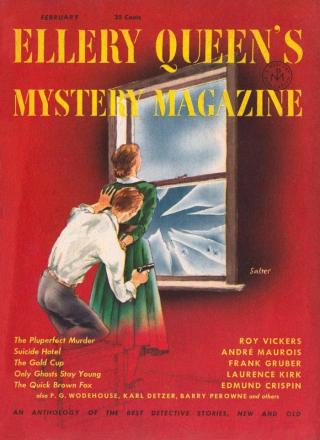
Ellery Queen’s Mystery Magazine. Vol. 19, No. 99, February 1952
- Автор: Грубер Фрэнк, Кемельман Гарри
- Год: 1952
- Язык: английский
- Год: American Mercury
- Жанр: Другие детективы

Электронная книга - «Ellery Queen’s Mystery Magazine. Vol. 19, No. 99, February 1952». Краткое содержание книги:
With one hand she clutched an elaborately carved ivory jewel-chest. The other hand clung to the balustrade. Slowly she mounted the stairs, one at a time. At every second or third step she would pause to rest.
She was muttering, shaking her head, unaware of Hillman and Gertie watching breathlessly from above. The voice, speaking their native tongue, floated up to them.
“I am old. Yes. Of course, I am old. Who says I am not? I am an old woman but I am also the Princess. Stop! Stop!” She paused on a step, closed her eyes. “My head! My blood pressure! Ah! Better now.” She resumed her climb, resumed her muttering. “Do not forget who you are, I beg of you. Do not forget why you have come. That is important. You should have come in the very beginning.”
She looked up and for the first time observed the two faces staring at her. She gave a start. “Oh! There you are!” She smiled, displaying dental plates that were yellowed like old piano keys. “My friends!” she croaked. “You see? I come at last. Wait. A little patience. I will soon be with you.”
Watching her tortuous journey became too much for Hillman. He rushed to the head of the stairs, Gertie also. “Shall I help you, Princess?” he stammered. “It is an honor...”
“No! Stay where you are. I am almost there. A few more steps. I will rest just once more, if you don’t mind.”
They stood there helplessly. Slowly she came... closer, closer. Only two more steps. One step. At last! What a relief. She was on the landing. She leaned against the railing, closed her eyes, clutched the ivory box.
Finally she opened her eyes. She smiled at them. “Look what I have brought you.” She drew herself erect. She opened the box. With one quick movement she brought out a jewelled pistol and shot them both dead.
The Quick Brown Fox
by Edmund Crispin
The port had been round several times, and Wakefield’s temperamental dogmatism was by now somewhat inflamed by it.
“Just the same,” he said, irrupting upon a discussion whose origin and purpose no one could clearly remember, “detective stories are anti-social, and no amount of sophistries can disguise the fact. It’s quite impossible to suppose that criminals don’t collect useful information from them, fantastic and far-fetched though they usually are. No one, I think” — here he glared belligerently at his fellow-guests — “will contest that.”
“I contest it,” said Gervase Fen; and Wakefield groaned dismally. “For all the use criminals make of them, the members of the Detection Club might as well be a chorus of voices crying in the wilderness. Look at the papers and observe what, in spite of detective fiction, criminals actually do. They buy arsenic at the chemist’s, signing their own names in the Poisons Book, and then put stupendous quantities of it in their victims’ tea. They leave their fingerprints on every possible object in the corpse’s vicinity. They invariably forget that burnt paper, if it isn’t reduced to dust, can be reconstituted and read. They spend, with reckless abandon, stolen banknotes whose serial numbers they must know are in the possession of the local police...
“No, on the whole I don’t think criminals get much help from detective stories. And if by any chance they are addicts, that fact by itself is almost certain to scupper them, since their training in imaginary crime — which is almost always extremely complicated — tends to make them overelaborate in the contriving of their own actual misdeeds; and that, of course, means that they’re easy game... For instance, there was the Munsey case.”
“It has always been my opinion,” said Wakefield to the ceiling, “that after-dinner conversation should be general rather than anecdotal. More-over—”
“I’d known the family slightly,” said Fen, unperturbed, “over quite a long period of years. There were five of them, you remember: George Munsey, a little, round, chuckling man who’d made money on the Stock Exchange; his wife Dorothy, vague and stately and benign, who acquired something of a reputation as a poetess in the earlier twenties and lost it again, conclusively, in the later; Judith and Eleanor, the two daughters, aged twenty-two and twenty-five respectively, and both uncommonly pretty; and George Munsey’s sister Ellen, a dour, disapproving woman who battened on them, being herself genuinely penniless. With the exception of Judith, they all endured Aunt Ellen very patiently; and Judith’s dislike of her hadn’t, I think, any rational basis, but was more in the nature of a violent temperamental aversion such as sometimes crops up between dissimilar personalities. Aunt Ellen didn’t reciprocate it, by the way: if anything, she was rather fonder of Judith than of the others.
“Aunt Ellen apart, they were a well-to-do family, since Mrs. Munsey and Judith and Eleanor had all inherited substantially from Mrs. Munsey’s father. However, they kept no servants, preferring, on the whole, to lead a mildly Bohemian existence, looking after themselves. Their house was — is, I suppose I should say — in St. John’s Wood; and I was staying there on the night of the murder.
“I’d traveled up from Oxford to deal with some odd scraps of business and to get myself a new portable typewriter (eventually it was a secondhand one I bought, in Holborn). On the following morning I had to attend a Ministry of Education conference, and I was proposing to stay overnight at the Athenaeum. At lunch-time, however, I chanced on George Munsey in the Authors’ Club bar, and when he heard how I was placed he suggested I should stay with him instead. I warned him I’d have to work — there was a long memorandum to be typed out for presentation at the M. of E. conference — but he was quite agreeable to that; and so at about half-past two in the afternoon I duly appeared on his doorstep, typewriter and all.
“I wasn’t the only guest, it turned out. The second spare bedroom was occupied by Eleanor’s current fiancé, an over-handsome but tolerably pleasant young man called Tony Odell, the owner (I was told) of a chain of milk bars in the West End. In addition to being Eleanor’s fiancé, he was Judith’s ex-fiancé; and I gathered, indirectly, that it was he rather than Judith who had been primarily responsible for the breaking-off of their engagement. However, none of the three seemed much discomfited by the exchange, and until the next day I wasn’t in the least aware of anything’s being amiss in the house.
“On arrival, I found that Judith was in the kitchen, concocting something or other; that Aunt Ellen was upstairs refreshing herself with an afternoon nap; and that the other four — Mr. and Mrs. Munsey, Eleanor and Odell — were playing Racing Demon in the drawing-room. Now, I have a fondness for Racing Demon, so having dumped my bag and typewriter in my room, I joined in; and the five of us played uninterruptedly for the next two hours. At half-past four, on the Munseys’ departing in a body to make tea, I retrieved my typewriter and settled down in the library to work. There I stayed — recruited by food and drink which the family brought in to me at irregular intervals — until nearly midnight. I hadn’t any occasion to leave the library, so I’ve no idea what the others did with themselves; and I don’t remember that anything more eventful happened to me, during the remainder of the day, than having to put a new ribbon into my machine. By the time I’d finished my job they’d all gone to bed, and I wasn’t at all sorry to follow them.
“But next morning, Odell being not yet up and the others unitedly engaged in cooking breakfast, Judith took me aside, in a state of considerable agitation, and confided to me certain matters which I must confess disturbed me a good deal. Summarized — for conciseness’ and Wakefield’s sake — what she told me was as follows: