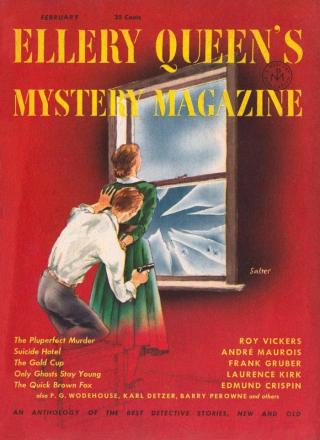
Ellery Queen’s Mystery Magazine. Vol. 19, No. 99, February 1952
- Автор: Грубер Фрэнк, Кемельман Гарри
- Год: 1952
- Язык: английский
- Год: American Mercury
- Жанр: Другие детективы

Электронная книга - «Ellery Queen’s Mystery Magazine. Vol. 19, No. 99, February 1952». Краткое содержание книги:
At last I saw in what direction Marjorie was heading.
“Darling!” I said. “I am quite prepared to believe in ghosts, but I am not yet ready to believe that they mess about with dial telephones.”
Marjorie now thrust the bill at me.
“But look at the numbers!” she cried. “Here’s the first. 0497. And then a week later it’s 0622, and then 0713, and 0944. The numbers are going up all the time.”
“Does that lead us anywhere?”
“Yes, it does. Because the Adamsons and the Greggs have got some of the missing numbers. And the three thousand other subscribers no doubt have got the rest. She’s going through them from the beginning until she gets the right one!”
“Who’s she?”
“Don’t be silly, darling. Alice Raynor, of course.”
“You think she’s trying to get Harry on the phone after all this time?”
“Not necessarily. She may be trying to get the man who killed him. Or his son. Or his grandson. If I were a ghost and someone presented me with an automatic telephone exchange, I could think of quite a lot of things to do.”
I thought I was going to have a bad night after this. When Marjorie dreams, she has a habit of flinging out her left arm suddenly and it falls almost invariably in my right eye. However, this time Marjorie slept quite peacefully. But that did not prevent me having a bad night. First, I was in the new telephone exchange. I knew the engineer in charge slightly and had been over it when it was first opened. It was an eerie experience even in daylight when I saw it. There are dynamos and dials, and batteries and cables; but the main feature of it is half a dozen tiers of shelves with narrow alleyways between them. The interior part of the shelves is a crazy criss-cross of wires: black wires and blue wires and red wires and white wires. But the outside facing you appears to be a collection of metal canisters. These look as though they might contain tea or rice or something innocent like that, but in reality their contents were quite beyond my comprehension. And as you stand there you may suddenly hear a click-click-click in the canister by your right knee: then a click-click-click behind your right shoulder: and finally a click-click-click-click at the far end of the room.
That was how it appeared in the daytime. Now at night it was much more uncanny. I was the engineer standing alone distractedly in one of the alleyways and the click-click-clicks danced around me in the silence like will-o’-the-wisps. My job was to stop poor Alice Raynor from troubling Mayfair; but they all seemed ghosts to me: the mother dialing for the doctor; the householder for the police; the lover to make up a quarrel; the lonely to hear the sound of a human voice. But no sound of any human voice came to my ears. It was click-click-click here and click-click-click over there, click-click-click beside me and click-click-click far away. Ghosts! All ghosts! Will-o’-the-wisps! Finally, I could stand it no longer and ran madly from the building...
I must have slept for a time after that, for next I was walking up Fisher Street before the bombs fell and while The Walled House was still standing. Alice Raynor was in front of me in her blue cloak and cameo, and this time I followed her right into the house, stepping through the heavy oak door in the same way she did. And the moment she was through the oak door the cameo and blue cloak vanished, and she was dressed as Mrs. Reason had described her with her pretty dark hair sleeked down the sides of her head — a girl of twenty-one wearing a simple yellow dress.
I had then one of those moments of extreme clarity which occur in dreams and only in dreams. Outside the house she had appeared as we would have seen her: aging, tiring, thickening; inside, she appeared as she saw herself: a girl of twenty-one. After all, she never Would be more than twenty-one. She was right to see herself like that. And for her there was a timelessness as well as an agelessness. She no longer had to worry because Harry didn’t come for her. He would come, and time didn’t exist. That was why the garden had bloomed so lavishly for nearly seventy years. Harry was coming for her. No doubt it was because the Germans had deprived her of her garden that she was now taking more active measures and making use of the thing that had taken its place...
I had rather a bad headache the next morning. All the crystal clearness of my dreams had vanished and I realized among other things that a call to Mayfair was not just a matter of click-click-clicks at our local exchange. It was a Toll call — Toll B to be exact — and one had to dial O on one’s instrument. A ghost might be able to dial O, and might not; but there were other complications. The call would go direct through our exchange to an operator at Canterbury. She — or rather he at night — would see the light on the panel, plug in, say “Toll B” — and then ask what number was wanted. Having plugged in to the outgoing line he would ask for the caller’s number. Finally, when the receiver was lifted at the Mayfair end, two lights would indicate that the call had been completed and the timing apparatus would begin to work. The operator had no need to listen in to tell when the call was finished: the lights did that, and the timing apparatus showed every tenth of a minute as it passed. Each call of this sort was recorded by the operator on a separate little slip of paper, which found its way finally to the billing department.
All this seemed to me to make it extremely unlikely that even the most practical of ghosts could have anything to do with it. But Marjorie did not share my doubts. She said that neither we nor the Greggs nor the Adamsons had made the calls — therefore Alice Raynor must have made them. And besides, she added, the calls were always made between twelve and one, and that was the hour during which Alice Raynor was going to elope with Harry.
I had a very prompt reply from the telephone manager, regretting that they were having some trouble at the new exchange (this seemed to indicate that the calls to Mayfair from other exchanges were genuine enough) and saying that another bill would be submitted omitting the disputed calls. Nothing more happened for two days; then on the third morning a supervisor called up from Canterbury and asked if we had rung up Mayfair 1321 at 12:29 during the night. I said no, we certainly hadn’t, and the supervisor thanked me and rang off. Marjorie was furious with me over this. She said that if it had been she who had answered the telephone she would have got the whole story out of the supervisor.
Marjorie went off a day or two later to stay with her sister, and I walked round in the evening to The King s Arms which is one of our forty-four pubs. There in a corner, by himself, looking very disconsolate, was the engineer who had shown me round the exchange.
I sat down beside him.
“Well, how’s everything?” I began cheerfully.
He drained off the remains of a pint.
“Awful!” he said feelingly. “Absolutely terrible!”
I immediately ordered two more pints.
“Is it the Mayfair calls?” I asked.
“Of course it’s the Mayfair calls!”
“Is that the only exchange concerned?”
“So far, yes.”
“Well, you’re bound to have teething troubles, aren’t you?”
“Teething troubles! This is a ruddy tusk coming in! A mammoth’s tusk!”
“But I’m sure all the people here understand that it isn’t your fault.”
“I’m not worrying about the people here. That’s nothing to the trouble at the other end. People don’t like being hauled out of their beds at one o’clock in the morning to answer the phone, and then hearing a voice say, ‘Hurry, hurry, hurry!’ It’s uncanny. They don’t like it. And I don’t blame them.”
“Is that what the voice always says?”
“That’s what it says when it says anything. Sometimes it just hangs up when Mayfair answers. It’s always this end that hangs up first.”