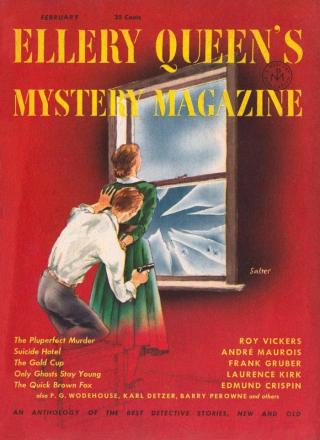
Ellery Queen’s Mystery Magazine. Vol. 19, No. 99, February 1952
- Автор: Грубер Фрэнк, Кемельман Гарри
- Год: 1952
- Язык: английский
- Год: American Mercury
- Жанр: Другие детективы

Электронная книга - «Ellery Queen’s Mystery Magazine. Vol. 19, No. 99, February 1952». Краткое содержание книги:
Hillman examined the box of cigars. “I see somebody knows the brand I like.”
“You told us. Last Noel. So we bought you a box.”
“Yes, I remember. Tell me, Tomasso, how is the old lady? The medicine — is it helping her?”
A sullen expression came over the boy’s face. “She is not ‘old lady.’ She is ‘Her Highness’.”
“No more!” Hillman bellowed. “We are in France. In France she is ‘old lady.’ In France the landlord is Your Highness.” Unexpectedly he burst into laughter. He laughed so hard he was seized with a fit of coughing — spluttering, spraying, tears streaming down his face. Gertie grinned appreciatively, showing her gold teeth.
Different tears were streaming down Tomasso’s face, tears of humiliation. He raced down the stairs and out of the house.
Later, Gertie finished the supper dishes and came out of the kitchen to behold a strange sight. Hillman was stretched out in the hallway, his ear pressed to the open heat-register. Curious, Gertie came closer and listened.
“They’re moving her bed into the living-room!” he stage-whispered. With a struggle and his wife’s assistance, he came to his feet. He chuckled. “So! The medicine was not so strong, after all.”
That night it was the living-room radio that brayed loudly. The Poolks were in their bedroom, each sitting on top of one of the twin beds. Hillman read the newspapers and smoked. Gertie embroidered. The bedroom radio was playing softly. At 11 o’clock he ambled leisurely into the living-room and shut off the radio.
On Friday, Hillman spent most of the morning on a chair by the open register, listening. Gertie would come for a report.
“Anything?”
“Nothing.”
During lunch, he said between mouthfuls, “They are plotting something. I know. I feel it. Remember in the old country when a guest had to sleep overnight and every bed was full — remember what we did?”
“We made a bed in the kitchen out of chairs. You think...?”
He nodded.
“Don’t they know we also have a radio in the kitchen?”
“They know, but they think we do not know where she will be sleeping.”
Later they waited at the railing for the bell to ring. At a quarter to five, it rang.
“This time it is Gormel, the legless one,” Hillman chuckled to his wife.
Gormel, father of Tomasso and Matta, smiled up at the two pumpkin heads peering down at him. “Good evening!” he sang out in a lyric tenor.
“Good evening,” they responded solemnly.
“I have something for you.” He had a hand hidden behind his back. “A surprise, a wonderful surprise. May I come up?”
“Please do.”
They watched, their eyes glittering with interest, how cleverly he manipulated his artificial legs. With one hand he clung to the banister, the other hand behind his back holding the surprise. When he arrived at the top, there were beads of perspiration over his upper lip, but he was still smiling.
“How did you enjoy the caviar? The breast of pheasant?”
“We haven’t opened the tins yet.”
“We are saving them for a special occasion,” Gertie volunteered.
Hillman stared at her sternly. Be still! his eyes told her. I will do the talking.
“Look!” Gormel flourished the gift before them. “Something to go with the caviar. Champagne from the old country. One hundred years old!”
Hillman tried not to show how impressed he was. He cleared his throat. “Thank you. Tell me,” he croaked. “How is she... the old one?” With a shattering sound he cleared his throat again.
Gormel shook his blond head. He smiled sadly. “Her nerves are in a bad way. The doctor says she must have rest and quiet. During the day she dozes. Fitfully. She cannot sleep. Street noises bother her. The children. She has had no sleep these past few nights. You understand.” Gormel gazed at them hopefully.
“I am sorry to hear it,” Hillman said stiffly. “Good night.”
“Good night, Mr. and Mrs. Poolk.” Holding onto both banisters, Gormel swung himself down the stairs.
When the front door closed, Gertie demanded indignantly, “Why don’t they take her to a hospital? Why don’t they move out?”
Hillman nibbled one of her chins with his fingers. “Patience. There is something else I want to see happen.”
In appreciation of the champagne Hillman turned on the kitchen radio, not loudly, not softly, just medium. The same with the bedroom radio. The same with the living-room radio. Then they put on their coats and went to a neighborhood movie. They came home at midnight. They looked at the stairs. They looked at each other. Hillman chuckled. Gertie grinned. When they arrived in their apartment, they turned off the radios and went to bed.
The next day Gertie inquired, “Tonight Namka will bring something, you think?”
“Yes. Then only the Princess remains.” Hillman rubbed his hands. His eyes glittered.
Gertie’s eyes popped open. “You think she will come? The Princess? She is ill. Dying, maybe.”
“She will come. Ah! That is what I’ve been waiting for. To see her climb those stairs.”
That evening they waited by the railing. Gertie passed a remark. “I hope no more perfume. Don’t they know I never use perfume?”
At six o’clock the bell rang, the door opened. There stood Namka, wife of Gormel, mother of Tomasso and Matta, niece of Her Highness, the Princess. A beautiful figure of a woman was Namka. Tall. Regal. With black hair and flashing eyes.
Hillman gazed at her greedily. He felt his wife brushing against him. He frowned. He moved away and came to the head of the stairs. He beamed at the visitor. “Good evening, Namka. How goes it with you?”
“With me all is well. I wish I were able to say the same for Her Highness, my aunt.” She looked at him coldly. Her lips curled. “I have something for you, Mr. Poolk, and something for Mrs. Poolk. Stay where you are. I will bring them up to you.”
She bounded lightly up the stairs. From a pocket of the coat she was wearing she brought out a brooch and a watch. The brooch she gave to Gertie, the watch to Hillman.
Her voice was flat, lifeless. “Those are heirlooms. They are priceless. That is a chime watch, Mr. Poolk. It was made in the old country. In good condition still. It will strike the hours.” She hesitated. When she spoke again, her voice trembled. “That brooch, Mrs. Poolk, was worn by Queen Zora, grandmother of my aunt, the Princess.”
Suddenly she burst into tears, clapped her hands to her face. “Excuse me,” she mumbled, and ran blindly down the stairs. The door slammed behind her.
From pink, Hillman’s face changed to red; from red, to purple. He was finding it difficult to breathe. Furiously he flung the watch away from him. He snatched the brooch from Gertie and flung that away.
“Bribes! Insults!” He paced the floor gesticulating. “Do they ask us once to shut off the radios? To please, I beg of you, not to play the radio so loud? Not to slam the door? No! They will not condescend to beg a favor of us. We are peasants. We are common. And they? Nobility. Pah! They bring me gifts. Cigars. Champagne. A silly watch. Not enough! Not enough, I tell you!”
“Hillman! Hillman! Do not excite yourself!”
With an effort he calmed down. “All right. Tomorrow night it is her turn. Then we shall see. The radios cannot kill her. Perhaps the stairs will do us that favor. We shall see.”
Sunday evening she came. The Princess. A very old woman. Very old. But holding her head high, carrying herself with dignity. On her head was a tower of yellow-tinted white hair. Jeweled combs glittered. Her face was like a death’s-head, so little flesh was left to cover the bone structure. So sunken were her eyes, it was as though she had no eyes at all. Now and then a highlight flashed from their hollows. Blue veins stood out on her forehead; blue veins also on the backs of her hands that were like the long bony claws of a scavenger bird. She wore a yellow lace evening dress with a high collar, and around her shoulders, a silken shawl. High-button shoes peeked out from the rim of her dress.