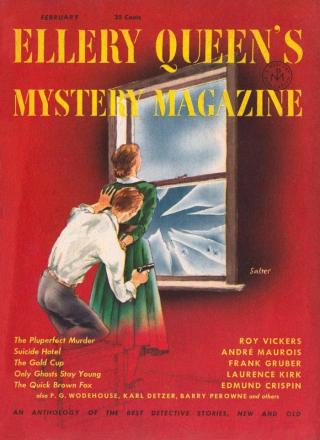
Ellery Queen’s Mystery Magazine. Vol. 19, No. 99, February 1952
- Автор: Грубер Фрэнк, Кемельман Гарри
- Год: 1952
- Язык: английский
- Год: American Mercury
- Жанр: Другие детективы

Электронная книга - «Ellery Queen’s Mystery Magazine. Vol. 19, No. 99, February 1952». Краткое содержание книги:
As suddenly as it came the pain left him. He was able to breathe again. What blessed relief. Then it wasn’t death, after all? Not this time. But the next time? Surely it was a warning. The stairs had spoken.
Weakly he mounted the few remaining steps. He staggered into the living-room. He collapsed on a divan.
Gertie was there, embroidering. She stared at him. “What is it?”
“An attack. Here. In my side. As I was climbing the stairs.” All at once he was consumed with rage. He stood up. He clenched his fist. He waved it in the air. “No more! I should endanger my life for that old woman? No more! It is ridiculous!”
“Why don’t you speak to her, Hillman? Why don’t you explain to her? Tell her she must go.”
“Why?” His eyes bulged at her. Flecks of red showed in them. “You ask me why? Because I too have pride. She regards us with contempt. In Bulgaria she was a Princess. We were peasants. To her we are still peasants. Has she once invited us into her home? Never! She lives in the past, that old lady. She does not realize that in France we are a republic — that here we are her equal. Ah! Such arrogance!”
Rage gave him a sense of power. The blood raced through his veins. He reached into the humidor for a cigar. He thrust the end of one between his teeth. He lifted the metal cover of the humidor and banged it shut over the opening.
“You hear that, Gertie? Listen.” He slammed the lid down again, even more loudly. “You know what that is, Gertie? That is noise. That is what the Princess does not like.” Abruptly he yelled at the top of his voice, “Gertie! The living-room door is open! I will shut it!” He reached out, banged the door shut.
Gertie was fascinated by his performance. In her lustreless eyes appeared a dull glow of appreciation. She nodded vigorously. “Good! Good!”
Hillman puffed a light on his cigar. He blew out the match. “That is only the beginning. Ha! What a fool I am. Why didn’t I think of it before?”
He pointed a stubby finger at her. “From now on — I am in the living-room, you are in the kitchen — no more do we come running on tiptoe when we want to say something. We stay where we are. We call out like this.” He took the cigar from his mouth and bellowed, “Ger-rtle!” He lowered his voice. “Now. Your turn.”
“Hillman!” she yelled.
“Louder! Louder!”
“Hi-illman!” she screeched.
“That is better. Don’t forget. No more whispering. No more closing the door softly. From now on we bang the doors. We play the radios as loud as we please. A-ah!” He paused, struck by an inspiration. “The radio! At 9 o’clock she goes to bed. At 9 o’clock we will turn on our bedroom radio full force.” He stopped to see the effect on his wife. He puffed on his cigar.
She was impressed. “Wonderful!”
He went on excitedly, “It will shatter her nerves. Those delicate harp-strings. It will kill her, perhaps? Killed by noise.” An expression of wonder came over his fleshy face. “What a weapon for a murder — noise! If she dies, it will be as though we murdered her. Do you realize it, Gertie? And we cannot be arrested for it.” He chuckled.
Gertie was worried. “She may go to the Prefecture.”
“What! The Princess?”
“If not her, then the others may go.”
“Let them. What have we done? We made noise. In our own house. A door slammed. An iron pot dropped. Are we not entitled to our quota of noise the same as everybody else? Ah! The radio? Perhaps there we made too much noise. My wife and I — we do not hear so well. You understand. If my tenants are bothered, all they need do is to move out. Simple!” He grinned at her with the cigar clamped between his teeth. “Have no fear, Gertie. They will not go to the Prefecture. They will realize how useless it would be.”
Later, in the kitchen preparing supper, Gertie banged pots, rattled dishes. They had their meal, and waited nervously for 9 o’clock to come. “She thinks we won’t dare,” Hillman sneered. “Wait. She will see.”
The hour arrived. From the living-room Hillman scurried down the long hall to the bedroom. Before closing the windows, he swung the shutters against them. He did not want to antagonize his next-door neighbors. He turned the radio on full blast. He became deafened by a roar of sound. It made him dizzy. It made his heart beat faster.
There now, this was the test. Here was the weapon with which to kill. The sudden shock. That should do it.
He hurried out of the room. He closed the door behind him. The blare followed him, becoming fainter as he came to the living-room. He shut the living-room door.
They sat there for two hours. Hillman smoked and worked on his ledgers. Gertie embroidered. Diamonds gleamed on her fingers. Her swollen vein-mottled legs sought comfort on an ottoman. Eleven o’clock came. Hillman turned off the bedroom radio. They went to bed.
The next day was Wednesday. The Poolks did not leave the house. Four-thirty in the afternoon the doorbell rang. Hillman pressed the buzzer that unlocked the front door. He went to the head of the stairs. Below stood Matta, eight-year-old daughter of Namka and Gormel. Carefully she held a glass dish upon which were a small round tin and a large oval tin.
“Good evening, Mr. Poolk.” She spoke in Slavic. Her voice trembled.
“Good evening, Matta.”
“I have brought you something.”
“You expect me to come down for it?”
“Oh, no! I can come up? I was waiting for permission.”
“Come up. Come up.”
Resentfully, he watched how she defeated the stairs. She came fluttering toward him as though propelled by a breeze.
“Well! What have we here?” He examined the gifts. “Caviar. Breast of pheasant. So! Noble food for the belly of a peasant.” Suddenly he thrust his bloated features in front of hers. “The old lady. Is she — is she well?”
Matta shrank from his breath, from the frightening glitter in his eyes. “You mean...?”
“Is she... is she perhaps — dead?”
Matta was bewildered, frightened. She blushed. She shook her head. “Oh, no! She is in pain. In bed all day. Her head. We called the doctor. He gave her medicine. But she lives.”
A fear smote Hillman. “He gave her sleeping pills?”
“She asked for them. I heard her. He refused. He said they would be bad for her heart. He gave her a liquid medicine. He said that would make her sleep. Please? May I go now?”
Hillman straightened. He shouted toward the kitchen where his wife was getting supper ready. “Gertie! Did you hear? The old lady, she still lives!” He turned to the girl. Imperiously he waved her away. “You may go.”
So? A liquid medicine to make her sleep? Well, they would see which was stronger, the radio or the medicine. At 9 o’clock Hillman repeated the business with the bedroom radio. At 11 o’clock, when they went to bed, he turned the radio off.
Thursday afternoon the doorbell rang. This time it was Tomasso, twelve-year-old brother to Matta — a slim, dignified young man.
“More peace offerings,” Hillman muttered to his wife. She sniffed. Together they leaned over the railing at the top of the stairs.
“Good evening, Mr. and Mrs. Poolk.”
“Good evening, Tomasso.”
“It is a pleasant evening out, is it not?”
“Yes.”
“Please, may I come up? I have something for each of you, something I am sure you will both like.”
“Come up, Tomasso. Come up.”
He came bringing a box of cigars for Hillman and a bottle of expensive perfume for Gertie.