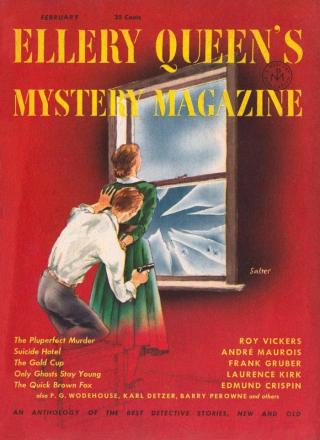
Ellery Queen’s Mystery Magazine. Vol. 19, No. 99, February 1952
- Автор: Грубер Фрэнк, Кемельман Гарри
- Год: 1952
- Язык: английский
- Год: American Mercury
- Жанр: Другие детективы

Электронная книга - «Ellery Queen’s Mystery Magazine. Vol. 19, No. 99, February 1952». Краткое содержание книги:
“She’d heard me come up to bed at midnight, and having finished her book, and being still sleepless, had set off, as soon as the closing of my bedroom door signaled me out of the way (she was a modest child, and apparently had very little on), to fetch a magazine from the hall. Arriving at the head of the stairs, however, she had looked down and seen Odell slip quietly out of the drawing-room and into the library, whence shortly afterwards she heard the rattle of my typewriter, which I’d left down there, In the normal way she wouldn’t have thought much about this, but Odell’s manner had struck her as distinctly furtive, and she was curious to know what he was up to. She hid in the hall closet, and after about ten minutes Odell emerged and crept upstairs to his room. Then she went into the library to see if she could find any indication of what he’d been doing there. Well, she did find something, and in due course showed it to me...”
Fen broke off rather abruptly; and when he resumed, it was to say: “You know that when you’re using thin typing-paper you usually put a second-sheet behind the sheet you’re actually typing on?”
Haldane nodded. “Yes, I know.”
“That’s what he’d done. And he’d left the second-sheet in the waste-paper basket. And you could read what he’d typed by the indentations on it. And what he’d typed was not in the least pleasant.”
Fen paused to refill his glass. “As I recall it,” he went on after a moment, “the message ran like this: You remember what happened at Manchester on December 4th, 1945? So do I. But a thousand pounds might persuade me, I think, to forget about it. I’ll write again and tell you where to leave the money. It will be the worse for you if you try to find out who I am.”
Haldane nodded again. “Blackmail,” he murmured thoughtfully.
“Quite so. But there was just one odd thing about the message on that revealing second-sheet, and that was its heading. It consisted of four words: ‘The quick brown fox.’ ”
There was an instant’s bemused silence. Someone said: “What on earth...?”
“Yes. A little mystifying, I agree. But anyway, there it was — and there too, more importantly, was the impression of the blackmail note. And if Odell was blackmailing someone in the house, then the situation required very delicate handling indeed. Judith wanted my advice, naturally enough,” (“Tcha,” said Wakefield) “as to what she ought to do. But I never had a chance to give it to her, because it was at that point in our conversation that we heard Eleanor’s scream. Eleanor had gone to call her fiancé down to breakfast, and had found him dead in his bed.
“Well, the police came, and the Ministry awaited me vainly, and as soon as the routine of the investigation was over, Superintendent Yolland took me into consultation. The facts he had to offer were singularly un-enlightening. Odell had been killed by a single blow on the forehead. The weapon was a heavy brass poker from the drawing-room, and no great strength would have been needed to wield it effectively. Death had occurred between five and six A.M. and had been instantaneous. There were no fingerprints and no helpful traces of any kind.
“Naturally, I felt bound to tell the Superintendent what Judith had told me; and by way of response, he produced for my inspection two sheets of typing-paper which he’d found hidden away in one of Odell’s drawers. The first one I looked at bore, in a faint and spidery typescript, the blackmail message I’ve already quoted — but not the — odd superscription. The other was identical with the first in every possible respect, except that it was addressed, like the second-sheet, to ‘The quick brown fox.’ And that being so—”
“That being so,” Wakefield interrupted, “you didn’t, I trust, have to do any very strenuous thinking in order to solve your mystery.”
“You think the solution obvious?” said Fen mildly.
“I think it child’s play,” said Wakefield with much complacency. “With what, after all, does one associate the words ‘the quick brown fox’? One associates them, of course, with the sentence ‘the quick brown fox jumps over the lazy dog,’ which has the peculiarity of containing all the letters of the alphabet. To cut a long story short, Odell wasn’t writing a blackmail note: he was copying one, in order to find out if it had been typed on that particular typewriter. In other words, he was not the blackmailer, but the blackmailer’s victim.
“He started to type out ‘the quick brown fox’ sentence, as a means of comparison, and then decided it would be simpler just to copy the complete message. And the original, together with his copy, was naturally enough found in his drawer. I take it that he wasn’t the man to accede meekly to blackmail, and that he’d made up his mind to find out who was threatening him; at which the blackmailer took fright and brained him while he slept.
“As to who the blackmailer was, that’s easy, too. As I understand it, both messages were in fact typed on Professor Fen’s machine.” Fen assented. “Just so. Well, then, between the time Professor Fen entered the house and the time Odell made his copy, what opportunity was there for anyone to use the typewriter? One, and one only — the period during the afternoon when Professor Fen was playing Racing Demon in the drawing-room. And — well, we know there were only two people who weren’t uninterruptedly engaged in that game: to wit, Judith and Aunt Ellen. Judith you can eliminate on the simple grounds that if she’d been the blackmailer she’d scarcely have told Professor Fen what she did tell him. And that leaves Aunt Ellen... Did you ever find out anything about Odell and Manchester and that date?”
“Yes,” said Fen. “Odell (and that wasn’t his real name) had deserted from the army on that date and in that place. And Aunt Ellen, who’d been in the ATS, had access, at one time, to the dossiers relating to deserters. In one of those dossiers she’d seen a photograph of Odell, and consequently she recognized him the first time he entered the house.”
“She didn’t attempt to deny having recognized him?”
“Oh, no. She couldn’t very well deny it, because — having discreetly checked back to make sure she hadn’t made a mistake — she’d confided the facts to Judith after Odell became engaged to Eleanor; and Judith had advised her to do and say nothing, on the grounds that Odell had a first-rate fighting record, and that his desertion, at the end of the war, was therefore a technical rather than a moral offense.”
“Well,” said Wakefield smugly, “I’m not asserting that on the case I’ve outlined you could convict Aunt Ellen of the murder — even though it’s pretty certain she did it. But she was arrested, I take it, for the blackmail?”
“Oh, dear, no. You see, Wakefield,” said Fen with aggravating kindness, “your answer to the problem, though immensely cogent and logical, has one grave defect: it doesn’t happen to be the right answer.”
Wakefield was much offended. “If it isn’t the right answer,” he returned sourly, “that’s only because you’ve not given us all the relevant facts.”
“Oh, but I have. You remember my telling you about changing the ribbon in my typewriter?”
“Yes.”
“And you remember my saying that one of the blackmail messages was in ‘a faint and spidery typescript’?”
“So it would be, if it was typed in the afternoon, before you changed the ribbon.”
“But you remember also, no doubt, my saying that apart from ‘The quick brown fox’, the second sheet of typing-paper was identical with the first in every possible respect?”