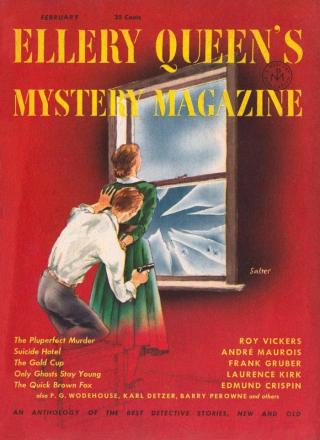
Ellery Queen’s Mystery Magazine. Vol. 19, No. 99, February 1952
- Автор: Грубер Фрэнк, Кемельман Гарри
- Год: 1952
- Язык: английский
- Год: American Mercury
- Жанр: Другие детективы

Электронная книга - «Ellery Queen’s Mystery Magazine. Vol. 19, No. 99, February 1952». Краткое содержание книги:
For once Wakefield was bereft of speech; he subsided, breathing heavily through his nose.
“Therefore,” said Fen, “both messages were in faint, spidery typescript. Therefore they were both typed in the afternoon while I was playing Racing Demon! And therefore Judith’s story about Odell using the typewriter after midnight was a deliberate pack of lies from beginning to end.
“Under police examination she broke down and confessed to the murder; and in due course she was tried and convicted, though the death sentence was eventually commuted to life imprisonment. She hated Odell for jilting her in favor of her sister; and if she hadn’t planted the messages in Odell’s room, and spun me her fairy tale about blackmail in a sophisticated, double-bluff attempt to incriminate Aunt Ellen, she might have got away with the killing. But the trouble was, she read detective stories; and what she dreamed up — in the hope that everyone Would make the very deductions Wakefield has just been making, and probe no further — was a typical detective-story device... I hope no one will imagine I’m mocking at detective-story devices. In point of fact, I dote on them. But so long as criminals take them for a model, the police are going to have a very easy time; because, like the wretched Judith, your genuinely murderous addict will dig his cunning and complicated pits for the investigators — only, in the upshot, to fall head-first into one of his own very extravagant traps.”
Only Ghosts Stay Young
by Laurence Kirk
You have probably read a Laurence Kirk short story before — his tales have appeared in most of the leading magazines in America — Harper’s, Collier’s, Harper’s Bazaar, Redbook, Ladies’ Home Journal, to list only a few. Laurence Kirk’s real name is Eric Andrew Simson, and he is a brother-in-law of one of our favorite authors, F. Tennyson Jesse. Mr. Kirk’s pseudonym has an interesting origin: he was born in Edinburgh, and spent most of his early life in Scotland, on the borders of Angus and Kincardine; his postal address at that time was Laurencekirk.
How broad is the meaning of the word “mystery”? In the publishing business it has come to be pretty much a generic term: pure detective stories, thrillers, tales of suspense, psychological case histories — all these and many others, including even the spy story, are now indiscriminately catalogued as “mysteries.” And surely it is true that EQMM has always interpreted “mystery” in the larger rather than in the narrower sense — indeed, each month we try to give you as diversified and varied a selection of stories as possible. Yet, in the past ten years, we have not strayed over the borderline into the supernatural more than a few times — so infrequently that perhaps we do not have an accurate gauge of our readers’ feelings.
Now, the Laurence Kirk story to which we gave a special award in EQMM’s Sixth Annual Contest is frankly a ghost story. True, there are ghost stories and there are ghost stories, and we think Mr. Kirk’s is an unusually fine one. But perhaps you don’t want ghost stories in EQMM, no matter how good they may be. If so — if you want EQMM to restrict its contents exclusively to tales of detection and crime, in a basically realistic vein — please let us know. But we can’t help thinking that every once in a while — every once in a long while — a ghost story just hits the spot...
It is an error to suppose that ghosts are transparent creatures who only show themselves by moonlight. It is equally an error to think that they drape themselves in white, drag chains behind them, or carry their heads beneath their arms. In reality they are very ordinary folk, like us. The only difference is that you will hardly ever hear them speak.
The ghost I am thinking of lived in a small Kentish country town. She went by the name of Miss Raynor and could be seen in broad daylight in the streets, generally walking in front of you. Far from being transparent, she was rather a stout old lady. But sometimes, even when she was quite close in front and turned a corner, there would be no sign of her at all when you turned the corner after her. That, of course, might be explained by the fact that she had gone into a shop. Or again it might not.
She lived in what was known as The Walled House. It was Queen Anne or very early Georgian and had a very beautiful fanlight above the door. It was quite a small house for the country — five or six bedrooms probably — but I have never met anyone who had been inside it. It was called The Walled House because the garden had a solid twelve-foot wall all around it. The only break in this wall was in Fisher Street, where there was a doorway with an exquisitely-worked iron gate which was always locked. Through this gate you could see over a bit of lawn into the garden behind, and people often paused there in the hopes of seeing Miss Raynor inside. But they never did. The lawn was always mown, however, and the garden well kept. The delphiniums in particular were a perfect joy in their season, against the gray wall. But whatever season it was, when you had finished eavesdropping at the iron gate, you probably came away wondering how one single old lady could keep the garden in such good order and yet never be seen at work in it. It was a little uncanny, and might mean that some of the strange things that were said about Miss Raynor were true. On the other hand, although it was known that she hired no gardener, it was certain that the milkman left milk at the door and that the coal merchant dropped sacks of coal through the manhole beside it; and that both of them had their bills paid regularly. So perhaps there was nothing in the strange things that were said, after all.
This was the situation one warm still sunny afternoon in September 1940, and had been the situation so far as I knew for sixty or seventy years. But that afternoon a frightened German pilot in a medium bomber thought he had a Spitfire on his tail. He therefore dived and unloaded his stick of bombs on the first target he could see, and that happened to be the little Kentish town. The first bomb fell in a pond on the outskirts; the second took a corner off a bakery; the third went bouncing down a street and lay unexploded on the steps of the police station; and the fourth landed slap-bang on The Walled House and blew it to smithereens.
They began to search for Miss Raynor almost before the dust had settled on the remains of the garden. But though they worked for days they never found anything that offered any explanation. There was the wreckage of some furniture, a few silver spoons, broken china and broken glass. But of Miss Raynor there was nothing. Not a finger. Not a drop of blood. No clothes. Not a brooch or a ring; nor the cameo she always wore when she went out. On the other hand they did come across a portion of a silken ladder made out of old bell-ropes; and the air-raid wardens who knew the stories about Miss Raynor began to scratch their heads...
Bombs can do the oddest things both in hitting people and in missing them. In another air raid near Selfridge’s, a taxi with four men in it completely disappeared, and as far as I know no one ever suggested that there was anything supernatural about it. The case of Miss Raynor was a little different, however, because of the stories that had been told about her, and a good many people in the town watched carefully to see what happened next. For instance, if Miss Raynor had really died in 1871, as was supposed by some, there was no reason why a mere bomb should interfere with her appearing in the streets. And again what about her money? If a ghost could sign checks, then a ghost could presumably leave a will. The Walled House had been a valuable property, and even though it was rubble now, it must have been left to somebody.