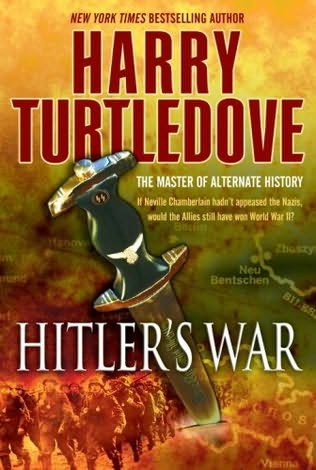
Hitler's war
- Автор: Тертлдав Гарри Норман
- Серия: The War that came early #1
- Язык: английский
- Жанр: Альтернативная история

Электронная книга - «Hitler's war». Краткое содержание книги:
Now, in this thrilling, provocative, and fascinating alternate history by Harry Turtledove, another scenario is played out: What if Chamberlain had not signed the accord? What if Hitler had acted rashly, before his army was ready-would such impatience have helped him or doomed him faster? Here is an action-packed, blow-by-blow chronicle of the war that might have been-and the repercussions that might have echoed through history-had Hitler reached too far, too soon, and too fast.
Turtledove uses dozens of points of view to tell this story: from American marines serving in Japanese-occupied China to members of a Jewish German family with a proud history of war service to their nation, from ragtag volunteers fighting in the Abraham Lincoln Battalion in Spain to an American woman desperately trying to escape Nazi-occupied territory-and witnessing the war from within the belly of the beast.
A novel that reveals the human face of war while simultaneously riding the twists and turns that make up the great acts of history, Hitler's War is the beginning of an exciting new alternate history saga. Here is a tale of powerful leaders and ordinary people, of spies, soldiers, and traitors, of the shifting alliances that draw some together while tearing others apart. At once authoritative, brilliantly imaginative, and hugely entertaining, Hitler's War captures the beginning of a very different World War II-with a very different fate for our world today.
“Yes, sir,” Mouradian said, and he waited.
The contest of wills was silent. The squadron commander didn’t want to say anything else. Mouradian didn’t want to come right out and ask, But what if it does? That silence stretched tighter and tighter. Finally, it snapped. So did Borisov: “We are at war with Germany. If German troops or aircraft operate against us, we are to prosecute the war against them. Is that clear?”
“Yes, sir. Thank you, sir,” Mouradian said.
It was clear to Sergei, too. He didn’t like it. Poland and Romania had been the USSR’s shield against Fascist Germany. If the Poles scream for help to their Western neighbor, that shield was gone. Stalin never would have made demands on Poland if the Germans weren’t up to their eyebrows in war on their other frontier. But if they weren’t quite up to their eyebrows…
Sergei had faced Messerschmitts and German antiaircraft guns in Czechoslovakia. He didn’t relish doing it again. Of course, the next time anyone set over him gave a damn about his opinion would be the first.
Maybe the high command did know something. Sergei was sure stranger things had happened, though he couldn’t think of one offhand. The day was cold, but it was bright and sunny. The SB-2 was fueled up and bombed up and ready to go. Sergei and Mouradian and Ivan Kuchkov climbed in.
Groundcrew men spun the bomber’s props. The engines roared to life. Sergei ran his checks. All the instruments looked good. The SB-2 slid down the snow airstrip. Sergei pulled back on the stick. The nose went up. The airplane left the ground. Anastas Mouradian cranked up the landing gear. The skis retracted almost as neatly as wheels.
Snow down below made navigation a challenge. It would have been harder yet if artillery bursts hadn’t shown the way. Tanks and soldiers were swathed in white, but cast long shadows across the even whiter snow. There was the border, and there were the Soviet troops crossing it to liberate the fraternal, peace-loving people who lived just to the west.
And there were the Polish oppressors: more soldiers in white with shadows stretching over the snow. Antiaircraft guns opened up on the SB-2s. After facing German fire, Sergei didn’t think much of this.
He saw a good concentration of troops and trucks ahead. There was the railroad line, too. If he plastered the neighborhood, he could do what Lieutenant Colonel Borisov wanted done. “Ready, Ivan?” he bawled into the speaking tube.
“Ready, sir!” the noncom answered.
“Khorosho. Mouradian will tell you when to drop,” Sergei said. Anastas was down in the bottom front of the SB-2’s glasshouse cockpit, peering through the bombsight.
“Now!” he shouted, and the stick of bombs tumbled from the plane’s belly. As always, the SB-2 immediately got peppier and more maneuverable. Yaroslavsky took advantage of that by getting out of there as fast as he could. He’d seen a couple of gull-winged PZL fighters in the neighborhood. They weren’t supposed to be anywhere near as dangerous as Me-109s, but any fighter was dangerous if you happened to be a bomber.
Other SB-2s were also hitting that concentration. The Poles down there had to be catching hell. Well, if they wouldn’t give the Soviet Union what it was rightfully entitled to, this was what they got.
Back to the airstrip he flew. He found it, much to his relief. The ski-carrying landing gear descended. Getting down was an adventure, but at last the SB-2 slid to a stop. Groundcrew men wearing white snow smocks over greatcoats rushed forward to refuel the plane and bomb it up again. “How’d it go?” one of them called, his breath smoking in the frosty air.
“Routine,” Sergei answered. “Just routine.”
* * *
“Happy New Year!” Peggy Druce said as the clock struck twelve. “It’s 1939. Oh, boy!” She raised a glass of what was supposed to be scotch. The stuff tasted more like oven cleaner. In wartime Berlin, you took what you could get and you were damn glad you got anything.
A handful of other people sat drinking in the hotel restaurant. They were split about fifty-fifty between neutrals stuck in Berlin and Germans who felt like tying one on even if the world seemed to be going to hell in a handbasket. Some of the Germans were civilians, others in uniform. The other way to tell them apart was that the military men were drinking harder.
The radio blared out war news. Everything was going well in the West-if you believed the announcer, anyhow. “Soon a battle of annihilation will sweep the French and English out of Belgium, which they invaded with flagrant disregard for international law!” the fellow declared. He had a high, shrill, unpleasant voice. Peggy thought so, anyhow; it put her in mind of screechy chalk on a blackboard.
Then he started screaming about what the evil Communists in Russia were doing to Poland. “It is a Jewish-Bolshevist conspiracy to terrorize small nations!” he said.
What about Czechoslovakia? Peggy wondered. What about Holland? What about Luxembourg? What about Belgium? Asking questions like that was pointless here. Even if the Gestapo didn’t haul you away and start pulling out your toenails, the Germans wouldn’t get it. They thought anything they did was okay because they did it. If the other guy did the same thing, he was a dirty, rotten nogoodnik.
And then the newsman came out with something Peggy hadn’t heard before: “Because of the magnitude of the unprovoked invasion, Marshal Smigly-Ridz has asked the Fuhrer for aid against the Bolsheviks. Foreign Minister von Ribbentrop has stated that that aid will be forthcoming. We are already at war with the Soviet Union. Now we have the chance to teach the Reds and the Jews the lesson they deserve.”
Peggy looked around. Nobody she could see looked excited about teaching the Russians a lesson. One of the soldiers, a major old enough to have fought in the last war, knocked back half a tumbler’s worth of something, put his head on his folded arms, and fell asleep at his table. The good-time girl who’d been with him stalked away in disgust.
Another soldier stood up and raised a glass on high. “Here’s to the two-front war!” he yelled.
His buddies dragged him down. They spoke in low, urgent voices. He didn’t want to listen. When they couldn’t make him shut up, they hauled him out into the cold, pitch-black blackout night. Peggy wondered if it was already too late for him. Was somebody in there taking notes? She wouldn’t have been surprised. People said there was at least one informer in every crowd. Peggy didn’t always believe what people said, but it seemed likely here.
Music started coming out of the radio. Saccharine-sweet, it was as annoying as the newscaster. Jazz was one more thing the Nazis wouldn’t put up with. Degenerate Negro music, they called it. No matter what they called it, what they made themselves was sappy and boring.
A naval officer came up to the table where Peggy was drinking by herself. “May I join you?” he asked.
“Sure.” Peggy held up her left hand so the diamonds in her wedding ring sparkled. “Don’t expect too much, that’s all.”
He smiled. His long, weathered face didn’t seem to have room for amusement, but it turned out to. “Thank you for the warning. I may need it less than you think, though.” He set down his drink and showed off the thin gold band on the fourth finger of his own left hand. “If I ask your name, will you think I am trying to seduce you?”
“Probably,” Peggy answered, which startled a laugh out of him. She gave him her name even so, and asked his.
“I am Friedrich Reinberger-a Korvettenkapitan, as you see.” He brushed the three gold stripes on one cuff with the other hand. Then he switched languages: “Lieutenant commander, you would say in English.”
“Okay.” Peggy was feeling ornery, so she asked, “Where’s your wife, Lieutenant Commander?”
“In Dachau, not far from Munich, with the Kinder,” Reinberger nodded. Peggy nodded-he sounded like a Bavarian. “I was called here to report on…certain things when my destroyer came into port. Maria, I think, believes yet I am at sea.”